

23 min read
Late in March, Sony announced price increases to their PlayStation hardware. With less than a week’s notice, people rushed to get the console before the price revision went into effect, likely going into debt to do so. After one too many YouTube videos expressing shock and disgust about the news, I began taking stock of how the ninth generation of consoles has gone so far. It was highly irregular: impacted by a once-in-a-century global pandemic, a new competitor that gobbles everything in its path, a trade war, and a dying AAA industry placing all of its hopes on a single title.
Let’s go back to 2019. Sony and Microsoft announced the successors to the PlayStation 4 and Xbox One. Developers were relieved, thinking how the release of the PS4 Pro and Xbox One X two years ago set a worrying precedent in an industry already wounded by the huge adoption of mobile. Generally, mid-cycle refreshes are introduced at a point of maturity in the console’s life. The use of smaller, cheaper components that can do the work of the prior chip at a fraction of the price often leads to smaller, more efficient consoles. For Gen 8, these were the PS4 Slim and the Xbox One S. These hugely upgraded SKUs were different — would this generation be even longer than the prior one?
However, I’d argue these revisions were necessary. When the PS4 and Xbox One came out, 1080p was the standard. This wasn’t the case by 2016, when 4K became commonplace, and neither console could render at that high a resolution. Sony sought to capitalize on their already hefty lead, whereas Microsoft wanted the title of ‘most powerful hardware’ back. Really, it’s all just marketing.
While the power of the upgraded hardware enticed developers, the need to support the older but sizable install base meant building around the lowest common denominator. If you were a third-party developer, that’d be the Xbox One. Also working against developers is the standardization of third-party game engines such as Unreal and Unity. A double-edged sword: both newly tenured and veteran developers alike didn’t have to learn a new engine every time they embarked on a new project, but much of its output was... same-y. You could tell whether a game was written in either of these. Since neither engine was designed to maximize any particular architecture, the hardware never showed its full potential. But the video game industry is a business, one that asked for a non-trivial amount of money not too long ago, only to ask for more the following year — optics be damned.
Both companies planned these huge, carefully crafted marketing campaigns to build momentum for the PlayStation 5 and Xbox Series X, only for COVID-19 to throw those into disarray.
As the world fell silent under stay-at-home orders, electronic gadgets were a comfort for many during these times of strife. It also meant that the factories that produced said gadgets also went silent. The supply chain disruption was unlike anything ever experienced in modern history. As much of the modern world operates on semiconductors, it was genuinely difficult to navigate these uncharted waters during the early period of the pandemic, and that’s not to mention the couriers being heavily restricted, all to avoid spreading the novel coronavirus. It was perhaps miraculous then that the PS5 and the Series X|S didn’t miss their announced launch date — though there’d be shortages for extended periods of time. Gamers who lived on the bleeding edge and somehow missed the preorder window became desperate, with some paying up to $2,000 for a console that cost $499.99 at retail. The practice of scalping, buying highly desirable items to resell at a huge markup, felt like a genuine threat this time. Many e-commerce websites were unprepared for bots that crashed sites, acquiring all of the stock moments before the listing opened. Imagine the Black Friday events of yore: people out in the cold for hours, only for the stock to be bought by the store’s employees and their friends.

Photo: Christopher Dolan/Associated Press
The most surprising thing was that Nintendo, often considered the ‘second console’ by many, was positioned to benefit enormously from these circumstances. By 2020, the Switch was three years old; a library of games was available for the platform, and some recent releases were particularly notable. Animal Crossing: New Horizons, the next entry in the series since 2012’s New Leaf, released mere days after time began blurring for many as major states issued stay-at-home orders. Social media buzz of the time praised its in-game time system: needed something from Nook’s Cranny? Better get it before 10 PM — 10 PM in-game is 10 PM in real life. It sold like hot cakes, which is impressive for a series that lacks the pizazz of Mario, Zelda, or Pokémon. Then there’s Ring Fit Adventure, a spiritual successor to Wii Fit. Staying active during lockdown, when gyms worldwide were closed, is important. It moved units by the thousands, and mine was one of them.
Contrast Nintendo’s position with Sony’s and Microsoft’s. Their prior gen libraries weren’t hurting, but they were asking for more money this time. The era of exclusive titles — the ones you *had* to buy the console to play them — was over. The PS5’s launch lineup had two exclusives, and the Xbox Series had zero, after the gaming press reported that Halo Infinite would miss the console’s release. The new consoles being backward compatible with their predecessors is helpful. Still, it raises the question: why should I pay for games to run slightly better than the Pro/One X? I don’t think there’s a satisfactory answer, really. I get that it’s easy to be critical in retrospect, and I’m not free of sin — I owned a PS4 Pro, Xbox One X, a Series X, which I only found a month after release, and a PS5, which I only managed to get a full year after. Nevertheless, that feeling of having wasted my money lingers: I can count the games I played that needed new hardware on one hand.
Participation in the gaming hobby reached record highs, thanks to casual gamers. Since Line Was Going Up, an industry that typically ran lean sought to seize the moment, believing the pandemic boom was here to stay. They hired people by the droves, promised remote work, which became the ‘new normal’ for white-collar work, and paid top money for talent. However, this spike in demand wouldn’t last — no one prepared for a future where lockdown orders were lifted, something which happened in 2022 as a majority of the populace got inoculated against COVID-19. People returned to their pre-pandemic lives, and gaming was no longer cool among non-gamers. Sony and Microsoft had a one-in-a-million opportunity to turn the curious and the dabblers into loyal customers, and they dropped the ball. Considering how this business treats those who regularly partake in the hobby, it was for the best.
A series of ‘market corrections’ came and went, and the consequences were squarely aimed at the wrong crowd. Microsoft’s acquisition of Activision Blizzard in 2023, after a lengthy regulatory review, turned them into the biggest third-party publisher, but they’d bitten more than they could chew. On the other hand, Sony wanted a piece of the highly lucrative live-service game market. SIE CEO Jim Ryan instructed his studios to prioritize development on these kinds of titles, intending to release twelve live-service games by 2025. Of course, the initiative failed. Ryan retired in 2024, but he gets a nice pension — something he denied thousands of families who worked for and believed in him. Microsoft Gaming CEO Phil Spencer wasn’t far behind in the carnage, though I want to believe he was placed in an impossible position by Satya Nadella, Microsoft’s CEO. Spencer retired in 2026.
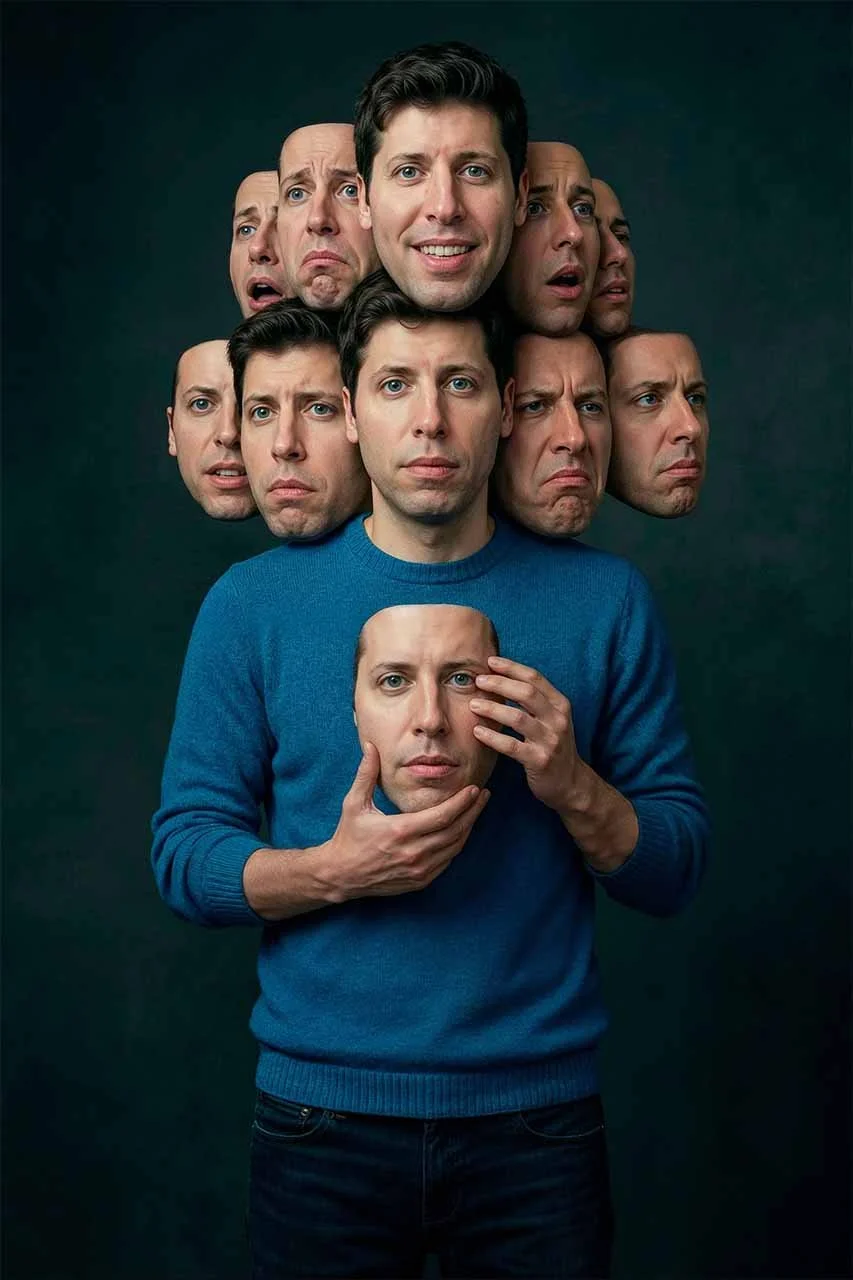
Image by David Szauder for The New Yorker; generated with A.I.
Then came the AI boom and subsequent gold rush, spearheaded by OpenAI.
The release of GPT-4 in 2023 was a paradigm shift in consumer technology and general awareness. ‘Artificial intelligence’ entered the lexicon, as well as its main champion, OpenAI CEO Sam Altman. His sales pitch was based on fear: AI is ‘dangerous,’ so we’re developing it so that the ‘good guys’ have control over it. Might someone have watched too many science fiction movies?
Altman’s a controversial figure, even inside his own company. By the end of 2023, the non-profit board had grown tired of his grandiose promises and was worried that the money needed to make those happen could threaten the company’s status. They ousted Altman, citing how he wasn’t “consistently candid in his communications” — in other words, a liar, but prettier. Microsoft, an investor in OpenAI since 2019, sought to reinstate Altman, even extending an offer to join its ranks should their efforts fail. Losing its CEO wouldn’t be a big issue for the non-profit, except that the events that came to light after the ousting were not in the board’s favor; I’m skeptical as to whether the events were truthful or the result of intentional reputational damage.
Over 95% of the workforce at the time, including a board member, threatened to resign, which would kill OpenAI. The detractors got what they wanted: Altman was reinstated, the board was replaced in its entirety, and his conduct was cleared in an internal investigation some time after. The snake-oil salesman won the battle, but could he win the war over AI world supremacy? I digress — this isn’t a piece on AI, but it is adjacent to what we’re discussing.
Back on the gaming side, not everything was doom and gloom. Hybrid consoles became viable with the Switch’s runaway success. Nintendo didn’t have any *real* competition, and Valve sought to correct that with the Steam Deck in 2022. It’s not the first time the Bellevue-based company dabbled in hardware — their first attempt was disastrous. Valve engineers buckled down, working on their Linux-based operating system, SteamOS, and after nearly a decade of work, they were ready to give it another shot. In an industry devoid of ideas, the handheld gaming computer resurrection wasn’t on anyone’s bingo card. That a company that thoroughly understood PC gaming, having learned from its previous attempt, was now taking the lead was promising news. Fun fact about the Steam Deck: some lucky gamers who preordered and were local to the Seattle area got a visit from Valve president Gabe Newell himself to hand them their order. Praise be to Lord Gaben, hallelujah!
Several miles northeast, Microsoft twiddled its thumbs. Instead of making a first-party Xbox handheld, they licensed Windows 11 to several third-party manufacturers explicitly interested in making a handheld. The first of these was Asus’s ROG ALLY, a solid yet unimpressive offering — it wasn’t going to take any wind off the Steam Deck’s sails. Besides, Microsoft had a bigger issue: their role as Sony’s foil dissipated quickly after their major defeat last-gen, a fact Spencer readily admits. That they made the same mistake Valve did ages ago is not lost on me.
Sony, on the other hand, knows a thing or two about handhelds. Releasing in 2023, the PlayStation Portal is a $200 companion device to the $500 PS5. Its intended use was to give customers a way to play the PlayStation library when the PS5 screen was unavailable. Cool, right? Not really: you couldn’t install games on it, you couldn’t stream purchased digital games on it, and it was useless outside a home network — an accessory in the purest sense of the word.
Rushed to market, and not even moderately useful until a year in its lifespan: once again, the industry ships a broken product and promises to “fix it later.” Sony hasn’t claimed the Portal is comparable to the Steam Deck, but it wouldn’t stop people from thinking it was — the duck test applies here. Even if they did, consider this: Valve’s goal is to make Linux gaming viable, free of the Windows ecosystem. Before Proton, if you wanted to run games on Linux, you’d better hope Wine was up to the task. It largely wasn’t. Sony, on the other hand, is preaching to the converted. Even with an upgraded feature set, I don’t believe the Portal’s high price is justified. It’s far from the PSP revival many would’ve hoped for, but a cheap tablet with a controller add-on — and hardly as functional as a bona fide cheap Android tablet. Its legacy will be as storied as that of the PlayStation Move, Sony’s failed motion-control effort to take on the Wii. It’s only hanging in there because Sony bundled it with PSVR: got to dispose of all of those extra units somehow!
By 2024, AI went from ‘technology you can try’ to ‘it’s everywhere, and you can’t avoid it.’ It’s always a good sign when something gets forced onto the customer without a way to opt out, right? After the fall of NFTs and the metaverse, the tech industry put its entire hope on large language models, a subset of generative AI, succeeding. The most visible push was the inclusion and subsequent deep integration of Copilot on Windows 11. Many rejected Microsoft’s “free” upgrade, becoming the second major reason to postpone it, the first being the inane system requirements. They wouldn’t have a choice after Microsoft sunsetted its predecessor, Windows 10, the following year.
There was a growing anti-AI sentiment, largely spearheaded by creatives who objected to LLMs being trained on their work without their consent. It’s not enough that the machines already help with menial work: it doesn’t make Line Go Up. It felt like a true paradigm shift once AI startups decided to go all in on creative applications. Mind you, Midjourney and Stable Diffusion were already out there, but only when ChatGPT could query DALL-E 3 from within the chatbot, all hell broke loose. In those days, being against AI got one called ‘ableist’ by the AI boosters. It’s a disgusting escalation of rhetoric, as if the disabled don’t have enough misfortune going for them. AI boosters argue as if they’re on the payroll, as if clout meant absolutely nothing — that is, until xAI CEO Elon Musk began paying eligible X users after their posts achieved a certain level of engagement. I’m not too versed on the details, as I left X two years ago. 1I wrote about my time on X on 'The Internet Died and We All Watched.'
The tech industry claims generative AI could be as revolutionary as the consumer smartphone... but if you ask me, all I see is the rampant flailing of an industry that hasn’t had a hit in almost two decades. They have marketing departments full of talented people: what campaigns are they devising to lure customers in? Instead of putting AI on everything, let the people come to you out of genuine interest. However, there’s just so much money riding on this industry-wide push, it has to be a success — the end customer does not matter. Businesses at risk of disruption have to paint themselves as not that: see Google and Gemini for a prescient example. Many young netizens don’t know how to write a query in specific SEO language to get what they want, and this is before we even get to Google’s enshittification of search. I get the appeal for this population, believe me. However, critics are right in calling out these practices and the weasely wording of AI startups. They have no definitive answer to the question: “What is it that this is supposed to do or help me with?”
These sycophantic machines try to be everything for everyone, but end up being nothing. AI is, and remains as of writing, a solution looking for a problem. I’m sure that at some point, generative AI will have a demonstrable, real use case; the time a user spends engineering prompts is often better spent learning the craft instead. In my job, I’ve certainly spent more time than I care to count wrestling with Copilot over spreadsheets — goddamn spreadsheets, which have been a use case for computers since the 80s! The kind of thing machines are supposed to be really good at! And all I get is glazed, which infuriates me more...!
Deep breaths...
Not content with stepping on a Portal-shaped rake, Sony unveiled the $700 PS5 Pro. The 2024 tech demo included plenty of side-by-side comparisons of their first-party titles, and tons of mentions about how ‘the power of AI’ enables these ‘upgrades.’ Sweet, a new buzzword! You’d be hard-pressed to find a difference, regardless of how hard you looked. No, really — they had us counting individual speckles, trying to find any difference.
Balking at the $700 price? How about the disc drive becoming a literal accessory? It’s now a $780 PS5 Pro. There’s no space to place the console horizontally, but it doesn’t come with a vertical stand — instead, two small plastic feet. The vertical stand sets you back $30, and it’s now a $820 PS5 Pro. Perhaps a second controller so your sibling doesn’t riot? You’re easily looking at a thousand-dollar purchase with sales tax factored in, and that’s before buying a single game.
Amidst all of this backlash, Sony said they weren’t worried. They were betting on the diehard PlayStation fan — they’d pick these up out of some sense of mistaken fanboy duty. They’d also double down on the one advantage consoles have over PCs: their ease of use. Now there’s the arrogant Sony I’ve come to know since 2005. Sounds to me like they wanted people to feel they want it...
Inflation crippled economies worldwide, and the vulnerable were suffering. The final months of the Biden administration were marked by an avian flu outbreak that drove up egg prices; people were already struggling to afford groceries! The GOP was paying attention and seized the opportunity, bolstered by the mainstream acceptance of the far right over Donald Trump’s first term. He never stopped campaigning. He molded the Republican Party in his image: a death cult of personality whose only purpose is to serve its Dear Leader. Trump won the 2024 presidential election in both the Electoral College and the popular vote. His messaging was terrifyingly effective amongst the hurting masses, more willing to embrace the narrative that the cause of all of America’s problems was whichever the GOP wished to demonize. As important figures of the tech world surrounded the President-elect during his inauguration, Trump made it his mission to undo everything the Biden administration had done with the stroke of a Sharpie. And his proposed solution to combat inflation? Tariffs.
As anxiety over the Trump Tariffs loomed over all consumer goods, Nintendo was gearing up to deliver the successor to the Switch. The first post-Iwata console lacked everything that made the Switch, or even Nintendo hardware, special. Nintendo CEO Shuntaro Furukawa, true to his accounting background, looked at a financial chart and concluded that, for Line To Continue Going Up, a more powerful Switch was needed. The Switch 2 featured a bigger screen, Joy-Cons snapping magnetically to the console instead of being clipped on — and those could be used as a mouse for some reason — and it was completely black. That was it. Notably absent from the Switch 2’s announcement was the price tag. Many expected $400, but many more were skeptical because of the pricing trend Sony began. Though Nintendo isn’t far behind in its pricing shenanigans...
In fairness to the Nintendo faithful, the Switch was an eight-year-old console that had every last bit of juice drained from it. Unlike the PS5 Pro, the Switch 2 was justified; perhaps it took too long to come out if you listen to the diehards. Gamers balked at the $450 price tag, but Nintendo would rely on a tried-and-tested strategy: bundling. It just so happens that the bundled game was Mario Kart World, the first time in the series that an entry made the launch window. The $500 proposition was appealing to many gamers, drawn like moths to a flame. However, pricing MKW at $80 caused its fair share of controversy — raising the price ceiling once more, all while wages remained stagnant. The Switch wasn’t exempt from the price bumps: it got a $50 raise soon after the Switch 2 came out. Which... is opposite to how aging gaming hardware is supposed to be priced?

Over at Microsoft, they can’t get a break. More layoffs and studio closures, of which Shinji Mikami’s Tango Gameworks is notable. Xbox marketing VP Aaron Greenberg is on the record saying how Xbox needed more games like Hi-Fi Rush, only for Microsoft to close the studio that made it two weeks after. You’d think Xbox would be in a far better place, but unfortunately, they weren’t. Microsoft bumped up the price of the Xbox Series by $100 and, later in the year, by $50. As of writing, the base Series S costs $400, and the Series X costs $650. Readers might be more familiar with the price increases to Game Pass, which were all over the gaming press, with think pieces and editorials about the subscription service not having the value it once was seemed to be a dime a dozen.
Sony, on the other hand, played it slightly smarter after seeing Microsoft stepping on rake after rake after rake. However, they ultimately succumbed to ‘market conditions’: i.e., the Trump Tariffs and, later, the semiconductor crisis. The first price increase was for $100, and then another hundred eight months later. The digital and disc-based PS5 cost $600 and $650, the Portal now costs $250, and the PS5 Pro costs an eye-watering $900. Recall the pricing exercise I walked you through earlier: replace $700 with $900. You’ll quickly see how the math gets out of hand.
Sometime after the so-called ‘Liberation Day’ event at the White House lawn, Trump de-escalated his tariff threats after powerful figures bent the knee and kissed the ring — or some in his administration successfully veered him off, who knows. He’d still impose an illegal 10% tariff on almost every country around the world, including those where consumer goods are manufactured. Understandably, this put the economics of everything out of whack. The US is a huge market: it’s entirely possible that the big three console manufacturers raised prices globally first to subsidize US pricing. People around the globe were already upset at the US shredding the social contract, and now gamers would have a reason. However, the Trump Tariffs wouldn’t warrant these dramatic price increases on their own.

Made in part by using A.I.
By 2025, AI startups continued to struggle to make an enticing product. The LLM market flood, not to mention thousands of wrappers that query the same three models, meant that AI startups now needed the infrastructure to match demand — and not by the public at large, mind you. The economics of AI up to this point relied heavily on server credits, with money seldom exchanging hands: ChatGPT runs on Azure, Anthropic’s Claude largely runs on AWS, and Google’s Gemini leverages the search giant’s server infrastructure. Building additional server capacity was unremarkable, just part of the expenses of running a service on the internet. The OpenAI Stargate project dialed up the volume to eleven: something tangible, at last! The accounting of both private and public companies involved in AI is heavily obfuscated, but when there’s real estate in between, well...
Seeing how AI is anything but conservative in its resource usage, these data centers need silicon in large quantities. Every piece of tech essential to AI in some way shot up in price dramatically. First, it was the GPUs, then the DRAM, which has a downstream effect of increasing prices on anything that uses it: basically, anything with a chip in it. The enterprise market quickly overtook the consumer market, becoming incredibly lucrative thanks to the billions of dollars the tech industry was spending. It wasn’t enough for manufacturers like Samsung to be backordered for months on end; some chose to leave the consumer market altogether. Micron’s shutdown of the Crucial brand in early 2026 sent shockwaves across the industry. The tech industry’s contempt towards the general customer was on full display here: in their eyes, non-enterprise customers were no better than plebeians whose sparse money they didn’t need. Hell, Nvidia no longer considers itself a ‘gaming company’ if you were to believe noted leather jacket fan, Jensen Huang. Most, if not all, of his company’s revenue comes from AI — after all, he’s the *only* game in town.
So, where does that leave us? Some genuinely believe that it was worth buying the consoles early in their lifespan, and even some of my friends believe this unironically. I have mixed feelings about preordering, especially for consoles. I feel as though I’m being sold a promise that the first manufacturing run will be successful. Sometimes it doesn’t, and you only find out months later: see the whole Xbox 360 RROD saga. This industry is hooked up on FOMO-based marketing, which does nothing but exploit the vulnerable among us. Gaming is not a cheap hobby, and as we’re priced out of it, all I see is applause and no resistance against this attack.
Take the Switch 2 Mario Kart bundle: rationalize your purchase all you want, but getting the game for $50 instead of $80 is not the win you think it is. Even if the series is a reliable seller regardless of whether there’s a boycott over its high price, not showing even a minuscule amount of pushback? Perhaps I’m the fool, expecting too much of gamers. In the end, nihilism — genuine nihilism — triumphed. Players, instead of voting with their wallets, only seem interested in mindless consumption, hoping to feel something, *anything* at all. Can these husks even call themselves gamers?
Even as I complain about my own, they aren’t the ones that worry me.
The release of Grand Theft Auto VI in late 2026, as of writing, may mark a point of no return, where all the infighting among the so-called gaming community is rendered meaningless. If hundreds of thousands of casual players stomach the artificially high prices of the consoles as well as the rumored $100 price tag for Rockstar’s crime thriller, it’s game over. I hope clearer heads prevail, that people who don’t follow the hobby closely are absolutely repulsed at the price of admission, and walk away. Because clearly, I can’t trust the fandom to deliver a consequential and lasting message.
We may even be due a reckoning the likes of which has not been seen in over fifty years.