

22 min read
Prior Entry | All Media Log Posts | Next Entry
Please be advised these posts aren’t spoiler-free.
Prompted by a conversation with a relative, here’s a music-themed prologue. I could probably write a whole post just on my music taste, but for now, I’m focusing on one track I recently discovered – and got obsessed with.
While looking for electronic sets to power my workouts, I stumbled upon a Paul van Dyk mix on DanceTV’s Chasing Sunsets. I recognized a few tracks I’d heard before, but one around the 14-minute mark really grabbed me. I didn’t think to look it up right away – but later, I did. Turned out, it was his XOXO remix of Energy 52’s “Café Del Mar.” That sent me down the rabbit hole.
I checked out the original “Café Del Mar” as well, but I didn’t like it. I couldn’t quite relate to the nostalgia people feel for it – but that’s probably down to my taste not being rooted in early 90s trance. My journey into dance music started with Daft Punk in the mid aughts, after all...
There’s a video for Paul’s version – appropriately trippy, as perhaps a PV for a trance-y track should be. It’s a continuous tracking shot through surreal, digitally rendered landscapes: natural rock formations, forests of giant mushrooms, and even outer space. I briefly wondered if it was made in After Effects, until I remembered Ae isn’t a 3D renderer. The backgrounds are by Gaël Corboz, a Swiss digital illustrator. I checked out his portfolio, but nothing stood out beyond what was in the video, until I saw he’d put some of his work up as NFTs. I don’t know what he sees in that space, and NFTs are pretty much irrelevant at this point, but hey – there’s always a market for something, I guess.
Sasaki and Miyano
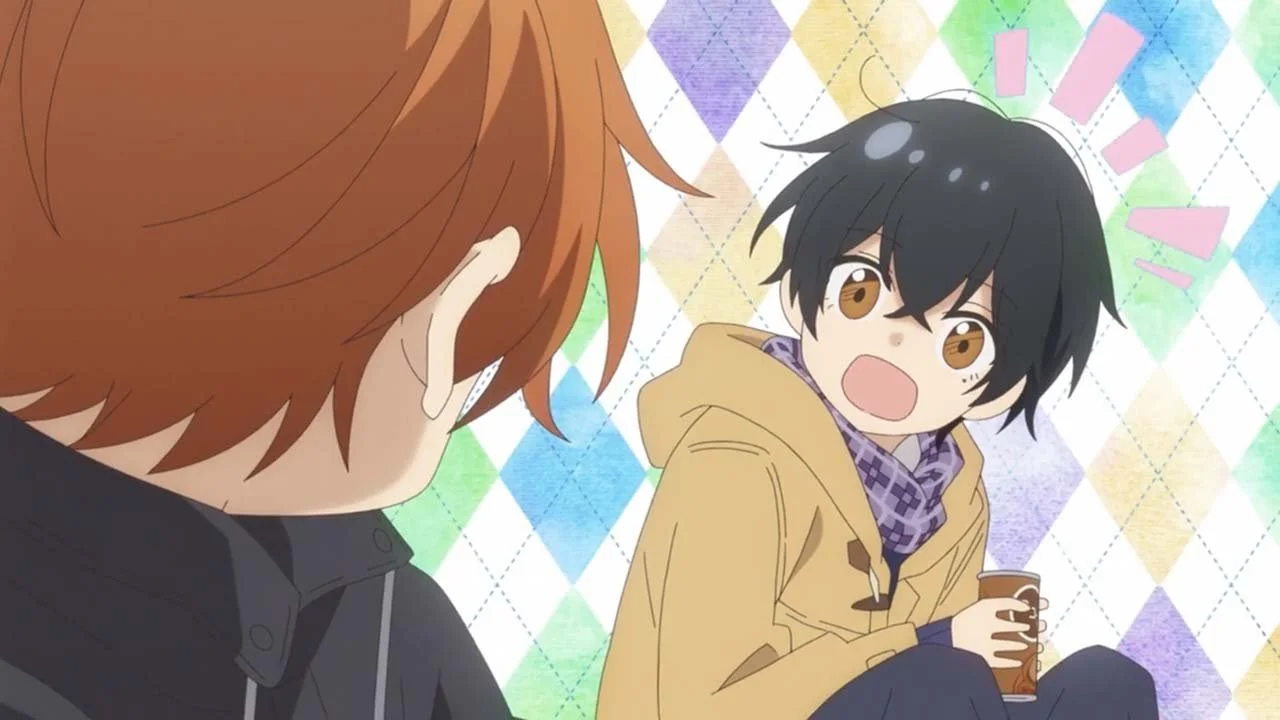
Are fudanshi supposed to live in the shadows? I’m pretty open about my affinity for BLs, smut, and BL smuts…
Sasaki and Miyano – SasaMiya for short – technically came to me as a friend’s recommendation. I’d already been interested, but for reasons I don’t quite remember, I hadn’t taken the plunge until they said I’d probably like it. They found it a bit slow to get going, but thought it picked up as it went. I don’t quite agree – if anything, it’s almost too compact, too fast-paced. The story justifies that by framing things around Shūmei Sasaki, a graduating senpai who’s fallen for his kouhai and doesn’t want their time together to run out. Still, I think it could’ve used a few slower arcs that take a break from the main plot and focus on fleshing out the side cast.
The first volume was in the final package I got from RightStuf before the Crunchyroll Store merger – and I didn’t remember this at all. I thought that last order was just the Bakuman. manga box set, but there was other stuff in there – receipts included, just in case I wanted written proof of how bad my memory is. This was around mid-2023, and by then, both the anime and the movie had already aired. It flew under the radar, and I blame the timing. SasaMiya was licensed by Funimation for their Winter 2022 season – their last before the big content migration to Crunchyroll. I can’t imagine BL fans – the one demo who’d absolutely know this series was getting an anime – signing up in droves when the service had an expiration date, both figuratively and literally. It wasn’t until the Graduation movie came out that the anime finally got the attention it would’ve had if events had played out differently. That lines up with what I remember, too; I saw trailers for the movie as part of Crunchyroll’s marketing push.
SasaMiya first started life as a pilot in 2015, created by series author Shou Harusono, and was picked up the following year for publication on Gene Pixiv – a joint venture between Media Factory and Pixiv. The series is widely credited with helping normalize respectful male-male relationships in BL, which the genre had too little of at the time. It wasn’t the first to try – the L’Étranger series, starting in 2013, comes to mind. I only discovered that one after seeing the movie five years ago, and it’s since become a favorite. This kind of recognition could’ve gone to earlier series, but the more I read about where others fell short, the more I return to where SasaMiya found its footing. I don’t know the full story behind Monthly Comic Gene, but what’s clear is that it was aimed at an underserved demographic. Add in the Pixiv partnership – which made the print magazine more accessible and highlighted select artists of the online art community to a wider audience – and SasaMiya’s success starts to feel almost inevitable.
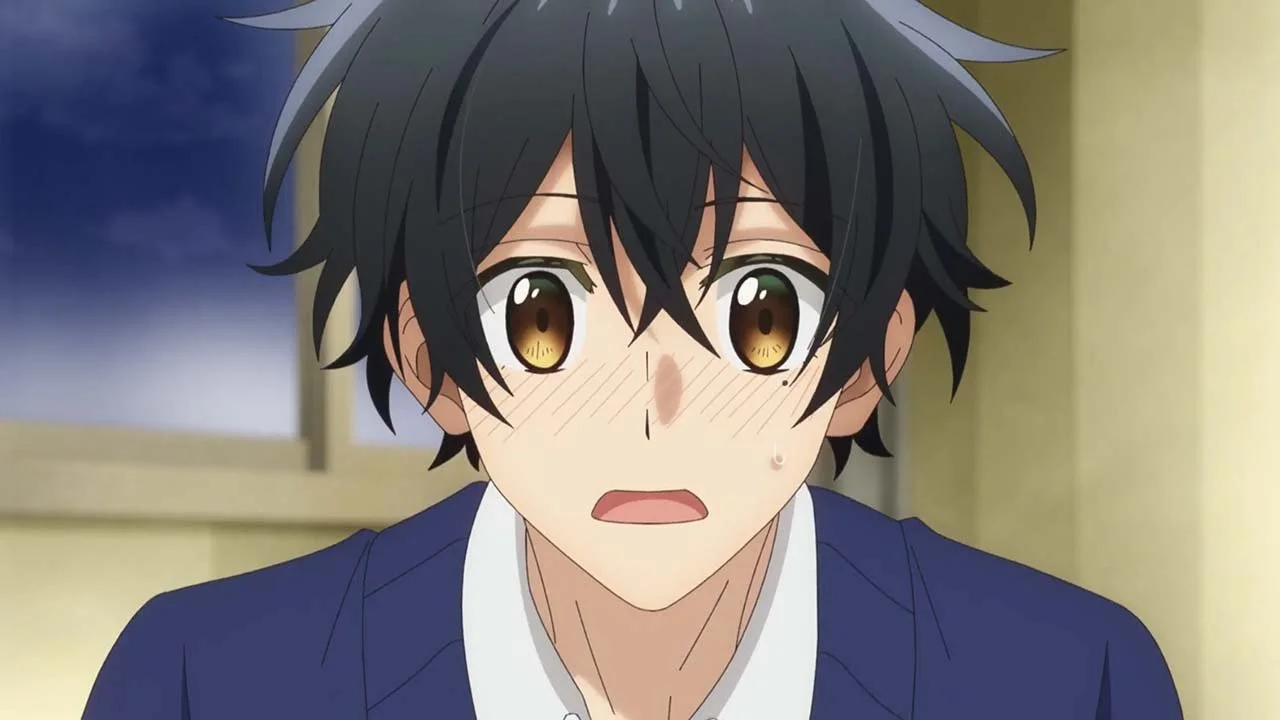
The story follows high schooler Yoshikazu Miyano: a diligent student, a caring friend, and someone with a strong sense of justice, if his decision to join the disciplinary committee is anything to go by. He has a complex about his “girly” face – he’s androgynous, and was teased for it a lot in middle school, even by his crush. Because of that, he tends to keep to himself. Outside of this, he’s a self-proclaimed fudanshi – a man who’s a fan of BL – and most of his free time goes into reading manga and listening to drama CDs in the genre. But this isn’t just a character quirk. One way to read Miyano’s frequent deadpan commentary on BL tropes is as a vehicle for the author to critique them. It’s ironic, then, that SasaMiya still operates firmly within the BL genre – though the author would push back on that, saying it stands for “boy’s life.” Apparently, it was a play on words suggested by their editor… I wonder about that.
One day, while heading to his school’s south building, Miyano overheard bullies picking on Tasuku Kuresawa. Just as he was about to step in, Sasaki – another student – walked by and stopped him, stepping in himself instead. In that moment, Sasaki looked completely taken aback – not by the fight, but by Miyano. It was like love at first sight; Miyano’s androgynous features left an impression that never quite faded. The scuffle broke up, though not before Sasaki took a few hits. Three months later, the two form a typical senpai-kouhai bond – but it’s clear Sasaki hopes for something more. Curious to learn about Miyano’s interests, he asks if he reads manga and what he’d recommend. Miyano only had a BL title on him, which he lent out with some reluctance. The next day, when Sasaki shares his thoughts, Miyano lights up – his friends know he’s into BL, but he’s never talked about it with someone quite like this. He finally found someone he could share his passion with, openly and earnestly. From senpai-kouhai to BL book club, their friendship gradually deepens into something more. Sasaki may not have confessed right away, but ever since that first meeting, it was obvious to him that he wanted to be by Miyano’s side.
The TV anime covers volumes one through six of the manga, whereas the Graduation movie covers volume seven.
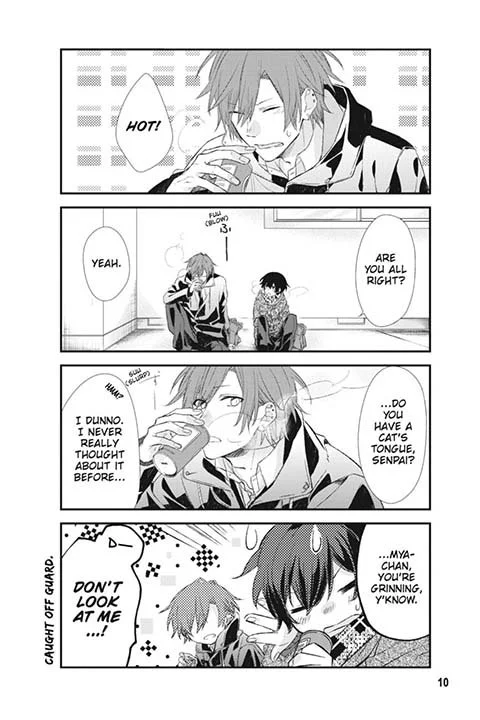
In the original manga, some chapter segments use the four-koma strip format. This doesn’t come out of nowhere – the original pilot was formatted that way too. While the format can be used for serious storytelling, it’s mostly reserved for gag comics, and early SasaMiya leans more toward that usage. These segments often set up Miyano as the punchline, accompanied by a third-party narrator who tends to deflate the humor, with Miyano’s own thoughts making only occasional appearances. In interviews, Harusono has confirmed that SasaMiya was initially conceived as a four-koma, but as serialization began, their editor suggested a hybrid approach: a mix of four-koma and standard panel layouts, preserving the original’s spirit while allowing the main story to grow. I think this was a misstep. It works in isolated moments, but as a whole, the mix gives the series an early identity crisis. That said, the further the series progresses, the more Harusono seems to embrace this quirk and uses it to shape reader expectations. Personally, I’d rather a story commit to one format or the other – even if SasaMiya is mostly easy to follow thanks to the way its strips are laid out in a logical, natural sequence. For instance, if a strip shows Taiga Hirano asking Miyano for help with disciplinary committee busywork and voicing concerns about Sasaki, the next one picks up with Sasaki walking into the classroom mid-conversation.
This cohesion immensely benefits the adaptation – both the TV series and the movie. Unlike the K-On! anime, which also began as a four-koma manga, SasaMiya didn’t need to retroactively fill in narrative gaps crucial to character development. I imagine the series composer breathed a sigh of relief. As for the adaptations themselves, I appreciated how some of Miyano’s BL monologues were trimmed when they didn’t serve the overall narrative – he tends to overdo it sometimes. One such cut: after Sasaki throws up from the alcohol-infused chocolates Miyano gave him, he remarks that Hirano can actually hold his liquor. That casual aside sends Miyano into a BL lore dump speculating about a relationship dynamic between Hirano and his dorm roommate, Akira Kagiura, a first-year. (That side story – Hirano and Kagiura – goes on to explore whether they become a couple, but that’s outside the scope of this entry.) That’s not to say anime Miyano isn’t still a dyed-in-the-wool fudanshi, but he’s less gratingly so. As a result, the anime strikes a more serious tone earlier than the manga did – and I found that to be a welcome change.
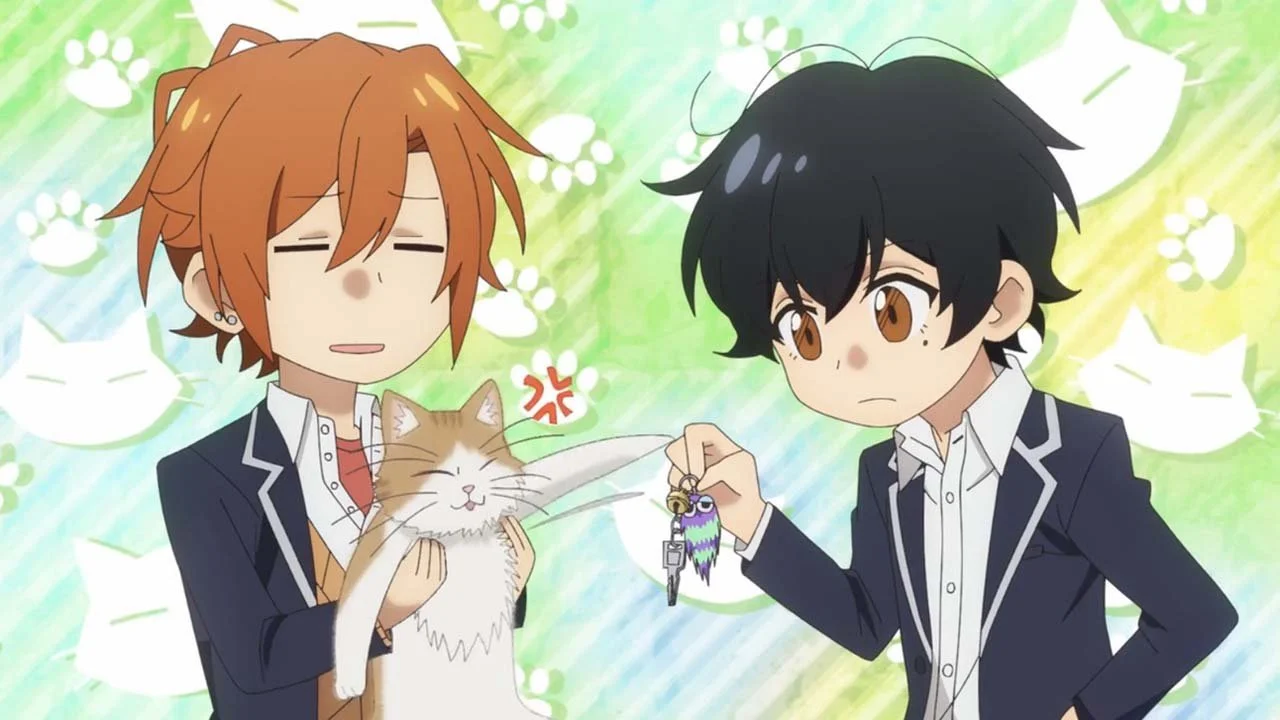
There were three months between the bullies’ incident and Sasaki getting all chummy with Miyano. I can’t ignore such a plot hole, especially one hiding in plain sight. Aside from a few vague nods to key events during that time, it’s largely treated as if it didn’t happen. Neither the anime nor what I’ve read of the manga – up to volume seven, funnily enough – seems to address it. I think it’s fair to ask: how did Sasaki get as close as he did? Did he really just research Miyano through Hirano? Was he sorting out his feelings, maybe too afraid to talk to him directly? Why wasn’t this potential turmoil deemed worthy of a few chapters?
It’s jarring. The first time we see Sasaki, he’s the cool senpai swooping in to stop a fight, and the next thing we know, he’s calling Miyano “cute.” I’d let it slide if the relationship stayed in the senpai-kouhai lane, but the way it plays out needs more scaffolding. That sudden shift in tone feels off for him – volume seven (and by extension, the movie) portrays Sasaki as deeply apathetic before meeting Miyano, which makes the whole “love at first sight and nothing else” bit hard to swallow. I just can’t wrap my head around it. It nags at me how any possible explanation that might shed light on Sasaki’s motivations gets swept under the rug the moment Miyano reciprocates – don’t ask questions, just cheer for them. It’s too convenient. The movie hints at Sasaki’s lingering insecurities when Miyano isn’t around, so maybe future volumes will revisit this gap… or maybe ones I just haven’t gotten to yet? Gosh, I hope so.
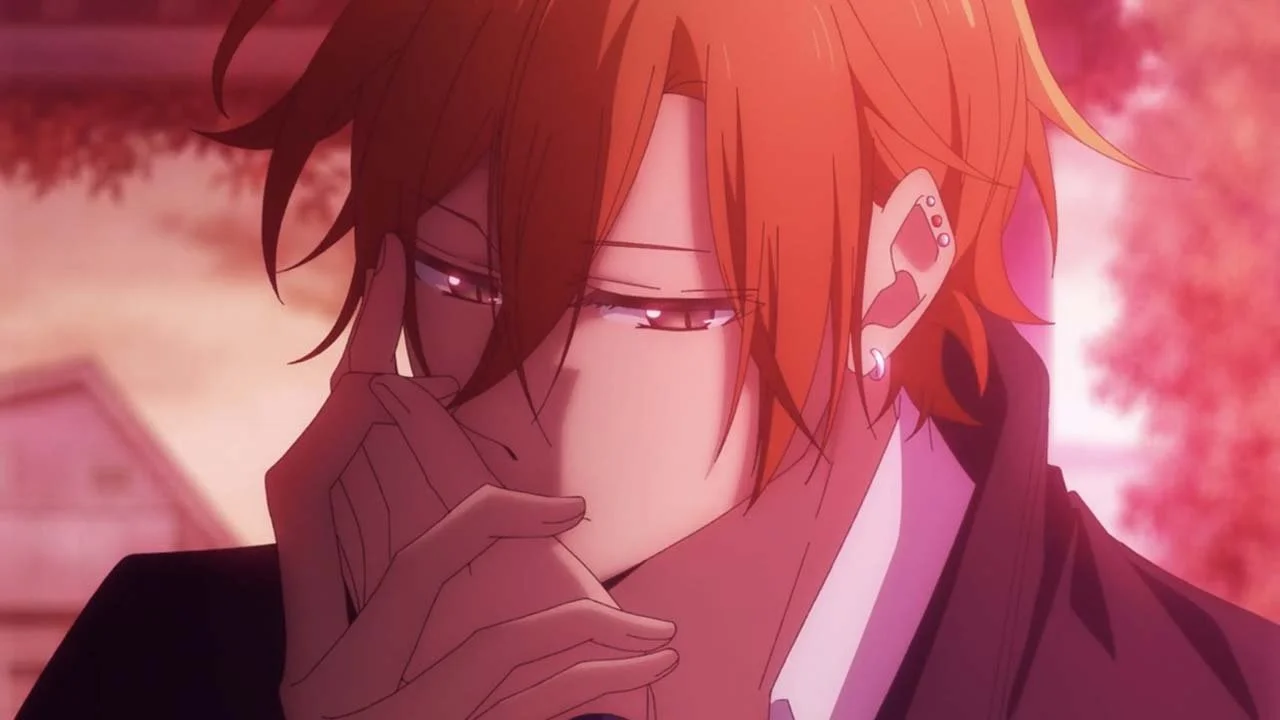
I admit, the lack of commitment from either Sasaki or Miyano to explicitly identify as gay bothered me. To add insult to injury, the characters brave enough to say it outright are tertiary: Masato Hanazawa’s older and younger siblings, Masaomi and Masaki, respectively. So, we’re not even worth a secondary role in a work where the titular duo are in a queer relationship. What made me second-guess that reaction, though, was Miyano running into his middle school crush, a girl named Nao Makimura. I’m reminded of my younger self: I had crushes on girls, even if deep down I knew I liked men. Maybe it was a coping mechanism – a way to fit in? Round peg, square hole, I guess. Still, growing up a gay kid in the late 90s was tough. I live in a deeply Catholic country, where attitudes today are more subdued – but back then, society had no qualms about humiliating anyone who dared be open about it. I fit neatly into the “gay” label, and yet I keep falling into the trap of thinking my experience is everyone else’s. That’s an obvious mistake by most standards, but emotional reactions rarely follow logic. What doesn’t help: I don’t know people in real life who define themselves as something other than lesbian, gay, bisexual, or transgender. I may know some online, sure – but for me, it’s one thing to read it off a monitor, and another to see with my own eyes how they live and express it. That, I find far more informative.
Queerness is far broader than just gay or lesbian, with a plethora of descriptors encompassed by the plus in LGBTQ+, and it’s something I should be better at, as my subconscious still defaults to narrower terms – even when I know better. The fact that I want meaningful representation and different orientations depicted in media isn’t mutually exclusive. In fact, by not focusing on labels – whether by design or indifference – Japan’s media industry might be doing more for queer representation than I’ve given it credit for. It’s unbound by the taboos that weigh down American media, which often tokenizes queer characters as little more than boxes to check. Sasaki and Miyano’s relationship – particularly Miyano’s soul-searching – reinforced what countless romance anime before this failed (or maybe almost succeeded) in teaching me: love is messy, love hurts, but love is beautiful. That makes the journey worth it.
Still, as I wondered aloud previously, I looked into it and have a theory about where Sasaki and Miyano might fall within the queer spectrum – something I’d like to share as food for thought. Based on what we know, I believe Sasaki is pansexual and Miyano is demisexual.
The Apothecary Diaries, Volume 12
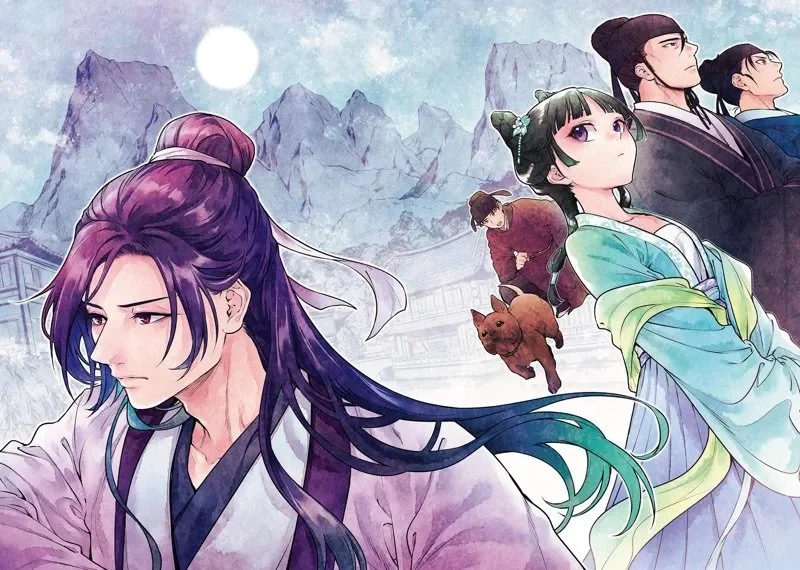
The anime adaptation of The Apothecary Diaries – Kusuriya from here on out – *finally* reached the infamous “frog scene” in episode 12 of the second season, which aired in late March. It was first brought to my attention thanks to Isaiah Colbert’s write-up for Aftermath, and memes only hammered it home once the dub aired a few weeks later. After one too many frog references, I started wondering where exactly that scene falls in the manga. I didn’t have to look far – though I did – because the answer was right in front of me. The cover of volume 12 has a frog perched on Maomao’s hand. I hadn’t thought much of it at the time, but once I started hearing about the scene’s infamous status in the fandom, the connection finally clicked.
How I didn’t give in to the temptation to look it up, I don’t know. But I can say with confidence that I knew next to nothing beyond its reputation. For the benefit of anime-only viewers: volume 12 of the Kusuriya manga adaptation roughly covers episodes 10 through 12 of the anime.
The volume opens with a chapter about scary stories. As payback for embarrassing Yinghua, Maomao is dragged along to an abandoned building in the northern part of the Rear Palace. Deep inside, a group of ladies-in-waiting, each holding a lit candle, are gathered around a brazier. The host kicks off the ritual: “Tonight, we shall be telling thirteen tales that will chill you to the bone.” After each story, they’re supposed to snuff out their candle and toss it into the brazier. But there’s just one problem – thirteen tales? Counting Maomao, Yinghua, and the host, there are only twelve people. Maybe someone’s telling two stories? Or maybe the thirteenth person hasn’t arrived yet? Maomao doesn’t think much of it and keeps the tidbit to herself.
By now, it’s clear how scaredy-cat Yinghua didn’t want to go alone – Maomao didn’t even get to finish her story before Yinghua bonked her in a panic. As the night went on, Maomao started feeling light-headed. When it came time for the twelfth person to speak, she could barely focus – until they said something that sent a chill down her spine: “You will be next.”
Her fight-or-flight response kicked in. She bolted to a nearby window and flung it open, letting the toxic fumes from the brazier escape. Had she not acted when she did, she – and everyone else – might’ve succumbed to carbon monoxide poisoning. Whether the host intended this outcome is up for debate… but they might’ve been a ghost themselves. Later, back at the Jade Pavilion, Hongniang casually mentions that the woman who used to oversee that building died the previous year, lending just enough weight to the ghost theory to make you wonder.
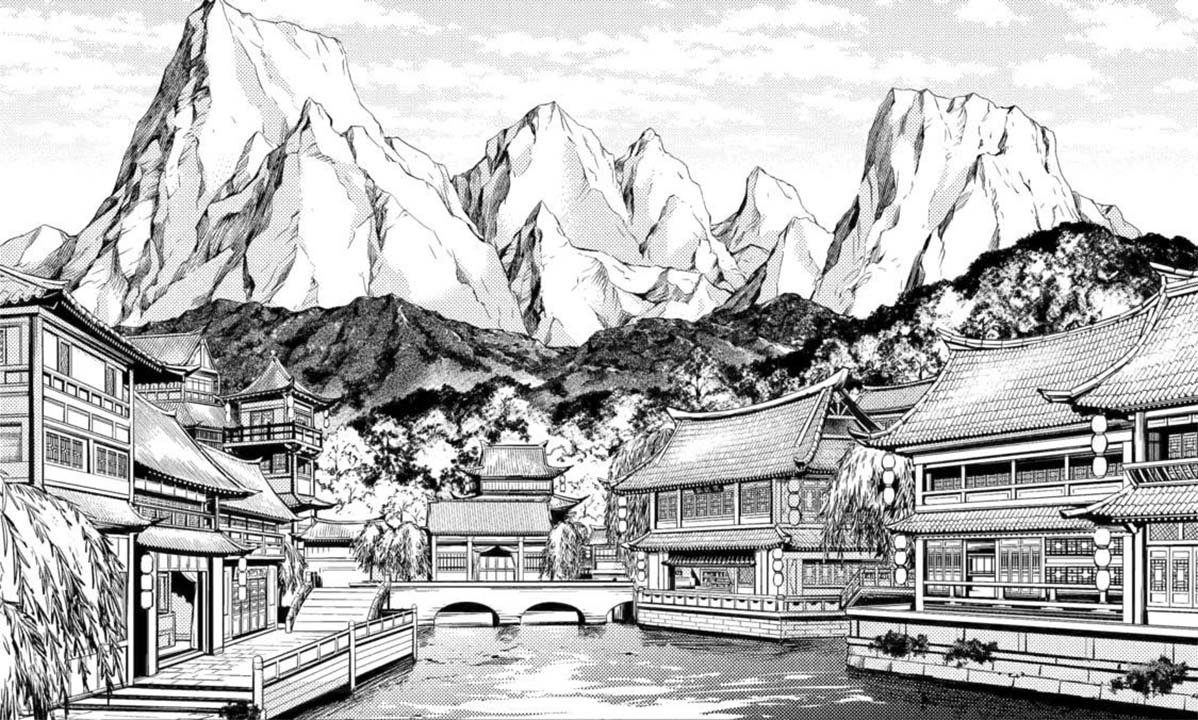
Next up, the start of what I’m calling the “Hunting Arc.”
Jinshi requests to borrow Maomao from Consort Gyokuyou for a few days, offering Suiren as a replacement food taster in exchange. He’s been invited to a hunt by Shishou of the Shi clan, held in the northern Shihoku Province, and wants Maomao to tag along. Also coming along for the ride: Jinshi’s assistant, Gaoshun – *not* acting in an assistant capacity this time, since he was also invited – and the man temporarily taking his place, Basen, Gaoshun’s son. For the duration of their stay in Shihoku, Jinshi requests to be called “Kosen.”
Nothing especially noteworthy happens until shortly before the infamous “frog scene.” Jins – erm, Kosen – steps away from the banquet feeling light-headed, likely due to heat exhaustion from the hood he’s wearing. Concerned, Maomao goes after him; he couldn’t have gone far. In the nearby forest, she finds him leaning against a tree. She urges him to take the mask off, but he doesn’t want to risk being seen by anyone outside his entourage. The two walk to a riverbank near the top of a waterfall so he can cool off.
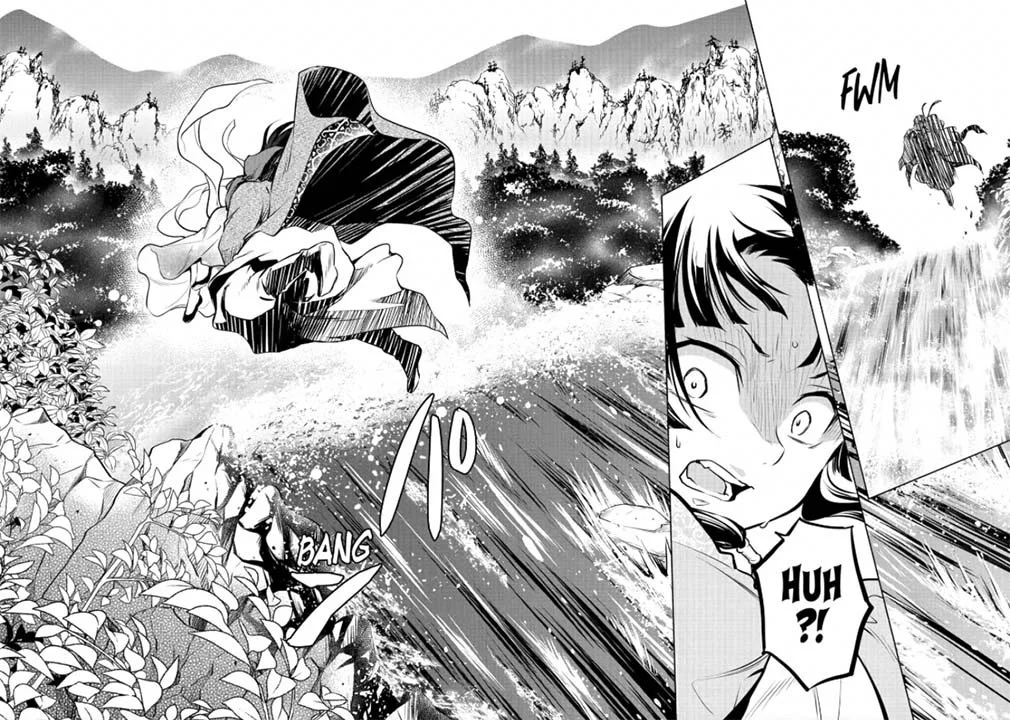
Then: gunfire. The shots miss, but tension spikes. Kosen pulls Maomao close and leaps with her into the falls.
Back at the banquet, his entourage grows concerned – he’s been gone for over an hour. Basen dispatches men to search for him, and before long, a torn, blood-stained piece of Kosen’s robe is brought back. The group snaps into high alert, and a frantic search begins.
Jinshi and Maomao take refuge in a cave behind the waterfall. Maomao nearly drowns from Jinshi’s stunt – he has to perform CPR to revive her. She comes to, coughing up water and immediately berating him for it.
It’s chilly in the cave, and their clothes are soaked. Maomao suggests they wring them out to avoid catching a cold. They share some butterbur sprouts from the pack she’d brought and begin walking deeper into the cave. Jinshi mentions there’s a hole in the ceiling toward the back – it looks climbable with a boost. Maomao isn’t strong enough to lift him, so he crouches down to hoist her up.
Standing on his shoulders, she reaches for the damp rock overhead, trying to find a grip, when a frog lands squarely on her head. She flails to shake it off, slips, and sends them both crashing to the ground. Maomao took a moment to recompose herself. The fall didn’t hurt as much as she expected – she’d landed on top of Jinshi. Her left hand was touching something; she figured it was the frog again, but…
“Could you move your hand? You’re putting me in a bit of a pickle,” Jinshi muttered with a slight grunt.
Her hand was in his crotch. He’s not supposed to *have one*. He’s a “eunuch.” Suddenly, a lot of things made sense – his figure, for one, far from the typical languishing body of a eunuch. But Maomao didn’t want to think about it. Ignorance is bliss.
Before she could stand, Jinshi grabbed her. “There’s something I need to tell you. It’s why I asked you to come along on this trip.” That line set off alarm bells. Whatever he was about to say, it was the kind of thing people got killed over. So, she played dumb: “I think I squished a frog.” Jinshi, understandably, lost it. He didn’t know about the actual frog that landed on her head, so to him, she’d just compared his manhood to an amphibian. He questioned her with the intensity of someone who’d just had their very identity thrown into doubt. She didn’t help matters by continuing the bit – frogs are slimy, after all.
He snapped.
He shoved her down and crawled on top of her, eyes burning with a predator’s glare. Yanking up her right leg, he growled, “Do you want to make sure?” If Maomao wanted to keep pretending he was a eunuch, she couldn’t anymore. She even considered kicking him in the groin to get him off her. Jinshi realized, too late, that he’d gone too far – but he didn’t move either. Just froze.
A dog barked. Lihaku’s dog. Maomao whistled, and it pounced on Jinshi, giving her a chance to slip out from under him. Lihaku soon followed and got them out of the cave. Outside, Kosen (mask back on) was still mad. When Maomao asked if he was okay, he lashed out, still upset about the comparison. She figured: “Such a lordly man with confidence in his looks must possess an equally fine frog.” Of course he’s outraged – he thinks she made up that whole story just to avoid facing the truth.
She does have a theory about who was shooting at them… but that’s where this volume ends.
Kusuriya is a mix of many genres, and among them is political drama. After taking a back seat for several volumes, we’re back in it, as Jinshi’s unspoken reason for visiting Shihoku seems to be diplomacy – or is it? Maybe the high stakes surrounding Jinshi make it easier to digest, but based on what’s presented in this volume, I struggle to care. In fact, most of what I cut from the Hunting Arc write-up *was* the political drama. Without full context, I find it difficult to piece things together or determine what’s relevant – and that might have something to do with my tendency to avoid currently airing anime.
I understand the Shi clan rebels against the Imperial Palace, and that conflict becomes more prominent later, but I shouldn’t need to dig through external details to make sense of it now. Instead, I find myself wishing the story would return to Maomao solving mysteries, as low-stakes as those can sometimes feel.
Whether or not I personally enjoy the genre, it’s possible Kusuriya handles political drama well. I can’t judge that – I’d need some grounding in ancient Chinese history to really say. I’m sure there’s value in that perspective, and it might even help make the story’s world feel more tangible. But as it stands, I’ve yet to encounter anything – either in the story or by chance online – that’s made me want to dive deeper.
Lastly, how I felt about the “frog scene.” I’m not going to mince words: I found the whole thing icky. No, I’m not making a pun – I was genuinely disturbed. By this event alone, my impression of Jinshi did a complete 180.
First, how the scene was handled. Before sitting down to write what might be my most scathing criticism of the series, I took a step back – maybe it played out differently in the light novel? Or even in the anime? In the interest of fairness, I looked both up.
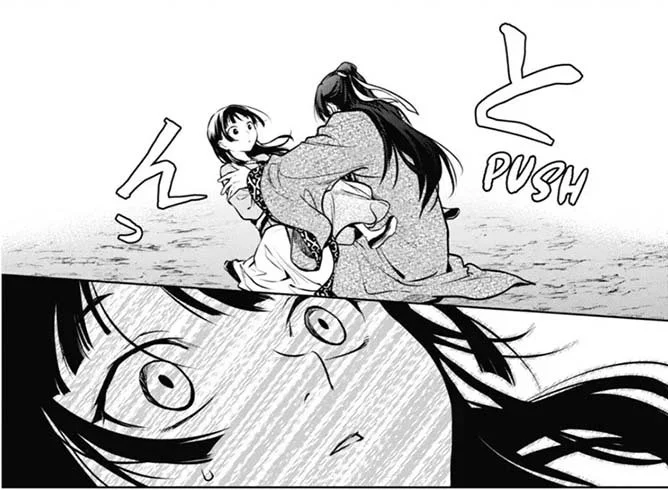
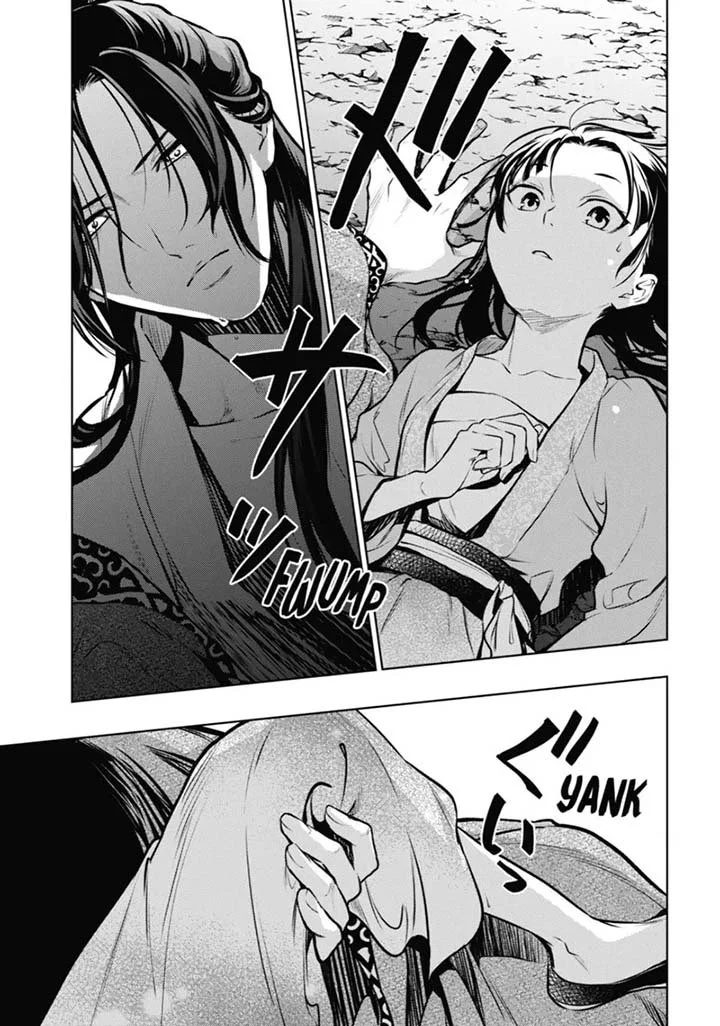
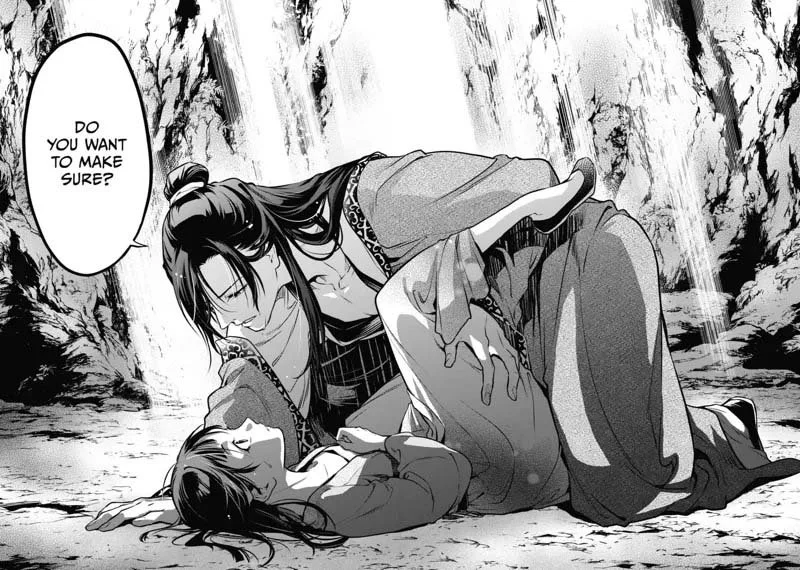
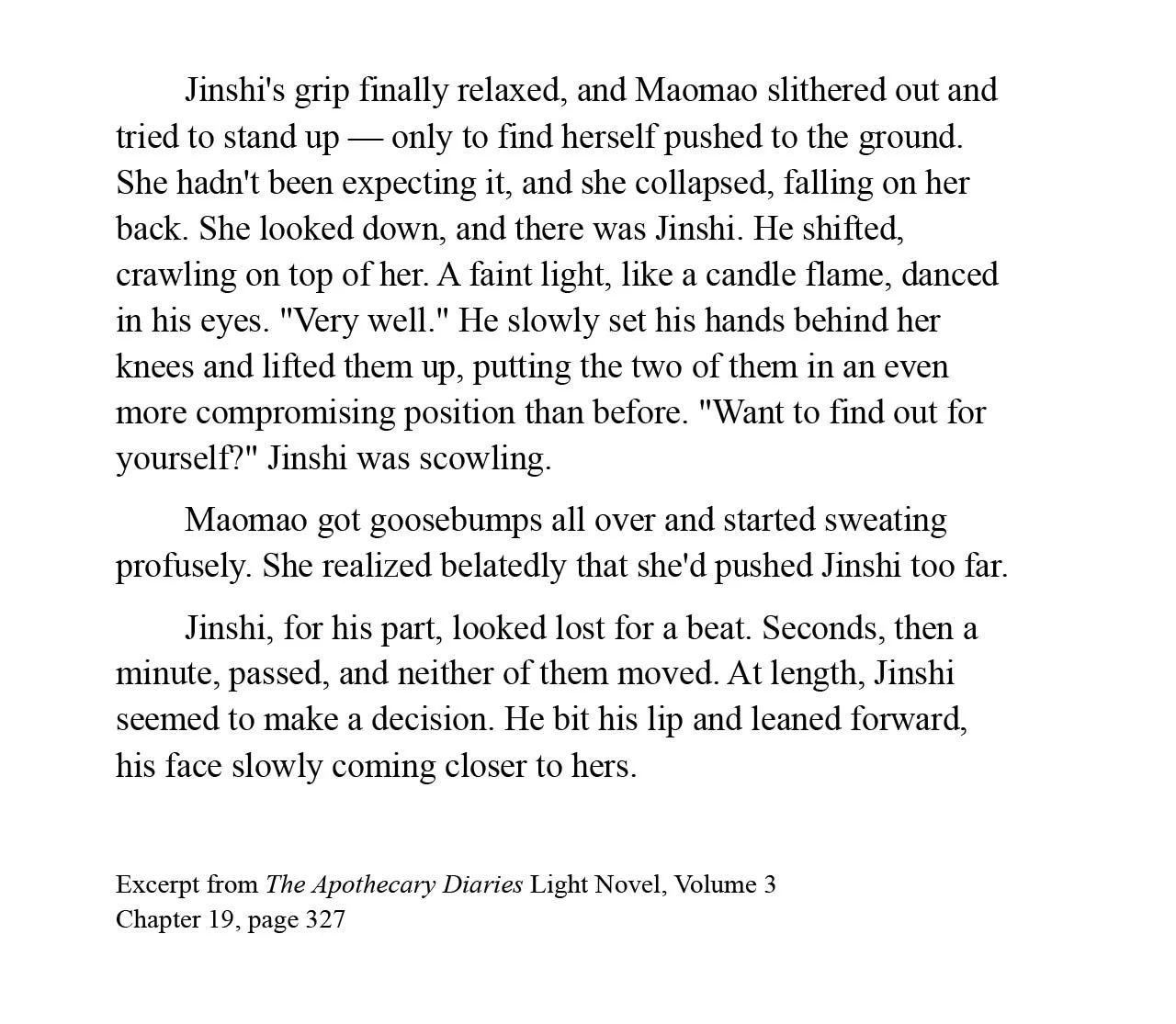
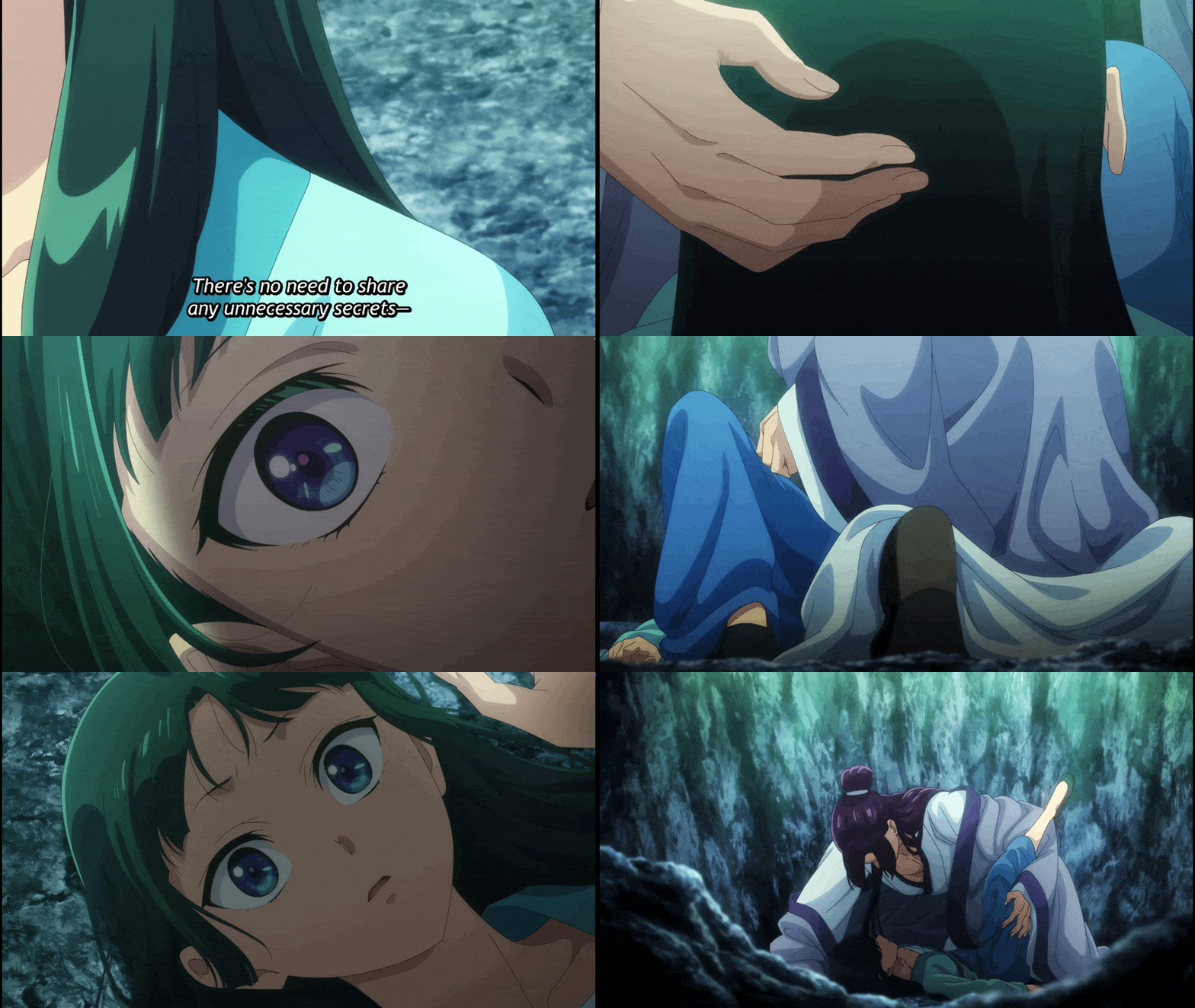
The result? I actually think the anime’s softening of the event is worse, perhaps out of a misguided sense of respect for MaoJin shippers – but more likely to avoid clashing with Nippon TV’s management. In the written work – an excerpt from both the light novel and manga panels is above – Jinshi is described as snapping and pushing her. And while I can see the importance of this moment in advancing their relationship, lying her down is not pushing her. It’s ridiculous to believe someone who snaps would do anything gently.
Maomao could’ve been seriously hurt by Jinshi giving in to his rage. The cave floor isn’t smooth, and moss isn’t a cushion. More importantly, this isn’t the first time Maomao has messed with him – so why now? The fact is, there was no need for this at all. Jinshi is a charming man, and Maomao even admits as much when she first meets him, even if she isn’t interested. Their interactions up to this point had been various shades of charming, but always polite – even when he behaved like a petulant child in private. I think back to when Maomao served him at Verdigris before he bought her – how he stole a kiss when her lips inadvertently touched his finger. That’s the Jinshi I knew – charm dialed up to 11. I don’t know this Jinshi.
This borders on sexual assault, and I don’t say that lightly. The fandom’s insistence that he “cares for her,” using all their previous interactions as proof that this was a one-off, really upsets me. It’s as if they’ll excuse anything to keep their ship afloat.
Ultimately, I’m just glad the dog came when it did.
That’s it from me. See you next month!