
70 min read
Prior Entry | All Media Log Posts | Next Entry
Please be advised these posts aren’t spoiler-free.
Writer’s Note
Apologies for the massive delay on this entry. I’ve dedicated all of my time in late July to “The Internet Died,” and as a result, this entry didn’t see work until August, after that post was complete. I didn't time manage well and didn't take many notes — which are essential for how I write about media. To make matters worse, I discovered that the Given films rearrange events from the manga, so I couldn't rely on that as a reference. I’ve had to rewatch my rewatch of the anime and the films. I hope the wait was worth it, and I’ll try to do better about sticking to a deadline, however informal that may be.
It would seem that my PC is damaged. Well, this sucks…
As I frantically look up computer repair places to get an estimate of how much it would cost to bring it back to life, I want to go over how this happened. The last time I turned it on, around the end of July, everything was working. I was asked to make a copy of a thumb drive — an easy enough task; I bought a similarly sized one and trusted the copying job to Windows. macOS can do the same job, but as I needed something off the tower, I might as well kill two birds with one stone.
Some days later, while working on “The Internet Died,” I boot it up — again, I needed an asset I knew was on the hard drive, and I began noticing an erratic behavior. I turned on the PC, and it appeared as if it was booting up, but it quickly went down. When I was about to turn on the power button to turn it back on, I noticed it did so unprompted, only to shut off again. This on-off behavior went on repeat unless I forced it off. I suspected that the power supply died, but maybe I could do something. I unplugged the power supply overnight, then attempted to boot it up after work the following day. It didn’t work. That’s all the troubleshooting I can do at the time, so I’d have to check it over the weekend.
Weekend comes, and it’s time for more troubleshooting. I open the case, get the GPU and the capture card off, start dusting it off, and do some light cleaning with a vacuum cleaner. Tried turning it on without the GPU, and it stayed on, but no video signal came out of the integrated motherboard GPU. I plugged in the dedicated GPU and switched my cable to it — no dice. I swapped monitors, thinking that might be the cause, and it wasn’t. Next, I installed the capture card, thinking that the computer was being finicky, and I unwittingly found the culprit for the on-off behavior.
The PCI slot the capture card was on got damaged somehow, and was preventing the PC from staying on. Luckily, I had a spare slot, and while it stayed on, I still had the no video issue. What about this CMOS reset? I did switch PCI slots, and the motherboard may need a reset in those instances. Nada, even with the motherboard battery taken out.
At this point, I’m getting worried. Baffled how a single bad PCI slot could kill the entire motherboard. People I know who are good with PC hardware repair suggested via chat, as daft as it sounds, to remove the RAM sticks and put them back. That didn’t work either. I asked one of them if they could drop by my house to give it a look, but given how they thought that my thinking that the hard drive was spinning or how the NUM LK key on the keyboard I was using meant something was me messing with them — not to mention another person who was cracking jokes at my expense — I think I’ll search for a third party instead. I didn’t appreciate how they made me feel dumber when I knew I was asking a dumb question. But these things, they may mean something…?
Maybe it was for the best that I never got into computer repair. The adults in my life thought that, since I know my way around a computer, I should repair them. I wasn’t interested in a career path in which I’d be tech support for my family, so I went for something else. Hardware repair is a different ball game. While I do know my way around software, more than your average user, all I have are critical thinking skills — something today’s society sorely lacks. Give me an instruction manual — y’know, the booklet many throw away after they’re done — and I can find my way around.
As I plan to go full-on PC for gaming in the future, an upgrade was on the cards… but I didn’t expect it to be this soon. I hope I can kick the can further down the road while I save some money to make it happen. I’ll be fine with just my MacBook, but urgh, another unforeseen expense…
given
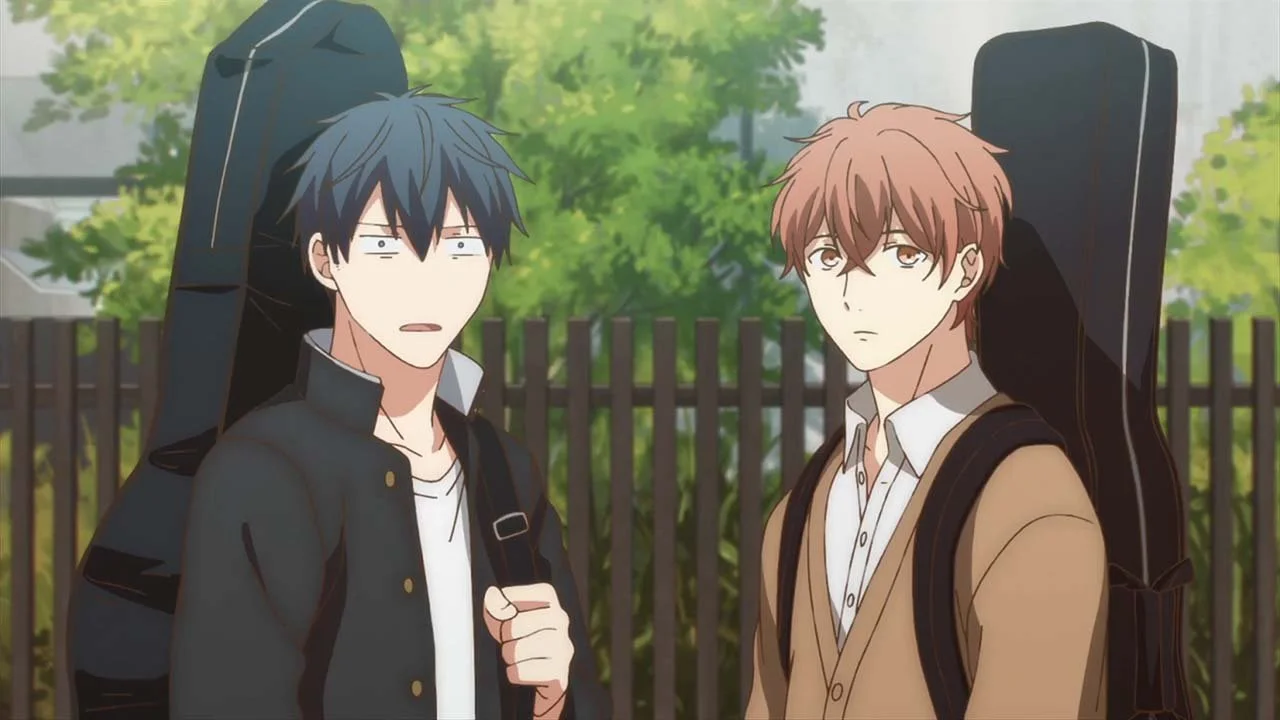
Music. Even in a foreign language, it can make one feel things they’ve never felt before. “Listen” — we already have a universal language, and it’s called “music.”
Given is a show from the days in which I somewhat kept up with anime simulcasts. I’ve just started to heavily get into boys’ love stories after Yuri on Ice, and I craved shows that were unrelenting about depicting an aspect of queer love that, quite often, media shies away from: affection. Recall the kiss scene in Yuri on Ice; back then, people argued over whether Victor really kissed Yuri or not. It all felt very silly when it got to the point that frame-by-frame analyses were used to make the point in either direction, depending on who was doing said analysis. I knew what the score was, yet this plausible deniability — not to mention the pervasive homophobia within anime circles — left a sour taste in my mouth.
I was initially skeptical when I saw footage of the two main leads kissing in Given, shown in its full glory with no room to interpret otherwise, but I dove in anyway. I figured how, if nothing else, there’d be something in it for me. I enjoy music shows; after all, I hold the K-On! anime adaptation in very high regard.
Back in 2022, when I was very much into buying manga, Given was one of the series I bought. Viz Media’s BL imprint, Sublime, had just gotten to the Hiragi Mix arc and was covering stuff that neither the TV anime nor the first film covered. Fast forward to the present, and I have volume 9 on my nightstand, ready to be read. I also haven't watched the final Given films. With some back pain making reading uncomfortable lately, I figured I'd rewatch the entire anime series first and work my way through the films.
The brainchild of manga author Natsuki Kizu, Given first started in 2013, was serialized in Chéri+, and it ran for a decade. The series spans nine manga volumes, several audio dramas, a TV anime, a live-action drama, and three anime films. The TV anime, in particular, is notable for being the first BL anime shown on the Noitamina programming block. With the release of Hiragi Mix and To the Sea in 2024, the series is fully adapted — it wasn’t necessary to jump to the manga after finishing. The TV anime covers books 1 to a portion into 3, the first film covers the rest of book 3 through 5, the second film, books 6 and 7, and the final film covers books 8 and 9.
Kizu is somewhat of an enigma. A casual search of her past work — or post-Given work, as it were — yields sparse details, but it’s a different story if you know where to look. Given is her most popular work, no doubt about it, but it isn’t her first commercial one: a one-shot, Yukimura-sensei to Kei-kun, predates it. Before that, she worked in doujin circles as Gusari, publishing works and reportedly making fan art for Hetalia, Kuroko no Basuke, and Haikyuu. As of writing, she’s promoting a project with fellow doujin creator Ameno titled “Paranormal Response Division 4.”
Given I watched the entirety of Given and nothing else during the month, I’ll be padding out this post by tackling each entry separately. I hope you’ll understand.
given (2019)
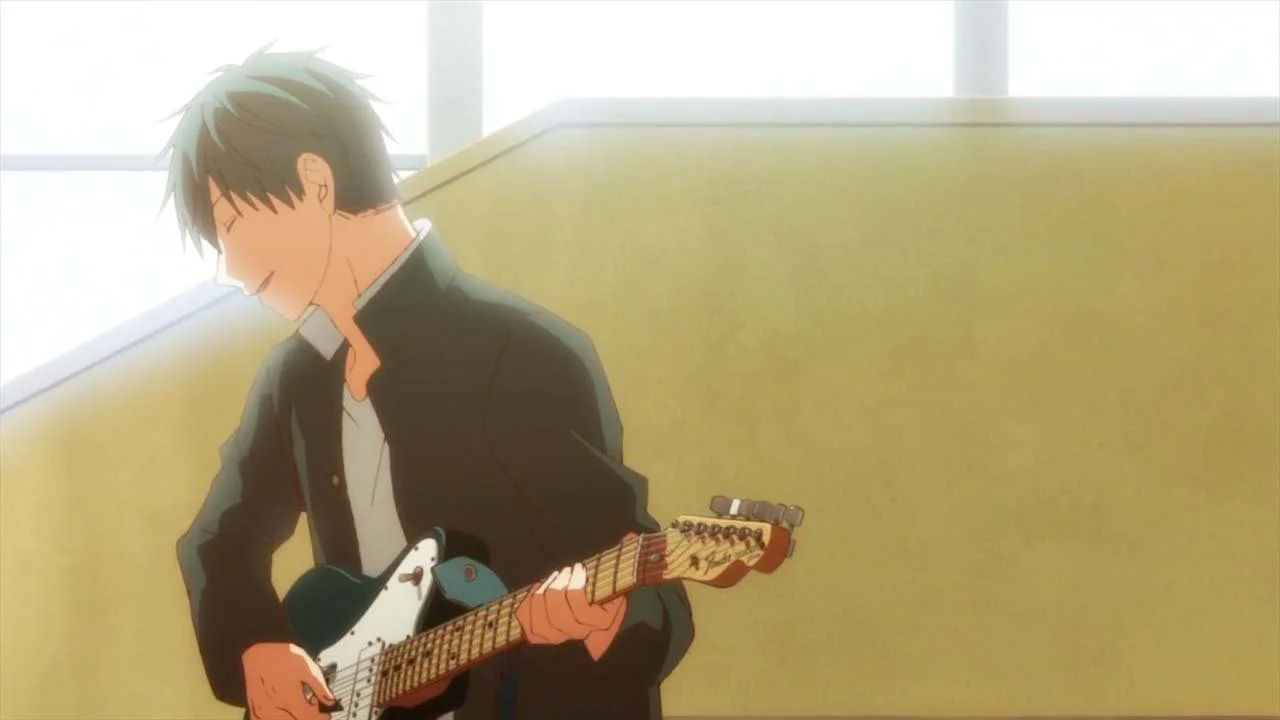
One day at school, Ritsuka Uenoyama — whom I’ll be calling by one of his nicknames, “Ue”, moving forward — felt so sleepy, he went to his spot at the stairs of the gymnasium, intending to nap the rest of the afternoon away. When he gets there, there’s another student, sleeping in *his* spot. Ue hasn’t told anyone about this place; maybe he found it perchance? The boy hugs what appears to be a Gibson guitar — is he a musician? Ue hasn’t seen him in the indie circle, but recognizes him as a student from the class next door.
Groggily waking up from hearing the door open, he stares at Ue, wondering who he is. As a footnote, character data files reveal he has myopia. His staring may stem from that: he only knows someone is there, but not who it is. The boy scoots over, making room for Ue to either go up the stairs or sit, whichever he wanted to do. Unnerved by the boy’s silence, he sits down on the now-unoccupied spot: “Use your words, man. The silent act is creepy.” How’s that for an icebreaker? It might’ve been better to talk about the weather. Ue immediately noticed the rusted strings on the Gibson and urged him to fix them. The boy came to life, shocked. He gets too close for comfort, asking, “This can be fixed?!”
It can. Ue can do it, but not right now. The boy deflates; Ue, feeling as if he’s being guilt-tripped, becomes ever more irked. He goes back to his classroom, picks up his spare strings & tools, and fixes the Gibson. After a quick test strum, he was eager to go back to his nap. Instead, he gets an eager student, wanting to learn how to play guitar. Ue’s skills are entirely self-taught, and his obsessive personality helps… can that even *be* taught? He isn’t interested in teaching someone else, nor does he have the skills to teach to begin with. Ue suggests the boy teach himself how to play, like he did, or join the light music club. Maybe start a band? The boy won’t take no for an answer — he wants Ue to teach him.
Before talking about plot points involving music, I should note: I’m not a musician. I had a drum kit once, shortly after I exited college, I think. I was pretty broke back then; I could barely sustain myself, and adding instruments to the list of purchases wasn’t tenable. I’d never translate the skills I got playing Rock Band to the real thing. True, they’re not a one-to-one translation in comparison; nonetheless, it’s a foundation to build upon.
To this day, I’m of the thought that I don’t have the hand-eye coordination to play electric guitar, and that’s part of the reason I’m drawn to the rhythm section: drums and bass. While unlikely that I’ll pick up the drums again, I cling to the dream of someday learning how to play bass — I only hope this ember doesn’t go out, and that it’s not too late whenever I get around to it, if ever…
In Ue's backstory, he explains that, as he improved and could play more genres, he became less excited about music. I must question his motive — did he only pick up the guitar because he had nothing else to do as a young child? This is one of the issues I have with him being painted as a “prodigy” just because he’s adaptable. My mind was cast back to how so-called “gifted kids” get showered with praise. While perhaps not the intention, it ultimately warps their worldview, and when faced with hardships, they can’t solve them. But they were told they were geniuses! They didn’t need to learn anything new! They could solve anything! Alas, they can’t, and often this type of person needs therapy. I speak from experience, and it’s hardly unique to me, but I’ll tell that story some other day.
Creativity is a never-ending journey, and those who walk the path are constantly looking for new ways of expression. Having Ue’s breadth of knowledge surely is the envy of many musicians, and he’s not exploiting that potential? Talk about wasted talent… Not only do I believe that Ue is going on about music the wrong way, but I can’t buy that as anything other than a framework for when he and the boy eventually team up. I could stomach this if I knew more about the prior bands Ue played in to gauge how, exactly, these “creative differences” occurred — they must’ve been quite profound for the founder of his current band being okay going along with his every whim, only to keep him.
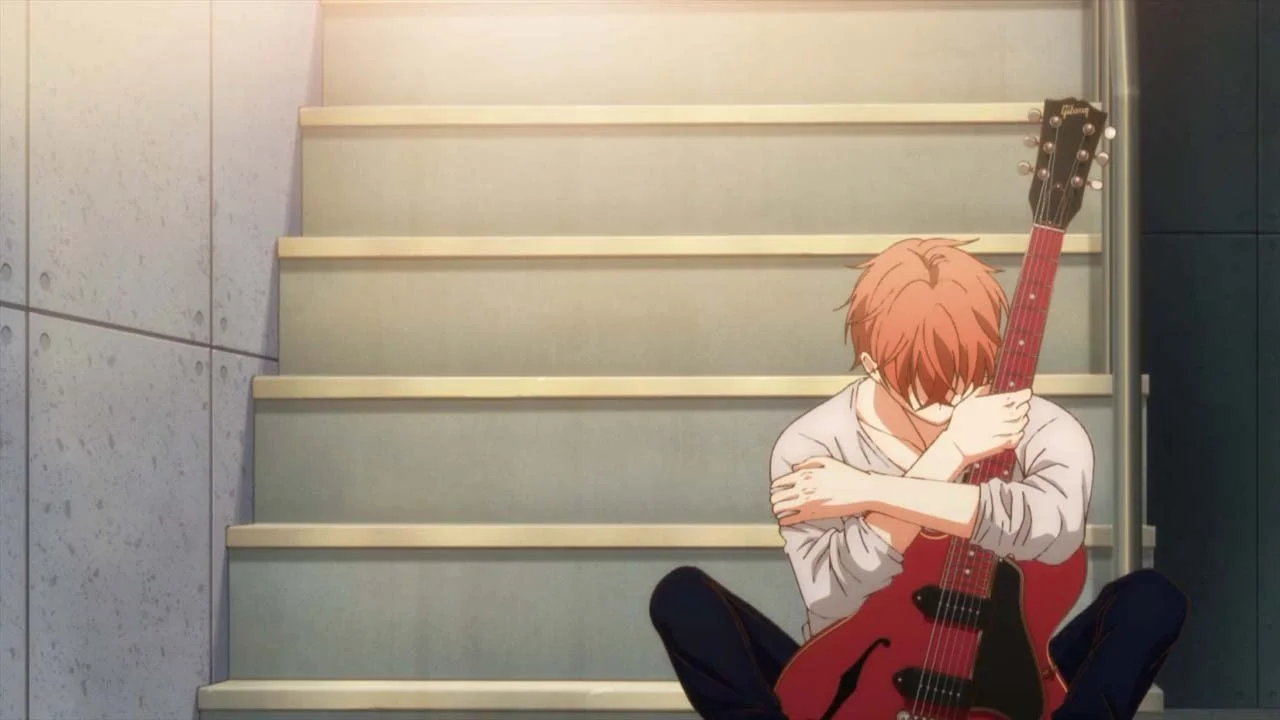
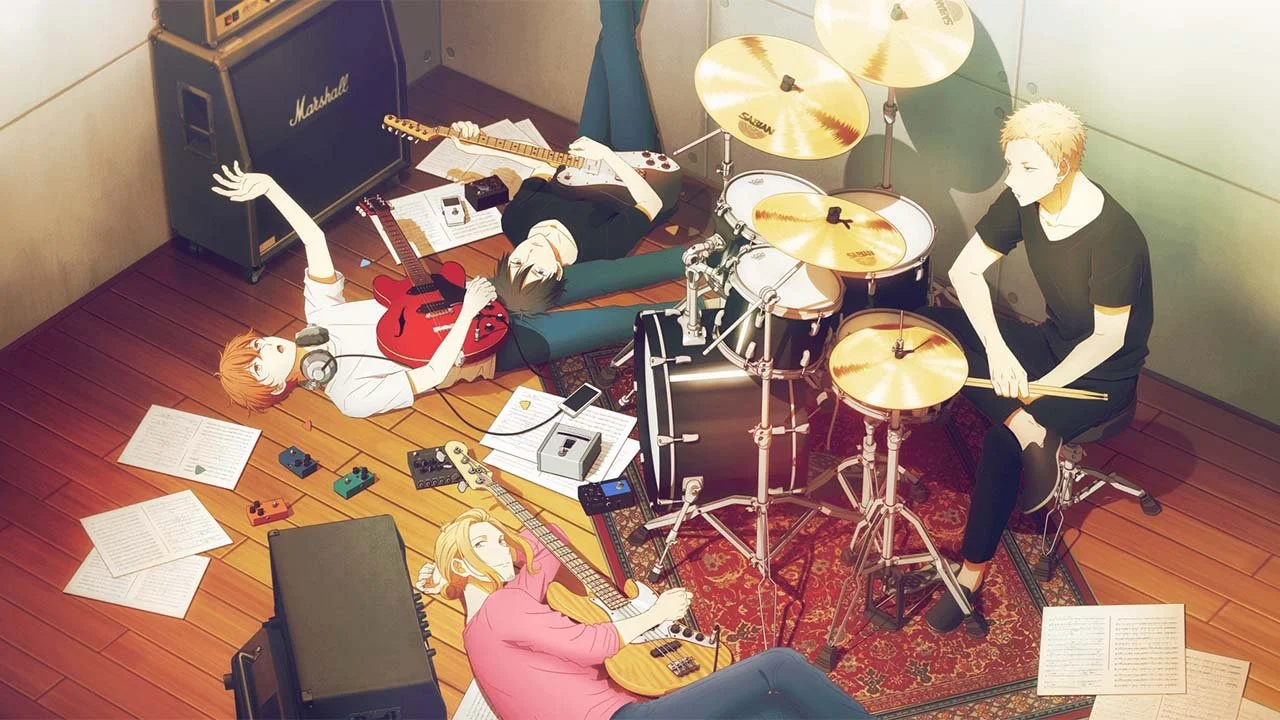
Mafuyu Sato, the aforementioned “boy” in the introduction, carries the guitar of his dead friend and lover, Yuki Yoshida, everywhere. In the middle of a lesson, Ue discovers Mafuyu’s impressive singing and invites him to join his band, The Seasons. They didn’t have a vocalist, and Mafuyu could be molded into becoming an acceptable rhythm guitar player through Ue’s lessons — the other members, drummer Akihiko Kaji and bassist Haruki Nakayama, didn’t object. Mafuyu resists the idea, but wants to make an effort, perhaps out of gratitude for the lessons. However, it wouldn’t be easy for the budding musician. In his own words: “I’m probably really bad at expressing myself compared to other people.”
Mafuyu’s love for music got complicated after Yuki’s loss. He knew Mafuyu loved music as he noticed how often his lover hummed little melodies to himself. Their love for music was shared: with the help of his childhood friends, Hiragi Kashima and Shizusumi Yagi, they formed a band, syh, an acronym of the first letters of the members’ names. Mafuyu wasn’t interested in going pro, but supported his friends in their efforts. As Yuki spent more of his free time between part-time work and the studio, a rift between them began. Yuki didn’t have time for Mafuyu, which made him feel as if the music was taking Yuki away. Mafuyu longed for intimate alone time with Yuki — moments that couldn't happen when surrounded by friends. At one such gathering, Mafuyu snapped, refusing Yuki’s affection, and fought him over his priorities. Shocked and apologetic, Yuki promised to leave syh if it’d make Mafuyu happy, saying he'd do anything for him; Mafuyu angrily replied: “Then, would you die for me?!” He didn’t keep his emotions in check and didn’t realize how Yuki… meant what he said. Some days later, Mafuyu came over to visit and found Yuki’s corpse hanging from his bedroom ceiling.
We got a taste of how harrowing it is when someone acts on something someone said while upset. All I know of Yuki comes second-hand: given his troubled past, he likely took Mafuyu’s words to heart — without his anchor, he’s nothing. It’s suggested that he didn’t plan to commit suicide that night, but as he drank his sorrow away, his inability to handle alcohol kicked in, surfacing the dark thoughts in his head. I can’t recall if Mafuyu screeched, seeing Yuki’s lifeless body, but his complete shock was enough to give me goosebumps.
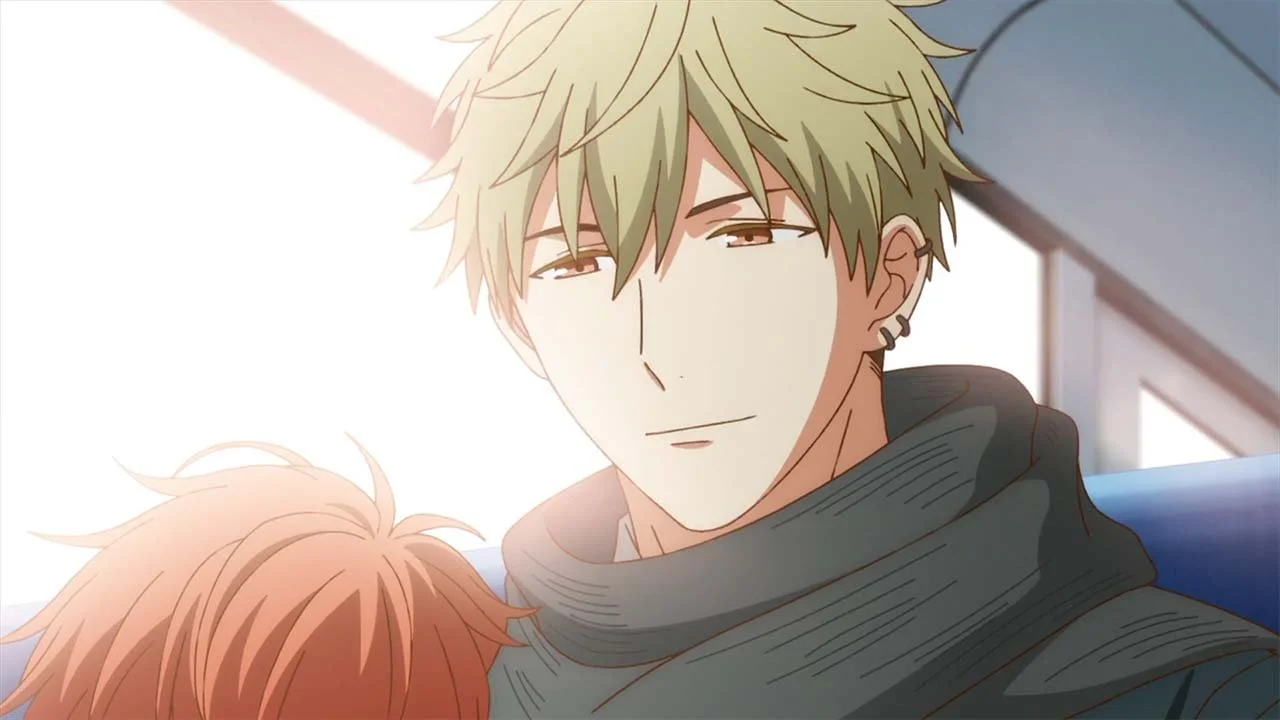
The actual circumstances behind the fight, revealed when they were, help the narrative: if you’ve stuck around for that long, you likely have an attachment to Mafuyu or the other characters. I, for one, share in the horror of seeing a loved one die the way Yuki did, though, admittedly, I don’t care for him, or rather, I wasn’t given reasons to do so until the final film. The only way I could get into the mindset of caring for that event was erasing Yuki’s name and face from my memory. This “not given enough reason to care” critique extends to all of Given’s secondary characters, and Yuki in particular bothers me as a large portion of Mafuyu’s character, if not the series’ main driver, revolves around his healing from the trauma of losing him.
Mafuyu can’t find the words to express his deep regret and ache because it was words that ruined everything. Somewhere along the way, Ue fell for Mafuyu. It wasn’t until a week before the presentation that Akihiko, fully aware that Ue’s love for Mafuyu could break the band apart, did a daring gamble with Haruki’s help. I presume Haruki told Akihiko about the conversation he and Mafuyu had one night exiting the studio, so he’s somewhat aware of the circumstances behind his writer’s block. He confronts him: “If you don't come to terms with your past, you won't be able to write those lyrics.” Haruki, giving Ue a lift, rolls the dice as well: “You’re off your game. With the way you’re playing now, Mafuyu’s sound is going to swallow yours.” With Mafuyu and Ue shaken at hearing what they just did, the senpais got the reaction they sought; whether it’ll work is another matter.
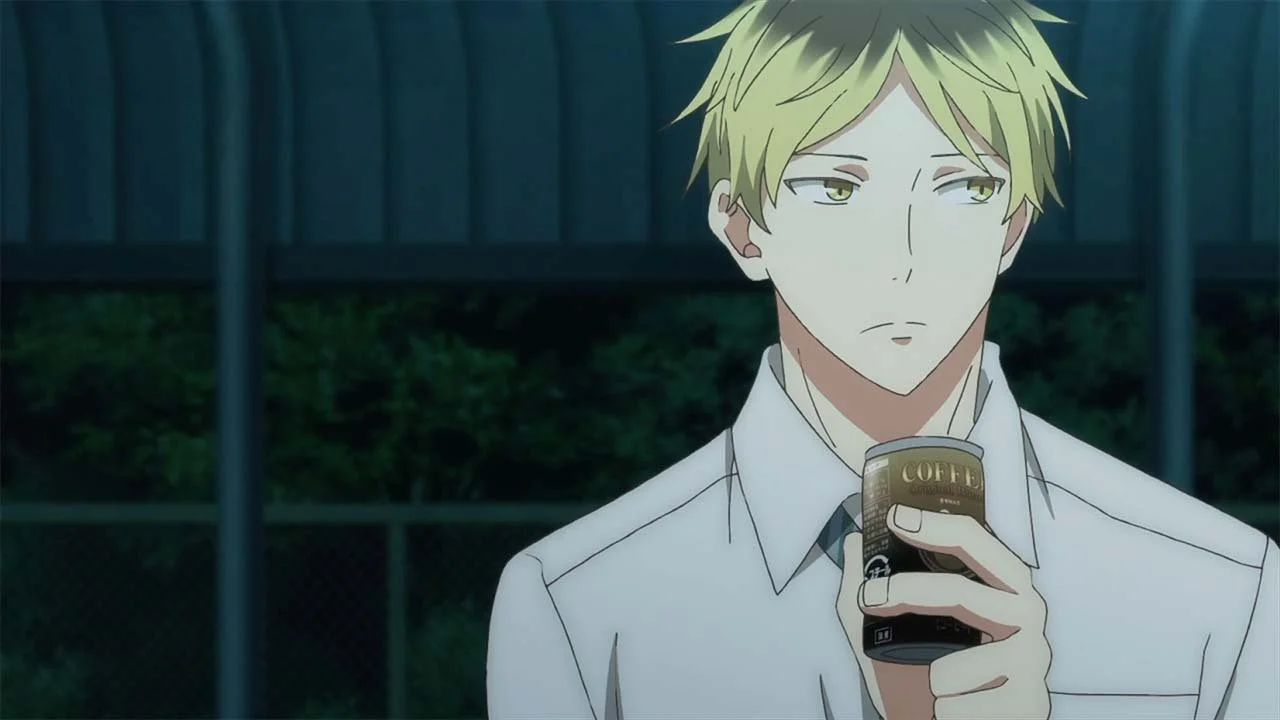
The next day, Hiragi came by Mafuyu’s place. Despite the scuffle a few days ago, with Hiragi suggesting Mafuyu should let go of his trauma — as if Hiragi didn’t lose a friend in Yuki also — Mafuyu allows himself to get close to Hiragi again; the first time Mafuyu does so after Yuki’s death. Whether the heart-to-heart they had can be considered a means to amend their relationship, I can’t say. Also, I don’t believe Mafuyu forgives Hiragi, despite the latter wanting his forgiveness — but for what, though? Couples have issues, and they should resolve them on their own. There’s no space for a third person, even if that person is a friend.
The night of the live show, Mafuyu told his bandmates he hadn’t finished the lyrics after all. I think he did, but couldn’t bring himself to sing it. Until he went up on stage, and by the first verse, he sang his story, which took place one winter. Sang his pain and misery away for anyone who would listen. Sang so that anyone can understand how it feels, even if a little bit.
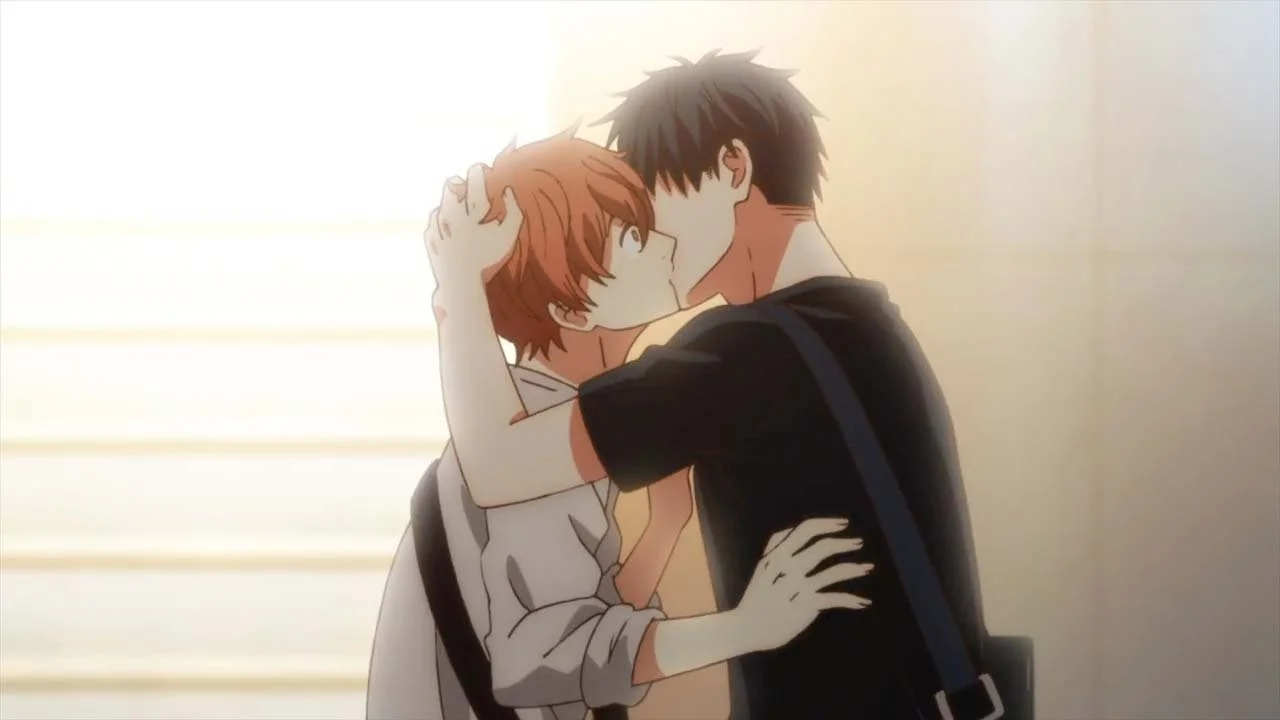
His bandmates were shocked, but the show must go on. Singing about such a sensitive topic to him was taxing, and by the end of Fuyu no Hanashi, he was utterly exhausted. Ue walked Mafuyu backstage, and when he was about to express his deepest gratitude, Ue kissed him.
A comment on the series’s use of computer-generated animation, CG for short: it’s scattered across the anime, but it’s heavily featured on the live performance. Given how time-consuming animating every cut is, it’s not feasible to do so hand-drawn any longer when tools exist to make the work faster and easier. I’ll tip my hat to Studio Lerche for achieving something I rarely see in CG cuts: fluidity. TV shows run at an average of 24 frames per second; TV anime is no different. And still, the CG cuts appear to run at that same frame rate instead of looking like the computer struggled to achieve, at most, 20 frames. You can tell which cuts are CG if you’re paying attention, but they blend in — by and large, most use of CG in anime from a certain period stands out because of how uncanny it looks, but Given is not one of those.
I’d be remiss not to make a note on the music. Centimillimental gave an interview to Animate Times in which, among the various topics, he spoke about how he was offered Given — I was surprised to learn this is his first work! Now I’m not a musician, so I can’t do a technical breakdown of the music. I can speak to the themes and whether it’s suitable for what’s being communicated. Starting with Kizuato, one of the few anime openings I don’t skip. It’s written from Mafuyu’s point of view: how he repressed his feelings towards Yuki’s death, and how “whatever he left behind became his everything.” It sets the stage for what’s to come, and after the viewer learns of Yuki’s fate, they’ll see the parallels. Having heard Fuyu no Hanashi, I want a given version of it.
Moving to Fuyu no Hanashi, again, written as a self-insert for Mafuyu’s grieving, is nothing short of powerful. The song represents the much-needed closure he seeks after Yuki’s death, finally being able to communicate how he feels. It’ll sound alien to anyone who doesn’t know Mafuyu, and it’s okay; perhaps this is what he wanted, for people who don’t know him to understand the pain, even if the relation of the lyrics to him isn’t immediate. It’s beautiful and cathartic at the same time — that yell Mafuyu does at the end of the second verse? It still gives me the chills.
By the end of the anime’s run, the band renames itself to “given” and Mafuyu and Ue start dating.
given the movie (2020)
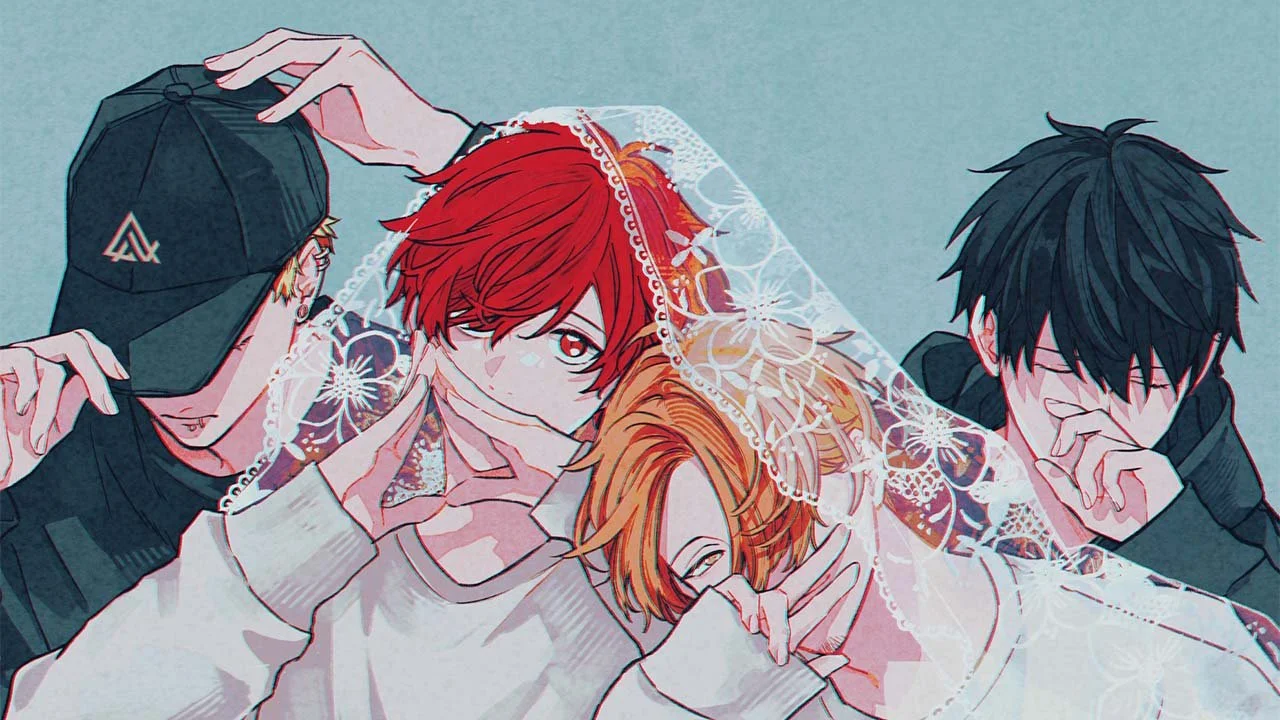
The story in Given is structured around character arcs; oftentimes, the character the arc is about ends up dating their love interest. The TV anime focused on Mafuyu Sato and Ritsuka Uenoyama (Ue). The first movie is about Haruki Nakayama and Akihiko Kaji… plus one passionate, if ambivalent, violinist.
After making his debut on the indie scene, Mafuyu goes into writer’s block. Fuyu no Hanashi was deeply personal, a ‘lightning in a bottle’ kind of moment. With hardly a background in songwriting, he has nothing to draw inspiration from. He asks Akihiko, his bandmate, for help in exposing him to different musical genres. Akihiko’s preparation is classical first, but outside the drums, he knows how to play bass and guitar — surely, a man with that skillset must’ve heard a lot of records. I’d argue Ue has almost as broad a taste as Akihiko, but perhaps Mafuyu thought he already troubled Ue enough with the guitar lessons.
Akihiko takes Mafuyu to a violin concerto featuring Ugetsu Murata, Akihiko's roommate & on-again, off-again boyfriend, in which he performs Tchaikovsky's Violin Concerto in D Major. Mafuyu resonated with Ugetsu’s playing, whereas Akihiko looked at his counterpart on the stage with envy: exquisite technique, breath-taking emotional range, sensuality… Ugetsu had it all.
Like Ugetsu, Akihiko is a violin player and has been since he was young. One day in high school, Akihiko saw Ugetsu practicing, bearing witness to just how good he is. Whatever aspirations or confidence Akihiko had were utterly shattered, relegated to always being second best to the violin prodigy. He was both full of awe and hate towards the man who kept besting him. Mafuyu, ever observant, realized Akihiko and he are alike in their inability to let go.
One morning, Mafuyu drops by Akihiko’s, unannounced, to show him what he was working on. He was greeted by Ugetsu. Mafuyu was surprised: Akihiko never mentioned he was roommates with the violinist he just saw yesterday; nonetheless, he accepted the invitation to come in.
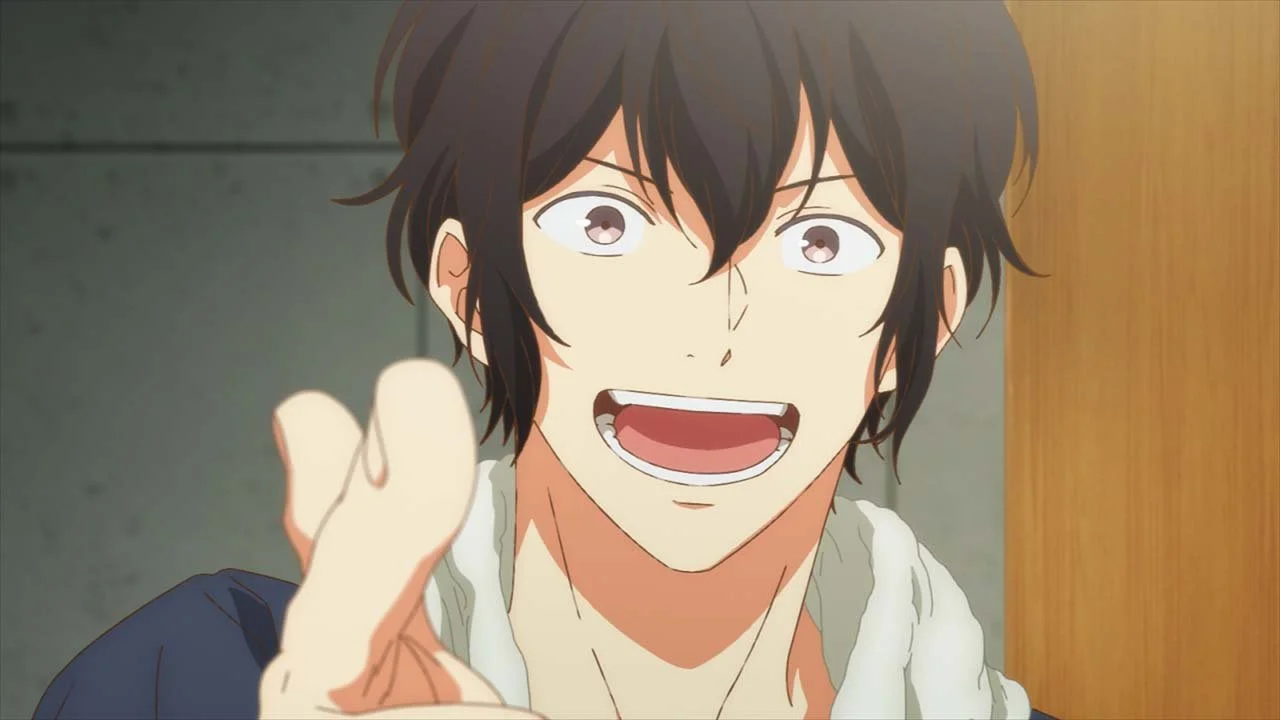
Mafuyu sought feedback, and Ugetsu obliged while Akihiko fights with his pillow — after all, Ugetsu’s interested in the budding musician ever since he first saw Mafuyu’s singing. Just from one listen, Ugetsu mercilessly picks apart what was wrong with Mafuyu’s draft and notices how he filled in chords, likely because he wasn’t sure where he wanted to go with it. The prodigious mind is a scary thing… unfortunately, Akihiko had plans with Haruki, so he couldn’t stay for the session. Mafuyu could keep Ugetsu company if he wanted. Meanwhile, Haruki is hung up on the fact that Akihiko has a roommate — wait until he hears that, of all people, it’s his ex…
Akihiko regards Mafuyu and Ue as geniuses. Haruki, thinking Akihiko was putting himself down, praises how he’s a jack-of-all-trades, which is not something that just anyone does in any sort of acceptable measure. As Haruki puts himself down as being the average type — and to return the compliment — Akihiko commends Haruki as the peacemaker of the group.
As I wrote my draft, I went off the manga, and as the anime follows the manga closely, I believed the movies took the same approach. This next part, which gives context on how Akihiko first met Ugetsu, appears to be manga-only. This rearranging and/or omission of events is a constant throughout this film, and yields mixed results. I get the reason why: if I look at this from the perspective of the director or even series composition, it’s all for the benefit of the story arc being covered, keeping it as focused as possible. If only I had noticed earlier, I would’ve saved up so much time…
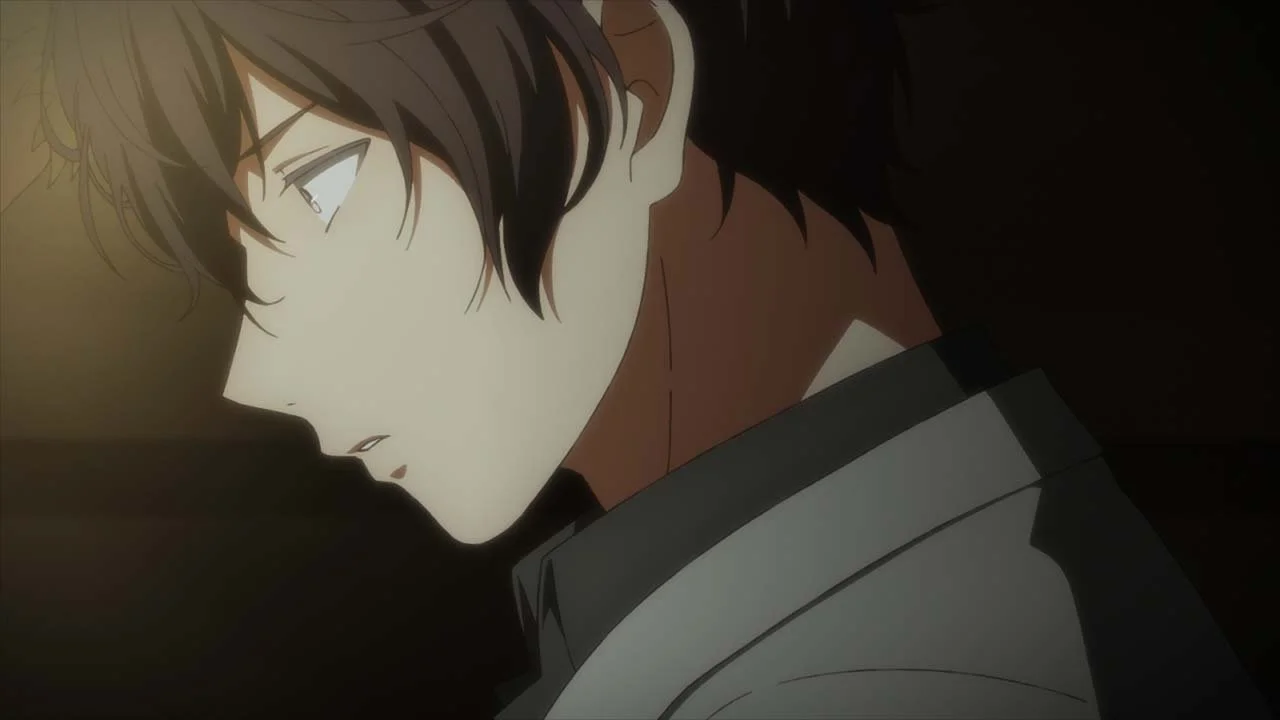
To illustrate one instance of this going wrong: how, exactly, was Ugetsu’s point of view more important than Akihiko’s? His not wanting to speak of this aspect of his life with Haruki is understandable, but internal monologues exist — in fact, one was used at the violin concerto to set the tone of Akihiko and Ugetsu’s relationship. The one way this makes sense is if Mafuyu is the audience surrogate: he’s the primary character, so secondary characters that are around him are in proximity to his spotlight. I’m okay with that, but… isn’t this film supposed to focus on Akihiko & Haruki? Why use Mafuyu as your narrative crutch? Why show one side, but not the other, just because Mafuyu was there?
Akihiko reminisces about his efforts to be the top violinist in Japan and how Ugetsu consistently beat him to first place. His overwhelming skill was enough for Akihiko to give up the violin, yet he noticed sadness every time Ugetsu swung his bow, exacerbated by how strongly he felt emotions compared to most. Akihiko wanted to ‘fix’ him, but Ugetsu began hating how his sound wasn’t the same when he was around Akihiko.
Ugetsu admits he fell in love with Akihiko. It wasn’t until the violinist debuted as a professional musician that he figured out how they’d both driven themselves into a corner. Not only was his ‘sound’ not the same, but he was acutely aware of how his presence torments his lover. Ugetsu calls off the relationship, and for two years, they constantly fought, only to make up later. Ugetsu both longs for the day Akihiko finally leaves, while also dreads it — he still has feelings for him.
I’ll briefly highlight the OVA, ‘given - on the other hand’, for this next part. Mafuyu and Ue are stuck taking remedial classes at school; they won’t get to their senior year, otherwise. Ue is miffed by Mafuyu spending ever-increasing time with Akihiko, which led to their first fight. I’ll let the clip below speak to that event:
Mafuyu’s growth is evident here: he’s being careful with his words, as he doesn’t want to lose Ue the same way he lost Yuki…
Back to film territory: Akihiko is in a foul mood after being kicked out of Ugetsu’s for the night. He was with a woman, so he wouldn’t attend a get-together that Haruki expected him to attend, fighting with Haruki when asked where he was. Haruki’s friend, Koji Yatake, proposes that Haruki play a supporting gig for none other than Haruki’s ex, noting he may need a break from Akihiko to get back his passion for music. Despite feeling guilty about it, he accepts the gig out of courtesy.
Over at the studio, Mafuyu is brainstorming with Ue when Haruki walks in. They ask for his feedback as they play what they have so far of the song. Haruki feels intimidated: “When did Mafuyu get this good?” he wonders as he listens followed by Ue’s composing. Haruki was already feeling guilty for taking the side gig, but as Ue proposes not doing live shows until they finish the song, he felt guiltier; just as he was having fun playing for the other band, there was a real opportunity to feel similarly with his band. It’s heartbreaking to see Haruki crumbling to pieces. I can relate to the feeling of not being in control of your thoughts and putting yourself down — I still do so, even to this day.
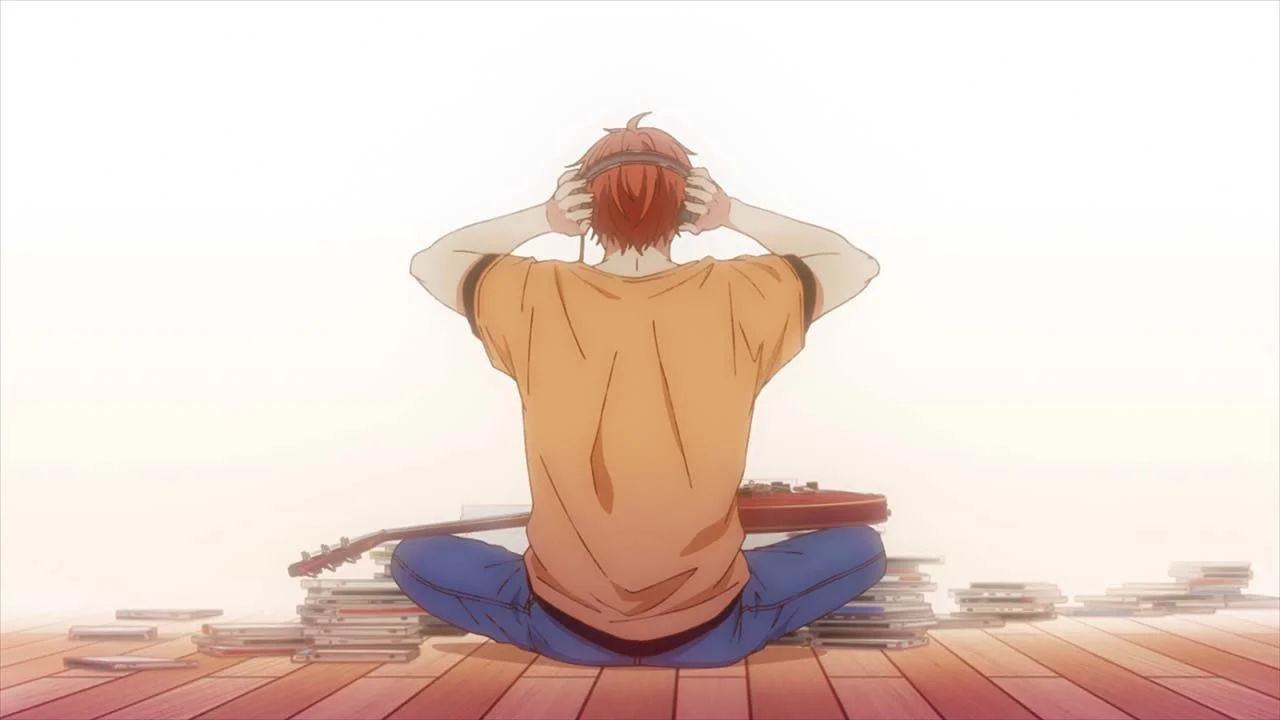
To make matters worse, Akihiko shows up after dark, unannounced, asking if he can crash over at his place after a fight with Ugetsu. Haruki lets Akihiko in and briefs him on what happened during the session. Akihiko senses that Haruki is hiding something and asks in a demanding manner — when Akihiko starts getting rough, Haruki tells him about the side gig, and that it's none of his business. In response, Akihiko casually drops the bomb that he knew about Haruki's crush on him all this time. Akihiko felt Haruki was running away by accepting the side gig.
Some time into the foreplay, Akihiko realizes that what he’s doing with Haruki is not out of love, but out of a desire to get back at Ugetsu. He’s reduced to a crying mess after that realization and stops. “Even if I told you, there’s nothing you can do about it,” Akihiko tells Haruki as he fights through his tears, whereas Haruki cries seeing Akihiko’s pained expression. Haruki agrees to Akihiko staying the night, but Haruki will sleep somewhere else — and wants Akihiko out by morning.
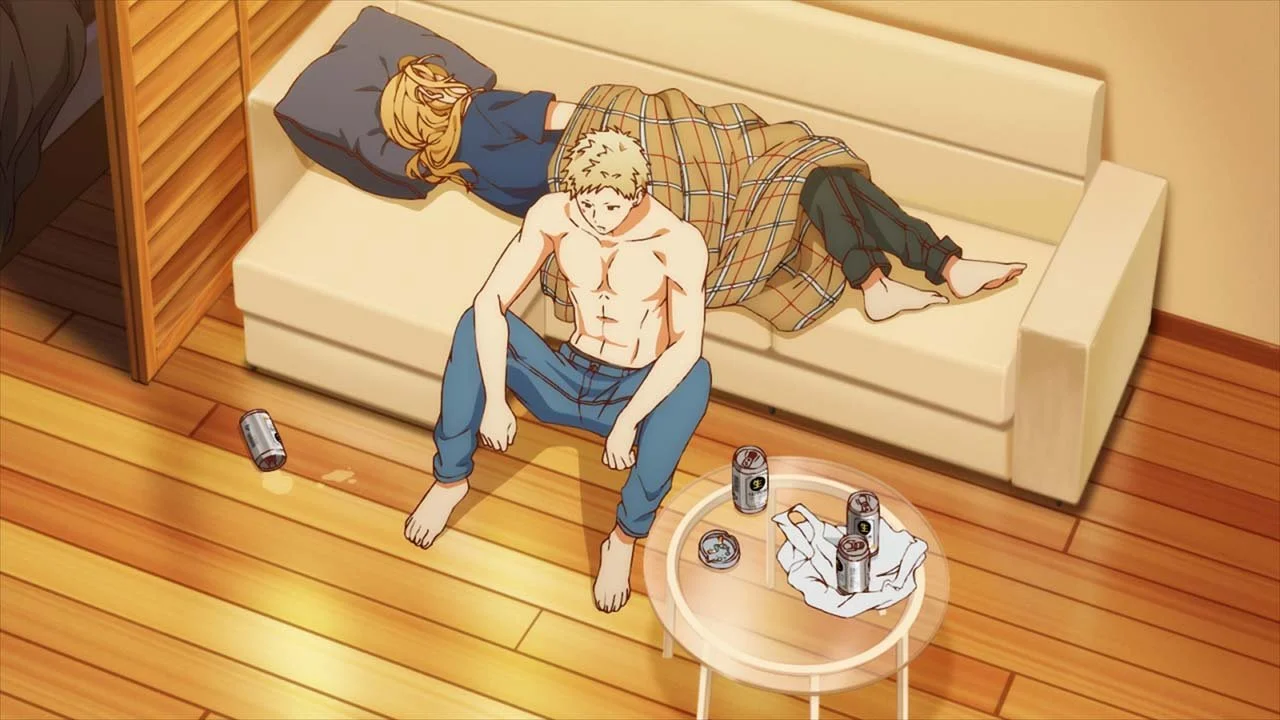
In this past sequence, Ugetsu and Akihiko’s relationship is revealed to be very dysfunctional. Quite frankly, what gets me is not the non-consensual act with Haruki, but Akihiko unveiling himself as the co-dependent one. I’m reminded of a friend-with-benefits that, whenever he wants something — whether it’s ordering something online, giving him a lift, or coming over to hook up — he wants it now, and it often puts me off. The result is that I’m not always willing to comply, which greatly upsets him, and he refuses to speak to me for days. I can tolerate this to a certain extent, but I’ve recently been of the mindset that his hot-and-cold personality is aggravating. As much as the sex may get me up on cloud nine, I don’t need him as much as he needs me.
Through that lens, I think I can understand a little how Ugetsu feels towards Akihiko, and I’m still confused. I don’t deliberately hurt my friend as he does — should I be reading ‘Ugetsu trying to move on from Akihiko’ as him setting boundaries instead? This is where I think Ugetsu’s conflation between love and pity stems from: he may say he loves him, but his actions speak a wholly different story. It feels as if I’m missing a piece of the puzzle that I can’t tie to a lived experience…
Akihiko never left, despite Haruki explicitly asking him to, walking a tightrope that could spell the end of given. Haruki came back the night after with a haircut, still brooding over the incident, and he wasn't happy to see Akihiko still at his place.
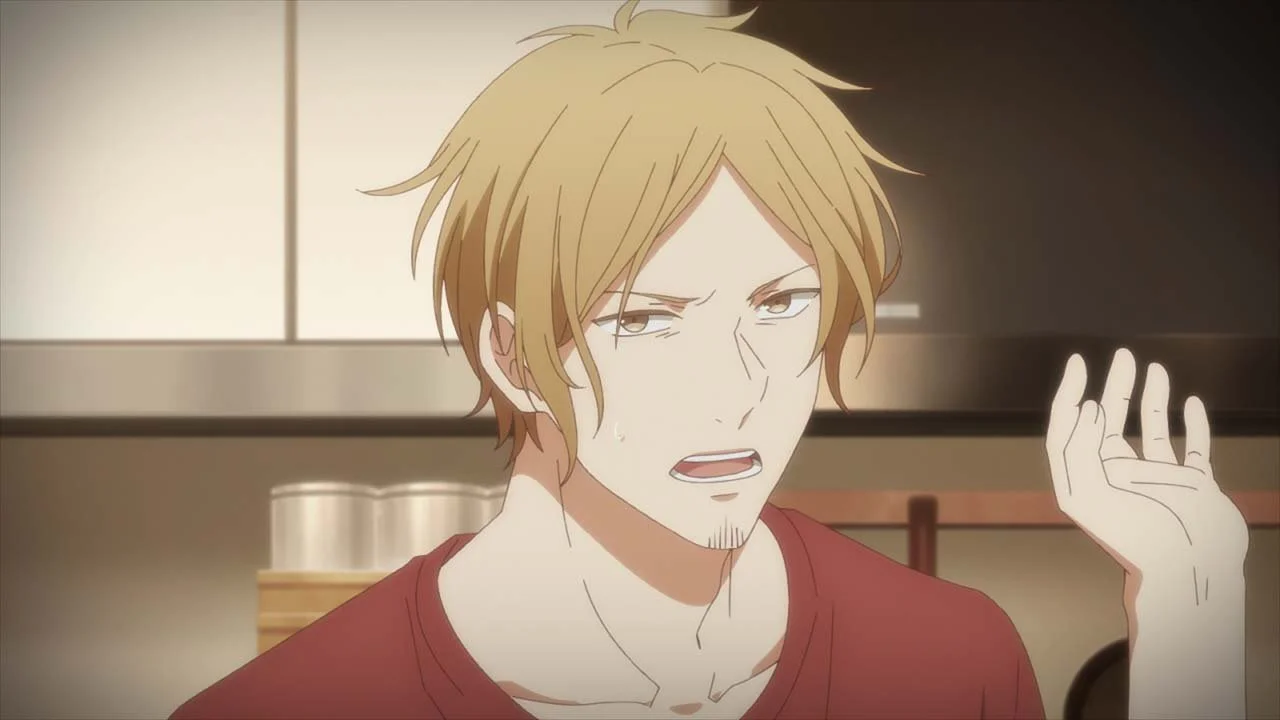
As Haruki throws out Akihiko again, he levels with him: he can't go back to Ugetsu's house. Desperately needing a place to stay, he offers to be Haruki's ‘chore boy’ if that's what it takes. Akihiko went from ‘you can't help me’ to ‘please help me.’ Had Haruki heard those words sooner, he wouldn't be this upset; nevertheless, he agrees, deepening his existing inferiority complex.
This conflict is reflected in the bass-drum coordination: when Haruki was upset at Akihiko, the bass went off-sync, grabbing Ue’s attention. Walking home after the session, Haruki breaks down and admits his feelings of inferiority to Akihiko. Baffled, he responds: “A band would never work out with four geniuses.” Suddenly, it all made sense — after being constantly reminded how the role of a supporter is necessary, it didn’t click until this disastrous session. Haruki begins warming up to Akihiko — eventually, the bass and drums are in sync, which Mafuyu notices.
One night, as they watch the Obon fireworks show, Akihiko opens up to Haruki. He spoke about the situation with his roommate, never once saying his roommate was Ugetsu. Everything we already know, Haruki is only finding out. Akihiko seemed ready to put that relationship behind him, realizing how much chasing Ugetsu hurts. Confiding in Haruki meant Akihiko lowered his defenses — what Haruki wanted to begin with.
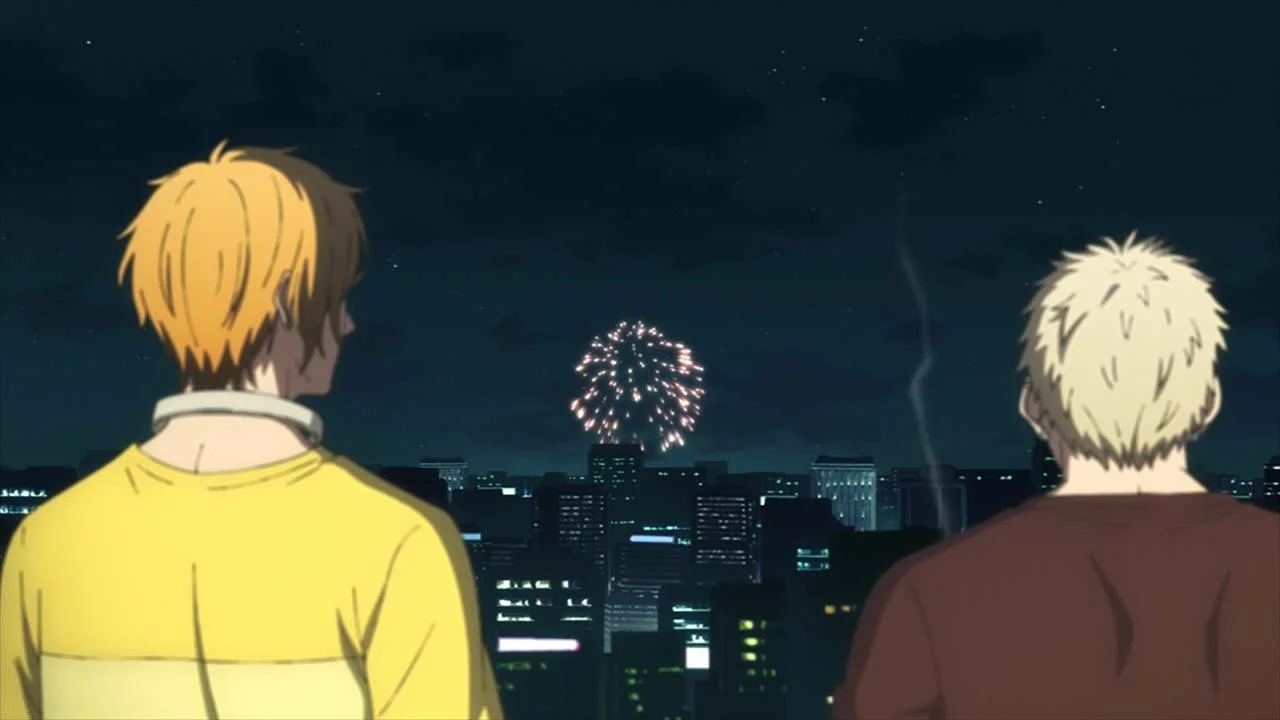
The Obon festival scene is much longer: there was a whole scene of Mafuyu meeting up with Ue that was omitted. Also, a whole scene of Mafuyu staying over at Ue’s when their jam session ran late. For this last one, it was better for Mafuyu to stay the night since Ue’s place was closer to school than his.
Earlier, I mentioned how the rearrangement/omission of events yields mixed results, alongside an example of it going wrong: these two scenes are examples of omissions that work in the film’s favor. I’m reluctant to refer to these as ‘cuts,’ as they made the OVA.
A plot point that would come much later was rearranged into an earlier sequence in the film, as the scene where it happens was omitted. That late session? Ue and Mafuyu walking home don’t talk about how the latter is on the verge of a lyric-writing breakthrough, but about staying over at Ue’s place. There were additional cuts made, but done so to fit a runtime; none are notable enough to highlight.
As Mafuyu is on the verge of finishing the lyrics, he felt a piece of the puzzle was missing. He sought aid from the same person who gave him his motif: Ugetsu. Watching him practice and talking with him after, Mafuyu found what he was seeking. Fast forward to the day of the competition, he, Ue, and Haruki went to see day one of the Countdown Fest Amateur Contest (CAC), which they’d entered as given. Akihiko had someplace he needed to be — it’s time to close his chapter with Ugetsu.
After the show, Haruki headed back to his place, pondering Mafuyu’s skepticism about him not having feelings for Akihiko. Sure, Haruki couldn’t just pretend he got over him, but in his eyes, Akihiko wasn’t interested. After being chewed out by Ugetsu, Akihiko waited by Haruki’s apartment, even though he had a key to the place. It would seem Akihiko began developing feelings for Haruki as he asked — or rather, pleaded — him not to go when Haruki needed to buy a lighter.
Day two of the competition, and given is set to take the stage. Mafuyu’s second song, Yoru wa akeru, felt tailor-made for Akihiko and Ugetsu: the only way the enigmatic singer could tell them that greener pastures lay ahead if they moved on was through music. Akihiko felt chills listening to it, his hands moving on autopilot. Ugetsu immediately caught how the song was about them — after all, he told Mafuyu he could use their predicament as inspiration. Ever the sharp individual, Ugetsu pegs Haruki as Akihiko’s new love interest, though how he reaches that conclusion is unknown.
After the show, Akihiko ran after Ugetsu to tie up loose ends. Contrary to what he suggested during their last encounter, Akihiko would still play violin. Even if he has fun playing drums, the music remains. That doesn’t mean his resolve waned — he was going to leave Ugetsu, and apologized for all the hurt over the years. Akihiko’s hand let go of Ugetsu’s, and reality sank in for him. As he reached towards a departing Akihiko with tearful eyes, looking just about ready to break, a flashback of Mafuyu came to his mind: “It’ll be okay. Everything will be all right.”
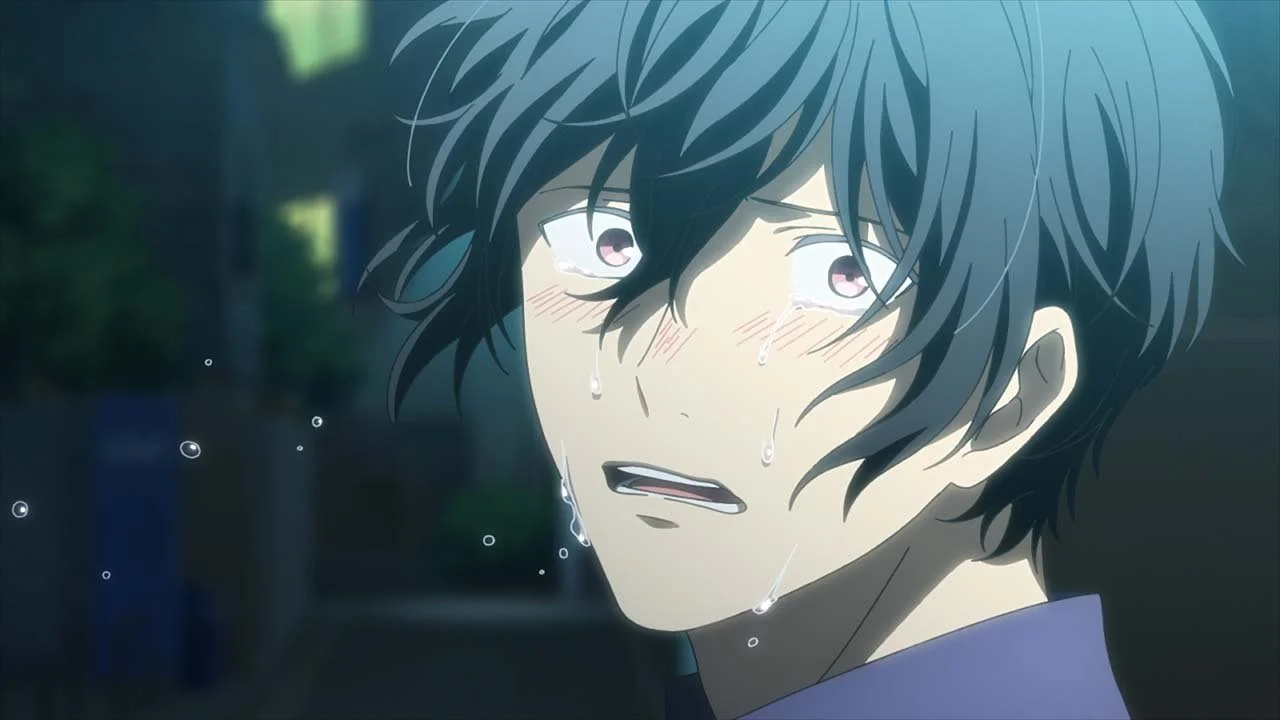
On Ugetsu Murata, one thing I found curious from his character data file, as portrayed in the manga, is how a soft rock song inspired him to get into music. How do we get to classical from there? He’d reminisce about listening to Paul Simon’s “Still Crazy After All These Years,” calling it a beautiful moment, and how he’d be okay to die after being exposed to it. He’d chase that feeling ever since — “I hope that, at least, the music remains,” huh.
His description as a ‘prodigy’ irks me, not because the title doesn’t fit, but because it speaks to something insidious about society as a whole. It’s the ‘gifted kid’ thing all over again: I applied it to Ue in the TV anime and now to Ugetsu in the first movie. I have no reason to think Ugetsu hasn’t put in the work to be the violin master he is, despite numbered sequences of him practicing. But hey, he’s a ‘gifted kid,’ who got out of bed, picked up the violin, and won prizes all over, right?
He’s a man of contradictions: his fights with Akihiko only to welcome him back under his roof is the one many will catch, but there are subtle ones as well. When Mafuyu visited Ugetsu the second time, he believed he was looking for Akihiko, which prompted a glare that felt like a thousand daggers. When Mafuyu clarified how it was to see him practice, his demeanor rapidly changed: “(You’re looking for) me?”
Another, on the cut segment on how Akihiko fell for Ugetsu: the violinist was practicing, his emotional display so raw that Akihiko embraced him, both out of jealousy and pity. Ugetsu was overwhelmed at the sudden display of affection, hesitating to return the hug before finally doing so.
On the first example, “I’m not worthy of attention.” On the second, “I’m not worthy of affection.” Ugetsu definitely carries some degree of trauma, resulting in these feelings of inferiority amidst ones in which he’s extremely sure of himself. Once again, I reject his labelling as ‘toxic’ by very much the same argument I’ve made in the past — Ugetsu is anything but a flat character.
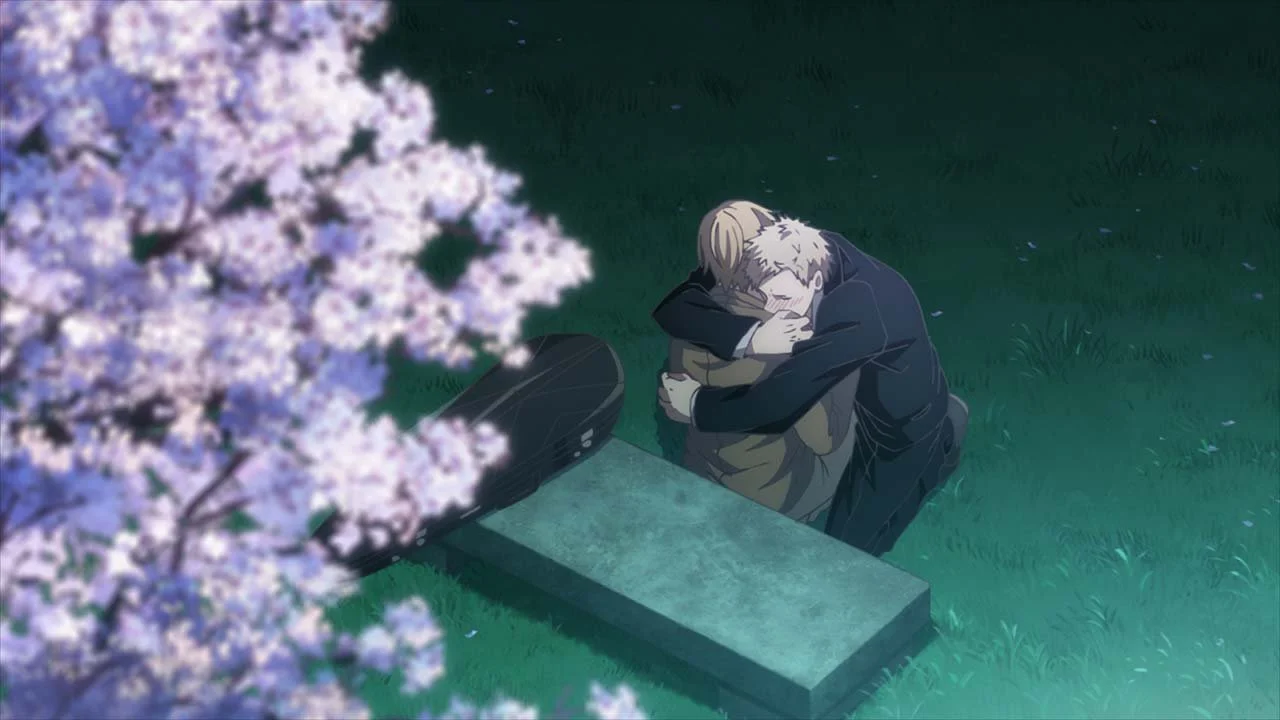
Akihiko moved out of Haruki’s place, started taking music more seriously, and even returned to school regularly. To prove he wasn’t all talk, he entered a violin competition, not out of spite for Ugetsu — who was among the judges — but for himself. Haruki was deeply moved: was this raw passion sleeping deep within Akihiko? Feeling overwhelmed, Haruki steps out, only for Akihiko to catch him by the riverbed.
All of these changes... Haruki caught up on the fact that Ugetsu was the one Akihiko fell for, so it made sense that maybe Akihiko was still chasing Ugetsu. Haruki had it all wrong, though; all of this was to become worthy of Haruki’s love.
A quick note: there’s a short, vocal-only version of Yoru wa akeru in the OVA. It’s a shame that this version isn't available outside of it. I would love for it to be released, or at the very least, an acoustic version of the song to be made available.
given the Movie: Hiragi Mix (2024)
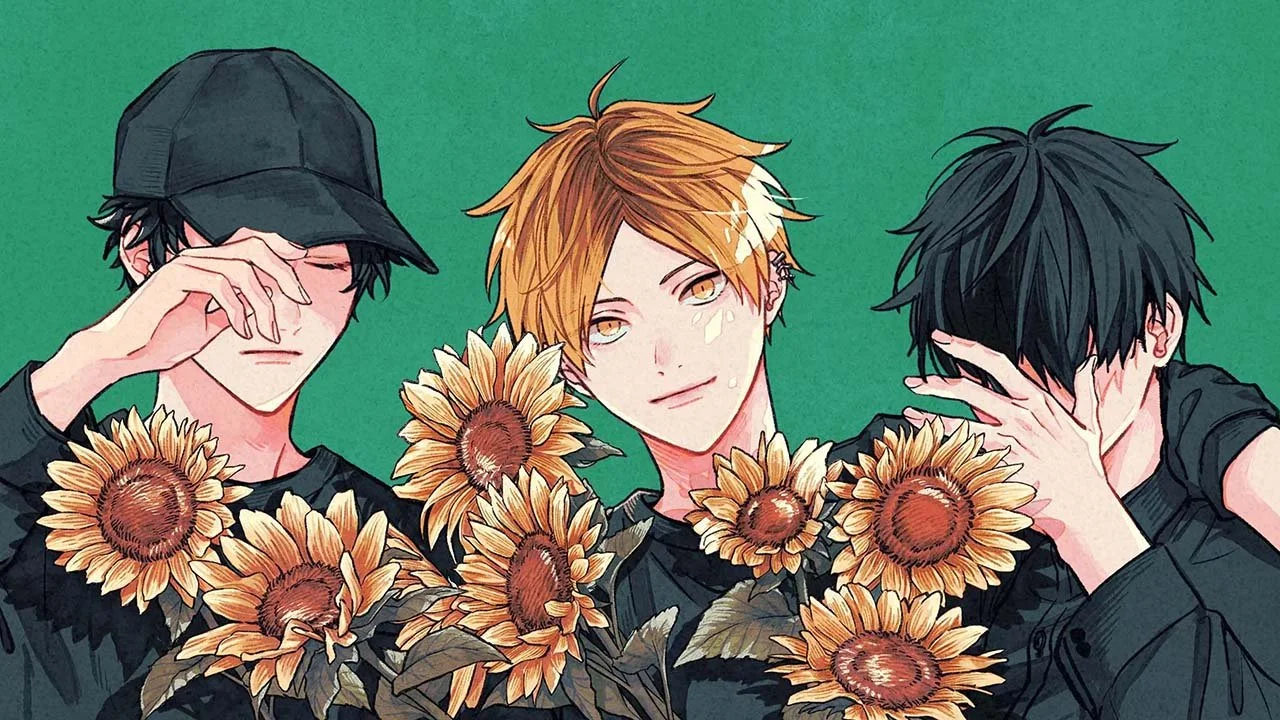
The given couples have formed, but what about the childhood friends? This is the story of Hiragi Kashima and Shizusumi Yagi.
Hiragi Mix & To The Sea are all one big film, originally released in parts in their home country. While they function as a single narrative, Western distribution marketed them as separate entries — Given films 2 and 3 — rather than as parts of one larger work. While both movies cover the same arc, the eponymous movie covers chapters one through twelve, whereas the final movie covers chapters thirteen through twenty.
Hiragi, a student at a different high school, shows up at Mafuyu's school, walking through the hallways like he's a man on a mission; he’s followed right behind by Shizusumi (Shizu). They’re looking for Uenoyama (Ue), and the matter’s serious enough for the duo to be there in person instead of, say, calling Mafuyu and asking him to make the connection. Fast forward to the afternoon, and they’re at the syh studio. Ue argues with Hiragi over a missed note, all while an uninterested Shizu toys around on the phone. Somehow, Hiragi starts bragging about how long his friendship with Mafuyu is, and this is relevant over a missed note, how…? It seems as if Hiragi dislikes Ue only because he’s dating his friend.
Hiragi hates how Ue acts like he’s God’s gift to the world.
Ue hates how Hiragi thinks only about himself.
Like repels like.
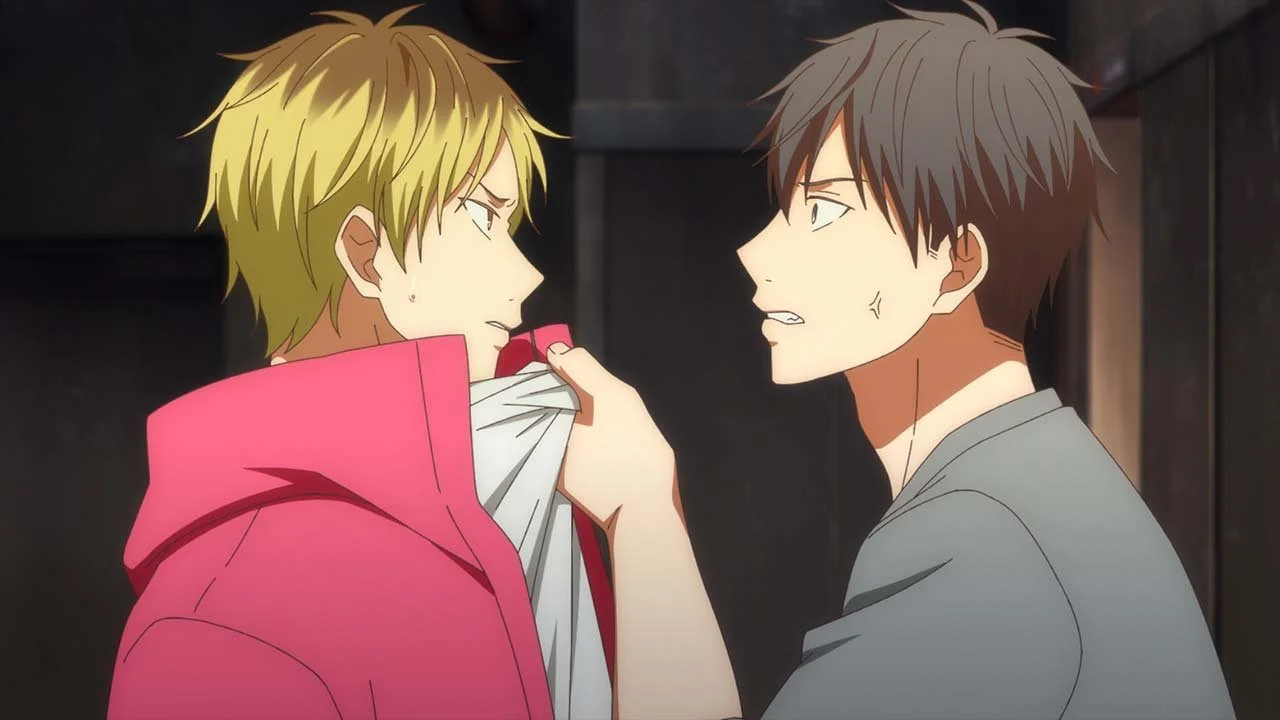
“Why did you agree to play with Hiragi’s band?” Mafuyu asks. Ue was impressed by Hiragi ever since he saw him play at the Countdown Fest Amateur Contest (CAC). syh beat every band, including given, to CAC’s top prize: a record deal. Unfortunately, their guitarist quit, and Hiragi wanted Ue until a suitable replacement was brought on board. Ue struggles to understand how Hiragi, the same guy who mocked him when they first met, wants him for syh, but when your playing skills net you a compliment from the lead of the winning band, does it matter? Not only that, Hiragi sought out Ue specifically to ‘try something’ with him.
After filming the MV for Straight, Ue runs across Haruki, who was on the guest list. Ue admits being jealous of Hiragi; even if Ue has fun playing for them, he wants his rise to fame to be with given. Haruki casually mentions how he got an offer from a producer he met at CAC, and Ue’s reaction picks Hiragi’s attention. He encourages them to seize the opportunity — when asked if he felt conflicted when a similar offer was presented to them, Hiragi answered that he didn’t.
One reading of this past interaction is as a foreshadowing of the contrast between Hiragi and Mafuyu. Ue, even as he felt his stomach turning, was ecstatic about the opportunity. When approached about the offer, Mafuyu wasn’t into it, choosing instead to “think about it later.”
Hiragi’s characterization gives me whiplash. When we first met him, he seemed shocked when he ran across Mafuyu in the street, who had dropped off the face of the Earth after his lover’s death. As Hiragi tries to make amends with Mafuyu, he first dismisses his grief, only to later monologue about wanting forgiveness. While he craves absolution from anyone, it's Mafuyu's forgiveness he wants most — something he never actually tells him. And now, he’s acting like a total brat?
I shouldn’t be shocked: the brief Hiragi/Mafuyu interactions on the TV anime hint at this behavior, but I chalked those up to how comfortable they felt around each other. Now, as Hiragi argues with Ue over petty stuff, it’s suggested he feels a duty to protect Mafuyu from… what, exactly? I lose track trying to understand their dynamic, and even more so trying to nail down what drives him. The story offers an explanation, but I’ll come back to this.
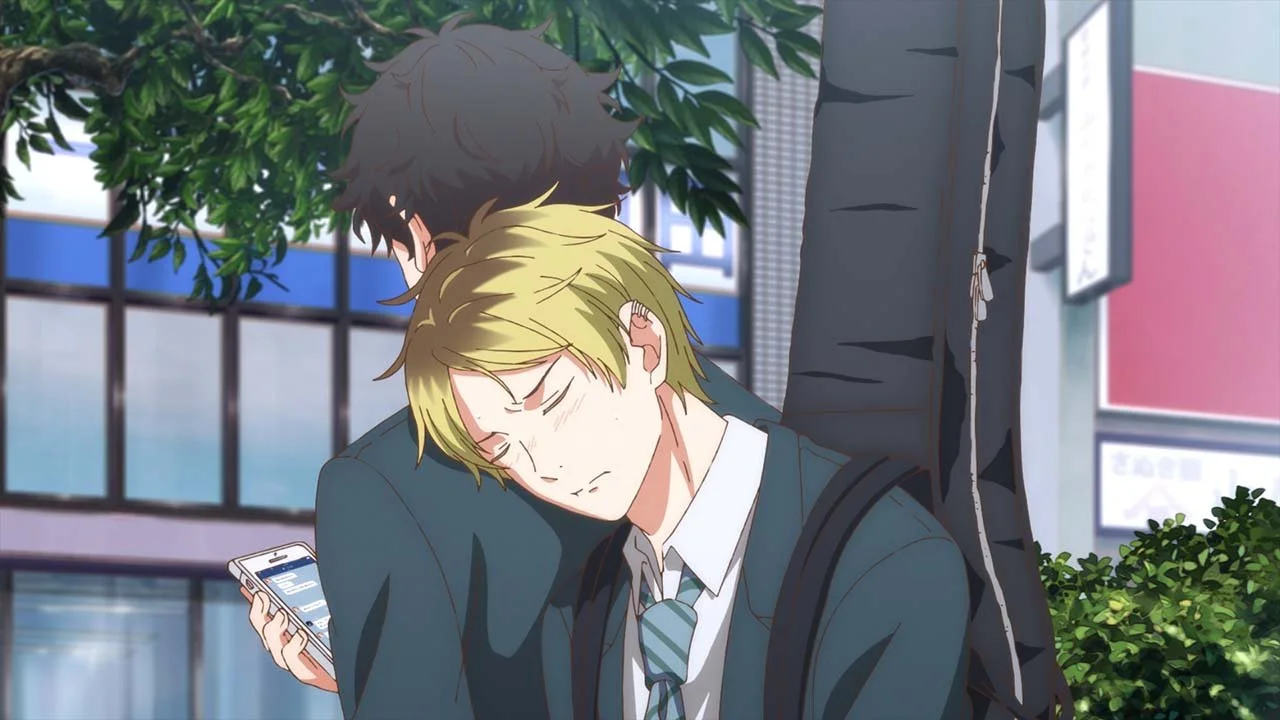
Hiragi’s passion for music isn’t entirely altruistic. Part of why he revived syh is to keep Shizu, the guy he likes, around. He’s gone along with whatever Hiragi wants ever since they were kids, despite looking uninterested. More importantly, when grief-overwhelmed Mafuyu cut contact with his old friends, Hiragi acutely felt this. He needed a shoulder to cry on, and Shizu was there to comfort him.
When Ue mentioned Mafuyu’s response to going pro to the syh boys, all gathered at a fast food place, Hiragi laughed at Ue’s expense — he really cannot help himself. The duo then explains how Mafuyu’s always been the type to think things over and not talk with anyone, as he’s afraid of making a mistake. Getting schooled by the childhood friends.
As they take the afternoon off from practice, which Ue wasn’t informed of, Hiragi lays his intentions bare, sharing a demo of an unfinished song the late Yuki Yoshida was working on. The new front wants to finish this, as he feels they wouldn’t be able to play Yuki’s songs once they got an official guitarist. But what does Ue have to do with this? Perhaps the duo trusts Ue because their childhood friend Mafuyu does. Being entrusted with something this personal, I shouldn’t have any reason to doubt their intentions, and yet I do. It’s one thing to appreciate Ue’s playing skills, but you’re asking Mafuyu’s current lover to play his ex’s songs…
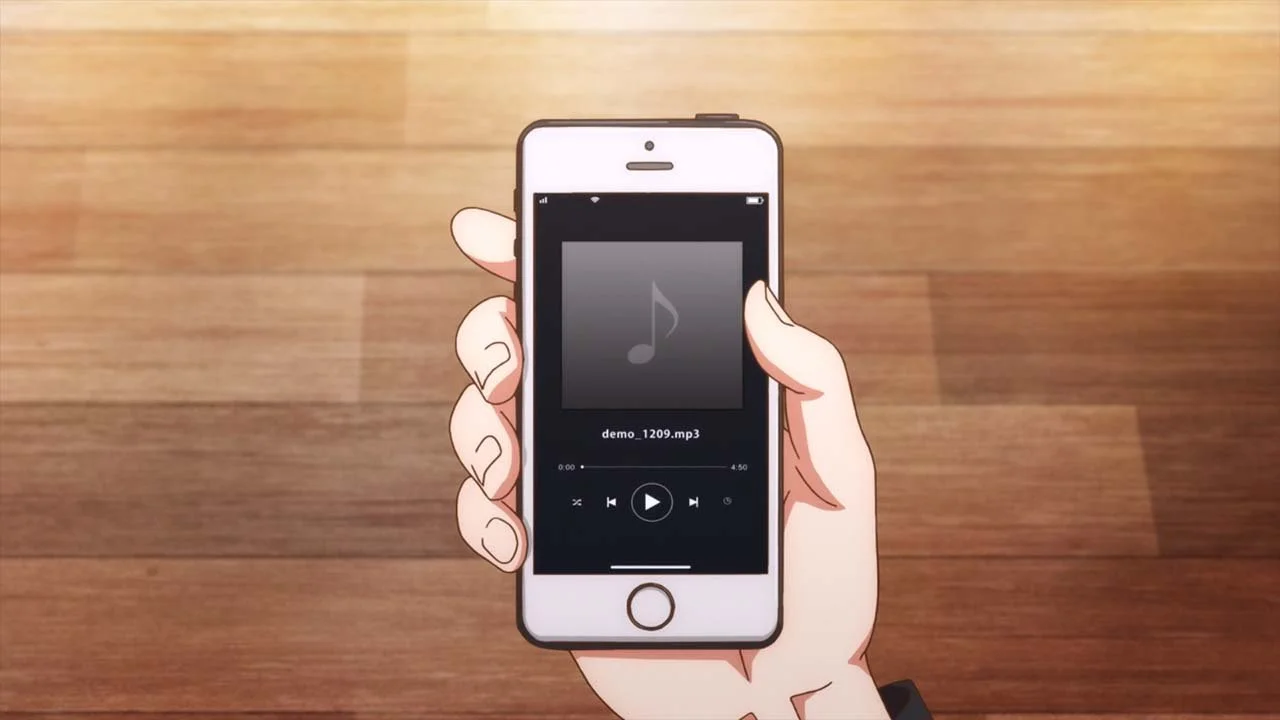
Questioning why Hiragi didn’t finish this song, and equating Yuki’s singing skills with Hiragi’s — for which Ue got chewed out — he listens to the demo on the ride home with low expectations; he was blown away. In that moment, he understood why Hiragi mentioned he didn’t feel capable of doing that song justice.
Mafuyu needed someone to talk through his anxiety about going pro. He confides in Shizu, asking to meet up late at night. Mafuyu admits having never thought of going pro, whereas Shizu tagged along when Hiragi declared so. “Because you love Hiragi?” Mafuyu confronts him, only for Shizu to drop the pleasantries: “You’re scared, aren’t you?” In that moment, as Shizu explains his devotion to Hiragi, he shows resentment towards the former couple. Having to watch their relationship from a distance, and not having that kind of relationship with Hiragi, Shizu’s bitter, scornful words aimed straight at the heart of the issue. Before leaving, he offers these words: “If you can’t commit to making your life with the band, or to Ue, then for your own good: drop out now.”
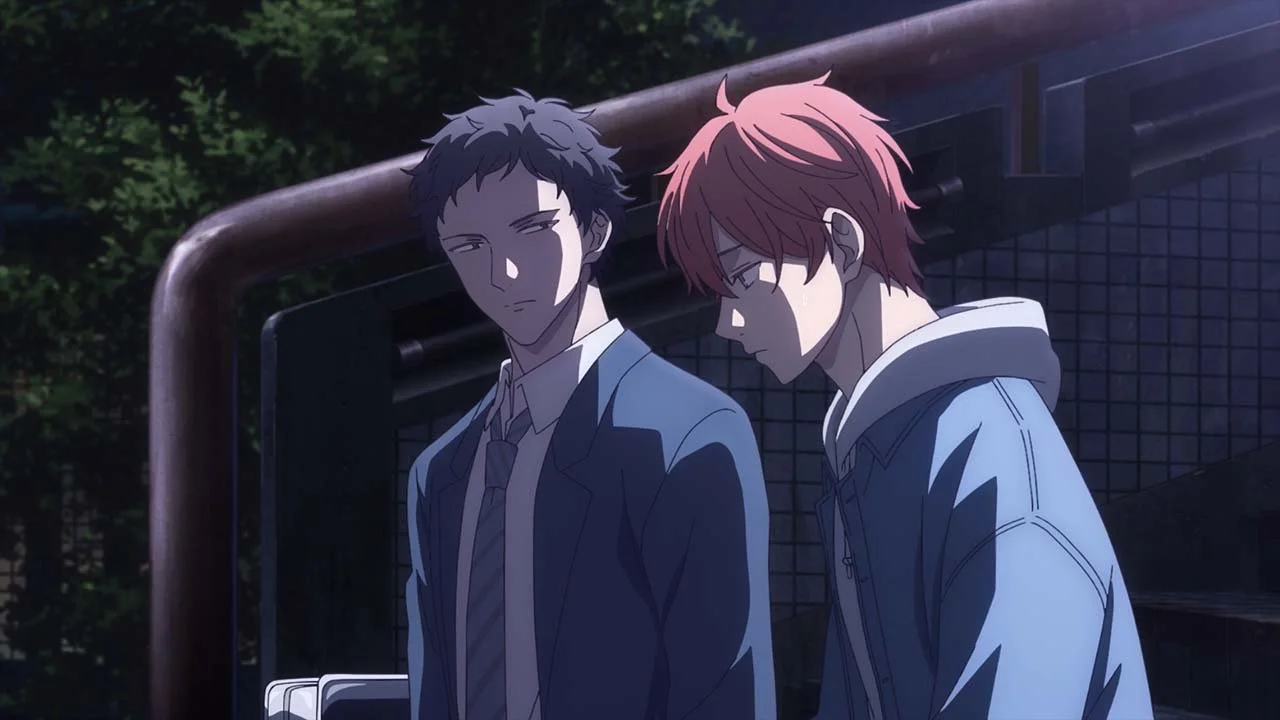
By this point, the story has already established how Hiragi’s resolve differs from Mafuyu’s. But in case there was any doubt, Shizu too is the total opposite of Mafuyu. His determination is only rivaled by the strength of Mafuyu's ambivalence. Given Hiragi's headstrong approach to continue the band, I must wonder if it stems from either his admiration for Yuki, his love for Shizu, or simply Shizu's personality rubbing off on him. Shizu could even be uncharitably read as a ‘yes man,’ but later events show he’s anything but.
I struggle with reading characters whose intentions are so direct that I wonder if there’s something I’m missing. As such, I find Shizu an even bigger enigma than Mafuyu. Going over his profile — and to get my thoughts in order: he’s a foster kid. Presumably, he was passed around until he landed with the family who lived in the same neighborhood as Yuki, Mafuyu, and Hiragi. Shizu appears to live on his own, which would take a perfect storm of events for that to happen, from what I’ve read of the Japanese foster care system. The omission of detail may be deliberate, then — the author’s intent to not complicate matters.
He describes his world as ‘filthy,’ making him cynical and emotionally numb, seeing in Hiragi a light amidst the darkness. There’s no doubt Shizu cares deeply for Hiragi, but did he feel this way ever since they first met? That random act of kindness in pre-school was all it took? On the other hand, his interest in Hiragi may simply be carnal: “I want to defile him,” he monologues on his way home, prompted by Mafuyu questioning what Hiragi means to him. I genuinely don’t know what to think. I don’t want to accept that Shizu is purely a what-you-see-is-what-you-get character.
Inspiration struck for Ue as he pulled an all-nighter writing a guitar tab for the demo. Eager to show Hiragi, he couldn’t wait until studio time, and went to his school instead. Hiragi was taken aback, thinking of Yuki as he heard it — it’s not Ue’s sound, and that’s on purpose. That night, Ue and his sister, Yayoi Uenoyama, speak about what he’s doing over dinner. Explaining his uneasiness, he ties it to something his sister understands: painting. Finishing someone else’s incomplete song is like finishing an incomplete painting — you could paint over it, but it loses all of the original artist’s meaning. Yayoi equates it to art restoration: “You have to understand this Yuki person better than anyone else.”
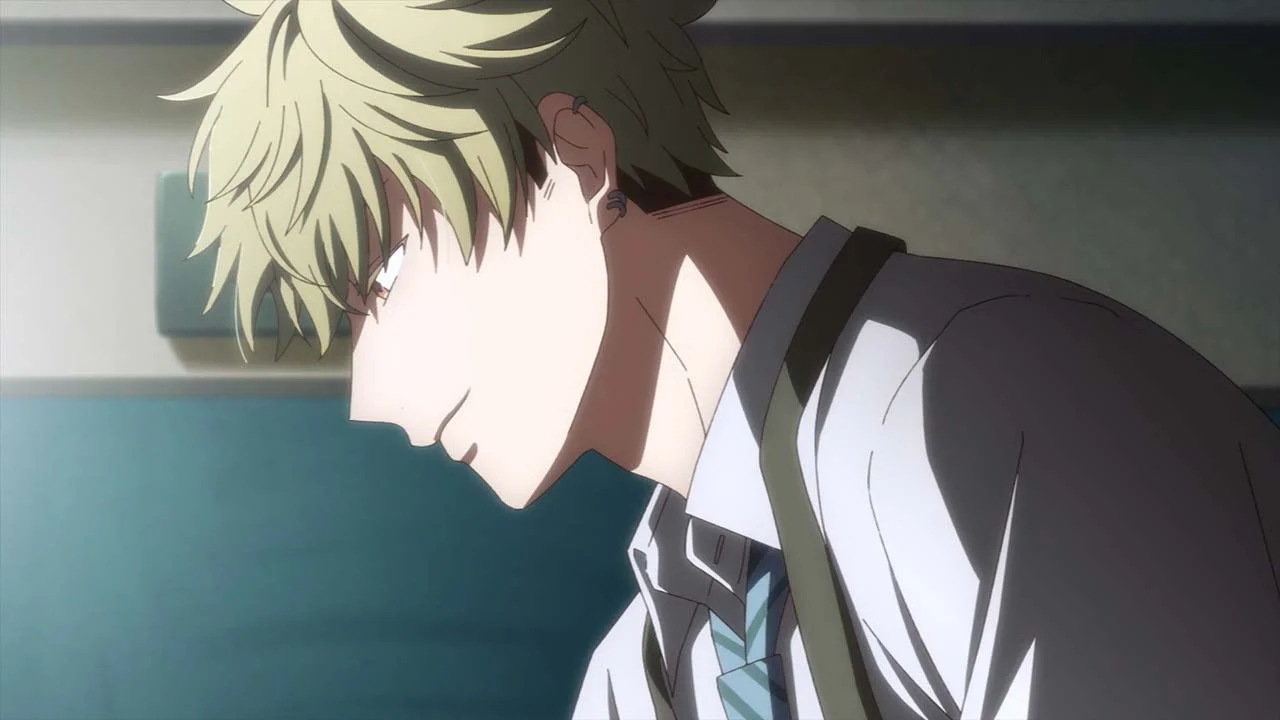
That impression? “Self-confident, hedonistic, cool-headed, and yet there’s a sense of loneliness.” Ue continues composing, determined to see the song through, even if given has to take a backseat for now.
As Ue hears his sister describe what he’s doing as hellish, he realizes how Hiragi *cannot* finish this song as the love he feels for Mafuyu isn’t the same as Yuki’s. Little by little, I’m convinced the song choice is deliberate: out of everything Yuki wrote, Hiragi shares one he knew was Yuki’s love letter. Only someone who loves Mafuyu to the same degree can properly express those feelings.
Ue continues to be wowed by syh: Hiragi got the bass down to a demo he first heard two days ago, plus Shizu’s wrist control makes his drumming a great complement. Their popularity has merit, not just commercially, but artistically. Hiragi sets a deadline for the completion of Yuki’s song: their album release show. He also mentions an MV recording for their next single and wants Ue in it.
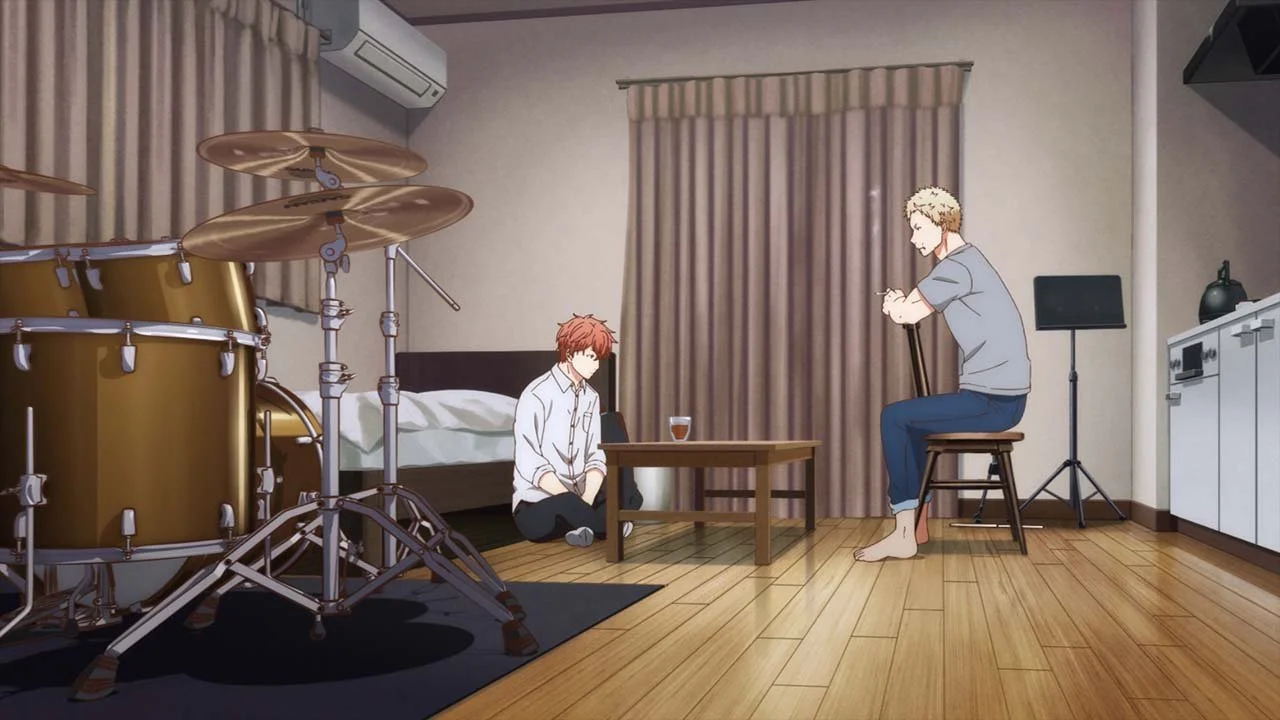
Mafuyu feels as if, in his words, “everyone is leaving me behind.” This feeling triggered the fight between him and Yuki all that time ago, and history seems to be repeating as Ue prioritizes his work with Hiragi. Everything is happening all at once, and Mafuyu needs someone to talk through the anxiety — evidently, Shizu didn’t help. Mafuyu heads over to Akihiko’s place.
Akihiko is resolute in his desire to make a living off music, whereas Mafuyu treats music as a hobby. What holds him back is the feeling that, if he goes pro, he could lose something again — Mafuyu lost Yuki to music, and doesn’t want to lose Ue also. Akihiko points out that syh has an upcoming gig, and that Mafuyu should go and see what it’s all about — he refuses.
Hiragi has an idea as to why Mafuyu feels the way he does. He may have been guilty of getting Yuki so hooked on music that he neglected Mafuyu. Hearing that, Ue realized how he was assuming Mafuyu would just come to their show, and he never asked how he felt about it. He’s so hooked up to music, just like Yuki was.
After dinner, Hiragi breaks down, coming to the same realization Ue does. Having Mafuyu hate him again over music is something he doesn’t want, and Shizu has had enough of lending his shoulder. Admitting to his feeling alienated, much like Mafuyu, Shizu accuses Hiragi of not being upfront about his intent to finish Yuki’s song and being in love with him. Hiragi had to correct the record; emotions ran high, and an impromptu confession was made.
Shizu wasn’t convinced, noting how Hiragi doesn’t know what he wants to happen next. He came in for a kiss, but Hiragi doesn’t return it — Shizu even suggests how love ‘normally’ involves sex. With a menacing look, he asks again: “What do you want to do? Your choice.” Still shocked about what just happened, Hiragi couldn’t respond, and Shizu left.
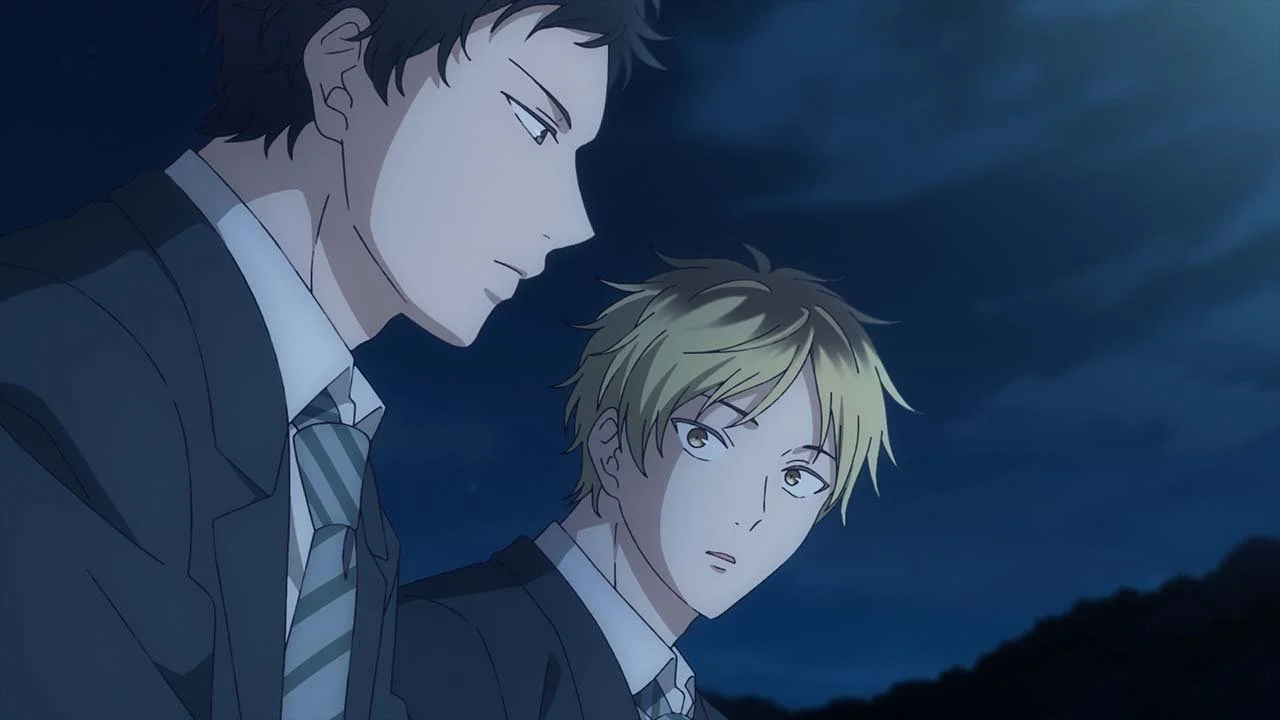
Going back to Hiragi’s characterization, consider this: brown-haired Hiragi partially dyed his hair blonde, whereas Yuki appears to be a natural blonde. And the three earrings? True, they’re not in the same place, but Yuki also had three earrings. As vain as it sounds, I’m not convinced by Hiragi saying he didn’t want anything romantic with Yuki — at best, he wanted his attention. This is how ‘Yuki’s special to me’ becomes ‘I want to be like Yuki.’
Depends on how you see it, he’s successful to a degree: Hiragi’s easygoing, mingles with everyone, and becomes quite adept at playing guitar. He'd get Yuki's musical attention through the band, but never the personal devotion that remained reserved for Mafuyu. In the end, he got what he wanted, at the cost of Mafuyu frequently giving him the cold shoulder — and already they argued over petty things!
The beginning of Hiragi Mix 9 reads to me as someone resigned they’ll never be the special one. Hiragi’s craving for attention means he’ll fall for anyone who gives it to him — first desperately seeking it from Yuki, then turning to Shizu, who made him feel like a god by following his every whim. As unfair as that reading is, watching Hiragi’s character develop throughout the TV anime and this film, it’s the only read I come up with.
At what point does admiration for someone turn into copying? Or even romantic feelings? Where do we draw the line when dealing with someone as emotional as Hiragi? It’s not that I have a problem with emotional characters — my read of Ugetsu shows that — but Hiragi’s level of turmoil exceeds even Mafuyu’s, and I grow frustrated by it. I’m convinced that, out of all of the Given cast, he’s the most underdeveloped; not a good look when this film focuses on you! Even worse, this comes straight from the source.
Akihiko and Haruki’s foreplay is interrupted when Ue drops by. He gave them tickets to syh’s show, and reminded Akihiko how given got an offer to go pro when he got jealous. Still, Mafuyu has to be on board — and Ue still treats him with kid’s gloves, as he’s unsure of what to do if luring Mafuyu with music isn’t working.
Hiragi skips school — he’d cried himself to exhaustion the night before. During his long recovery sleep, he dreamt of past moments with Shizu. Ue shares a newly tweaked demo on the band chat, which Hiragi takes his time getting to. When he does, he finally realizes what Yuki wanted to write: a completely smitten depiction of his ordinary, yet special, love for Mafuyu.
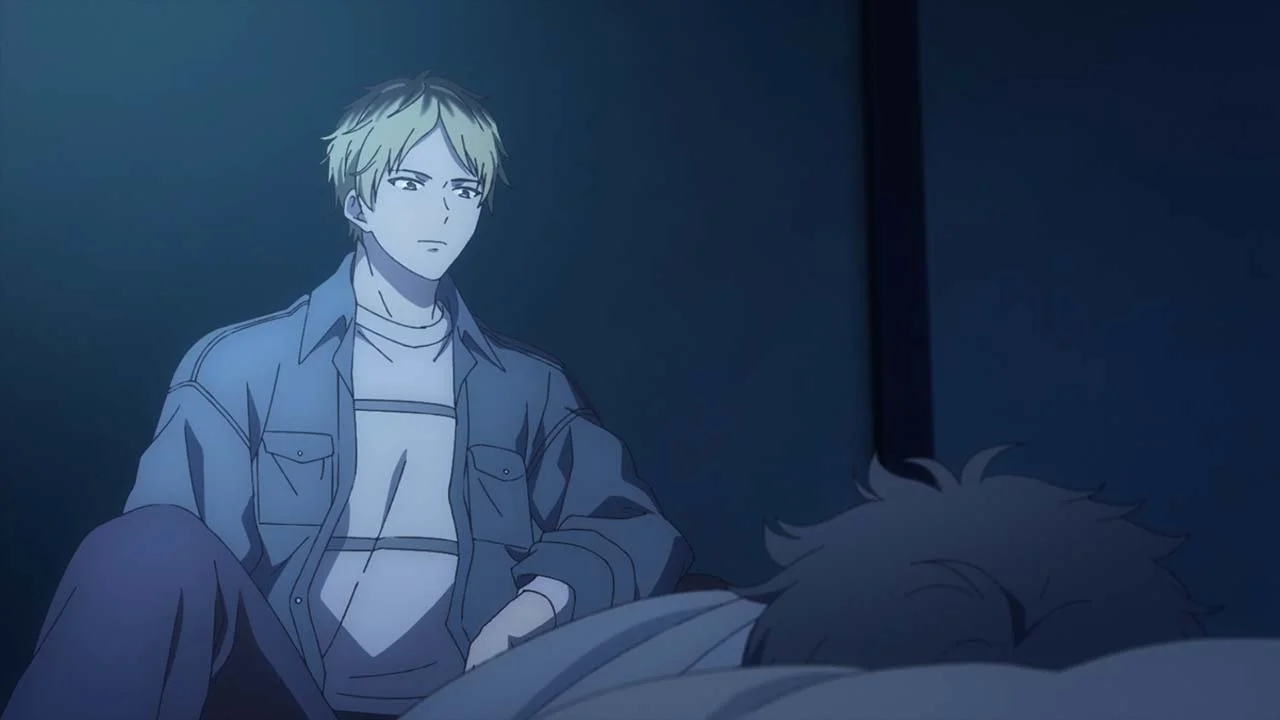
Hiragi knows this feeling.
Hiragi heads over to Shizu’s, despite it being the middle of the night. As he has a key to the place, he lets himself in, goes to Shizu’s bedroom, and sits atop him. “Do you understand what your action implies?” Shizu retorts, noticeably irked, but Hiragi is fully aware of what he’s doing. Circling back to a pre-school memory, the way Shizu made Hiragi feel needed, he’d become addicted to that feeling — even before Shizu began following him, Hiragi would drag him along. It’d evolve into romantic feelings: he wanted Shizu’s intense eyes to always be on him.
“Tell me you want me. I’ll give myself to you.” Hiragi says the words Shizu longed to hear, and he’s in disbelief: “You’re offering a sip of water to somebody dying of thirst in the desert…” Reassured that he can have his way, there isn’t even foreplay involved. And even so, Shizu still exhibits restraint: “Want me to stop?” Hiragi flips out: “Stop asking me over and over, you idiot!” Shizu grins widely. Even as he’s scared of the rough sex that’s about to happen, Hiragi notes how it’s rare to see Shizu smile. The next morning, Shizu reciprocates Hiragi’s feelings.
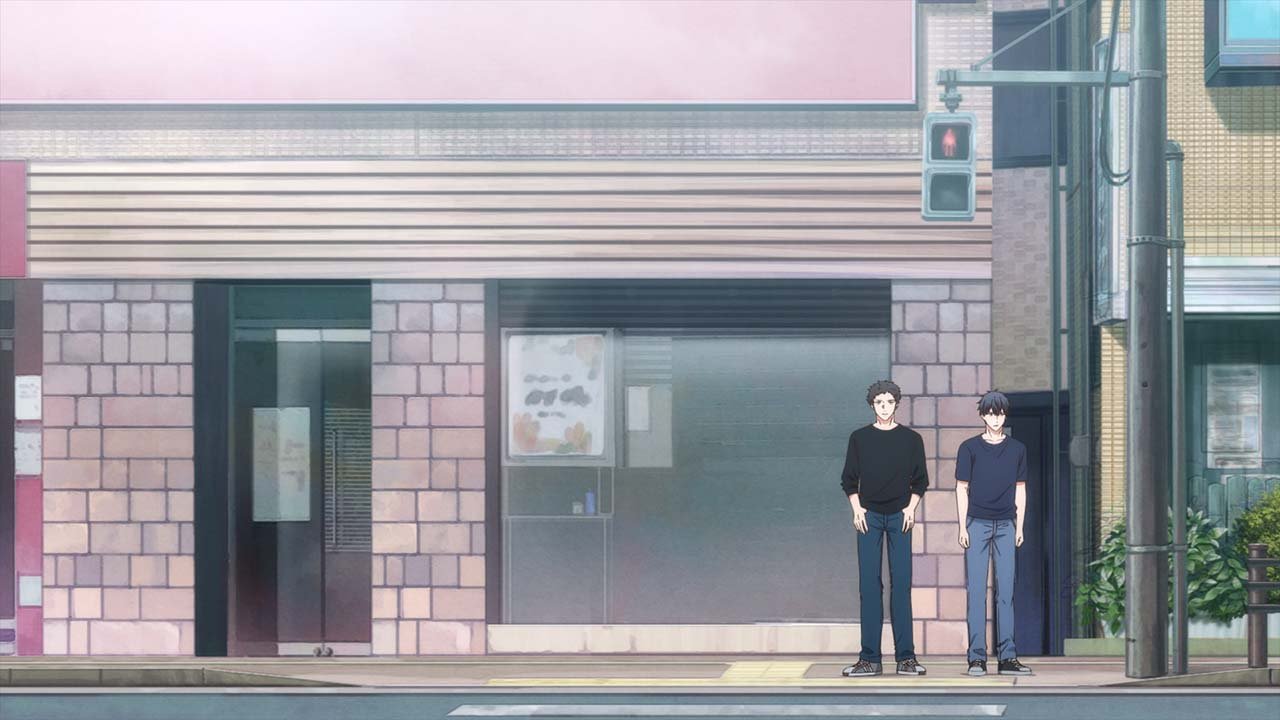
Ue noted how the band’s sound changed. He’s seen this before when Haruki and Akihiko started dating. Maybe it was the same for them? A blushing Hiragi denies there’s something between them, and sends off Ue to buy food — Shizu tags along. As Ue complains about Hiragi, Shizu listens uninterestedly. Ue becomes annoyed at Shizu’s lack of presence, calling him a ‘yes man’ and nothing more. He comes clean about their new relationship, and shrugs off how the two of them dating affects their music.
Shizu goes one step further: he declares how his commitment to music is serious, more so than Ue’s — referring to how he hasn’t convinced Mafuyu — and that he’s willing to sacrifice himself for Hiragi’s music. “That ‘suffering’ you guys do isn’t my jam. And that’s my strength.” Ue totally misread Shizu: he isn’t playing because Hiragi asked him to, but because he wants to.
An observation on the songs of this film: previously, Fuyu no Hanashi and Yoru wa akeru served the larger narrative; syh’s songs don’t. Maybe that’s the point, validating Ue’s initial read of ‘syh plays what’s popular,’ and yet, it’s still worth highlighting as part of the larger critique. I’m aware that this can put readers who follow the seiyu fandom on edge. Therefore, I want to clarify that what follows is not intended to criticize Hiragi’s voice actor, Fumiya Imai. He’s an actor paid to do a job — nothing else.
Starting with Straight, the song they play for the first MV. The first 45 seconds establish the type of music syh play. It's not hard to find the full version, as the intersection of fiction and reality meant singles were released through Sony's music division — leveraging the corporate connection between Sony Music and production committee member Aniplex. While anime singles aren't uncommon, the timing here is particularly apt: syh's first single after going pro gets released as an actual single, mirroring their fictional trajectory. If nothing else, reading it this way instead of chucking it to standard merchandising makes it interesting.
Now, onto the bad stuff: a gripe I have with a majority of songs featured in anime is how the featured half is the strongest part. Interested, I look for the full thing, and I come back disappointed. Unfortunately, Straight continues this trend. Outside of a bass and guitar solo that happens after the chorus, I get the impression Centimillimental could’ve written this in a week — and maybe I’m giving him too much time. Adding to that, the lyrics are sparse: a single verse and a chorus, repeated twice. Weaving this into the fiction of Given, Hiragi could’ve written this in a night after realizing how they don’t have anything for the first MV filming after winning CAC.
If there’s a deeper reading of the lyrics, tying it to themes within the series, I’m not seeing it. Even if I want to give it the benefit of the doubt, I can’t infer a meaning. Straight as a song is an acquired taste — and in its defense, I grew to somewhat like it after listening to it about fifty times.
Finally, Parade, a song written specifically for the film. Narratively, it’s inconsequential — there wasn’t an effort to weave its crafting into the story, with the depicted studio sessions exclusively focusing on composing and polishing Yuki’s song. I won’t count Hiragi Mix 14, covered on the final film, where there’s a brief sequence of Ue seeing a syh ad — it could’ve been the first MV they filmed as far as I’m concerned!
If the novelty of Straight was that it could be read as not being standard merchandising, Parade doesn’t have this cover. If you’ll permit me a thought exercise in justifying it, the one aspect that makes sense to me revolves around given’s releases. While syh’s two singles stand in stark contrast to given’s six, the band got two songs in the film itself; this is something not done since the TV anime, which credits given for Fuyu no Hanashi and Maru tsuke, the ED. Perhaps the film staff planned for syh making a splash in the same way given did all those years ago? It’s not like Centimillimental wasn’t working: his projects kept him busy, and he continued collaborating with the production committee, writing songs even when there wasn’t any new project to push. I may be going off the deep end, but given what we have, that’s my rationale.
Parade as an actual song, though? It’s okay. Lyrically, it appears to be written from Hiragi’s point of view, much like Kizuato is from Mafuyu’s, though Parade is more metaphorical in its approach — it’d make sense if we account for the level of songwriting experience Hiragi has. The bridge has a chord progression that sounds like literal parade music, but I felt it created a jarring tonal shift. My vision of how such an instrumentation would go is My Chemical Romance’s Welcome to the Black Parade — it’s not a bridge, but instead an intro. And, if you want to use that motif in a bridge, it should come after establishing it in the intro. At the very least, I’d know to expect it.
given the Movie: To The Sea (2024)
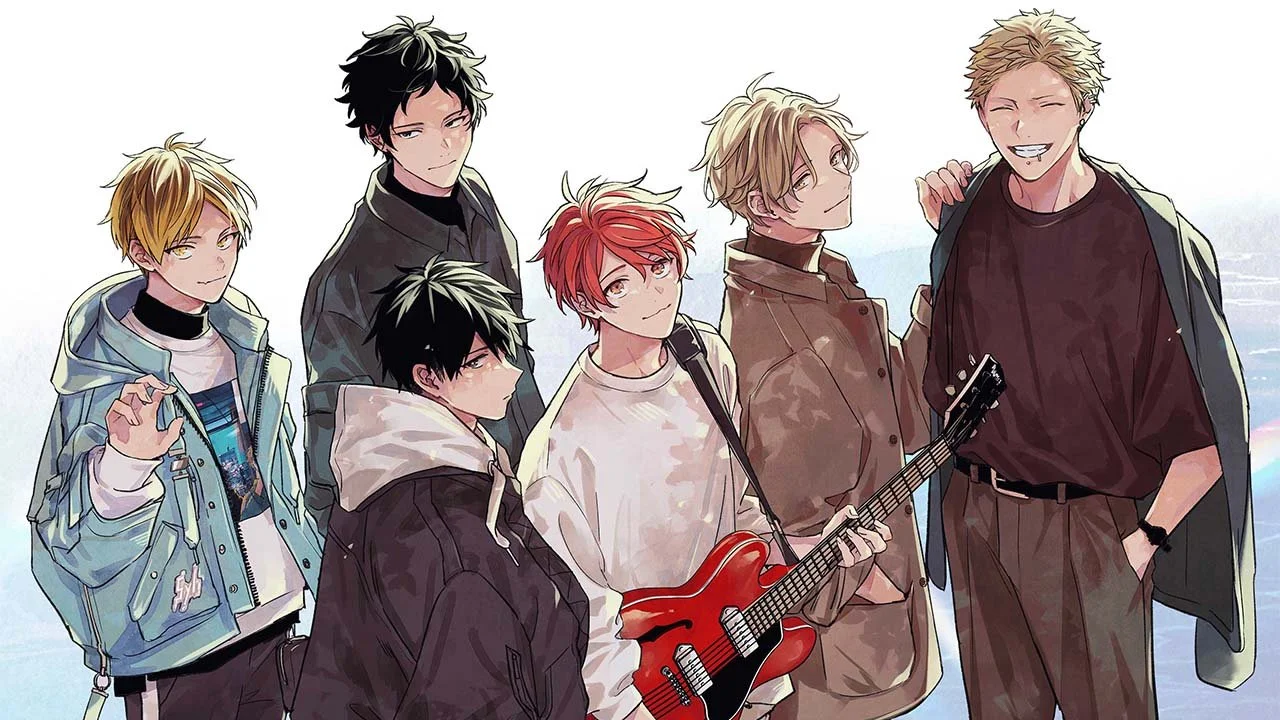
Mafuyu has never been to the sea. Yuki wants his first time there to be with him, so he brings him along. They’re seen walking along the shore, and Mafuyu gets bored out of his mind. He wants to leave, but Yuki wants to enjoy the scenery and asks for more time. Mafuyu insists, saying how he’ll remember this shared moment; Yuki assures him he’ll forget everything that happened in this moment.
Saeko Yoshida — Yuki’s mom — is in Mafuyu’s room. Yuki ordered a boxful of cup noodles, which arrived the day after his death. Saeko took it as a sign that, despite what happened, he was thinking about tomorrow. She describes Yuki’s psychological state as “the kind of guy who’d die in the most typical game of chicken,” and Mafuyu as being “his anchor.” Before leaving, she wants to leave Yuki’s guitar, his ‘memento,’ in Mafuyu’s care; when he refuses, she corrects herself, saying how she can’t bear the burden of holding onto something dear to her son.
Mafuyu and Yuki are in the swings of a playground. As he hums melodically, Yuki points out that Mafuyu’s stomach has a ‘hole.’ He’s bleeding through his cardigan — strangely, it doesn’t hurt. “The hole in your heart, while it may get smaller, it’ll never fully close. That’s why I was inside that hole and—” Yuki’s speech is interrupted as Mafuyu wakes up from his dream.
“How long have I not been singing? How did I even sing?” Mafuyu’s internal turmoil sets the scene for the finale…
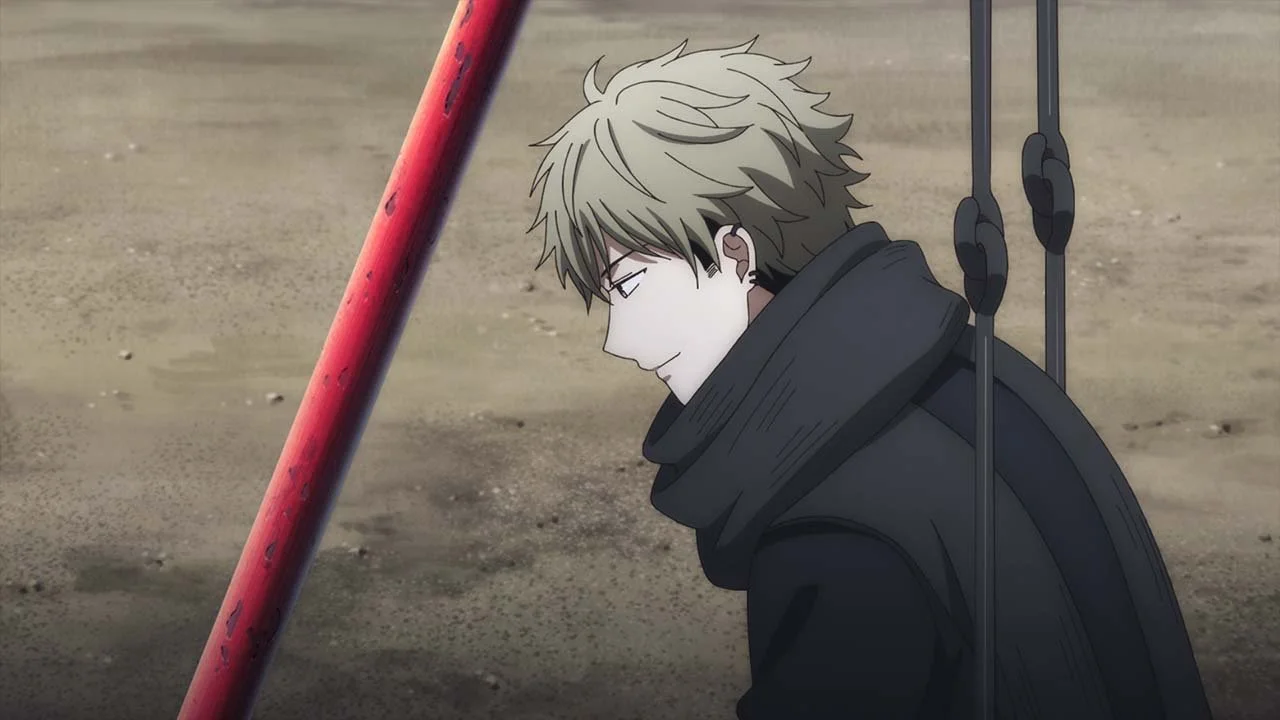
Yuki’s story is told through the people who cared for him the most. He was neither evil nor a saint, yet everyone spoke highly of the departed. On the surface, this creates the problem of unreliable narration: why should we trust what’s being said about someone when they have their own story to tell? The omission of detail is deliberate, as the author explores the various ways people cope with grief. We see this with Mafuyu — his aloofness used as a coping mechanism, his withdrawal from his circle of close friends, and what appears to me as lethargic behavior, despite bursts of motivation.
Saeko offers a ‘realistic’ take on Yuki, yet it cannot be taken at face value — she’s the one most prone to obfuscation of the facts to cope with her son’s loss. On the other side of the spectrum is the detachedness of Hiragi. For someone who says he admired Yuki, conversations that involved him were almost matter-of-fact, almost as if Hiragi didn’t care about Yuki’s passing. Hiragi's apparent detachment might make his perspective seem more objective than the emotionally invested accounts of others; I’d warn against viewing his take as the most accurate, as detachment is another coping mechanism, perhaps the most insidious of all if left unchecked. This may seem harsh given that Hiragi kept the syh name out of respect, but his detachment should still be considered when looking through the lens of this trope.
Yuki is both gentle & in touch with his emotions, but also reckless & detached — it depends on who you ask. They can both be true at the same time, and even so, the unknown lingers. At risk of sounding like a broken record: if Mafuyu and Shizusumi are enigmas when looked through their particular lenses, Yuki’s the final boss, even if it was to make a point about grief and coping. All of this made me reflect on the loved ones who passed away and how they are remembered — there are both Hiragis and Mafuyus — and how I don’t fear death as much as I fear how people would remember me after I’m gone.
Have I made a positive impact on the world, or at the very least those around me? Will my memory be as ephemeral as the days at the funeral house? Would I even be remembered in an increasingly grim reality? These thoughts keep me up at night… but seldom prompt me to action. The concept of ‘relationships’ utterly exhausts me, as they become ever more high-maintenance. People mean well, but I’m almost always giving up my time with no real choice in the matter. But were I to become assertive, they get put off — in this give-and-take, I often feel as if I’m trying to have my cake and eat it, wishing it could all be easier.
Maybe I'm just selfish. At times, I don’t even know who I am…
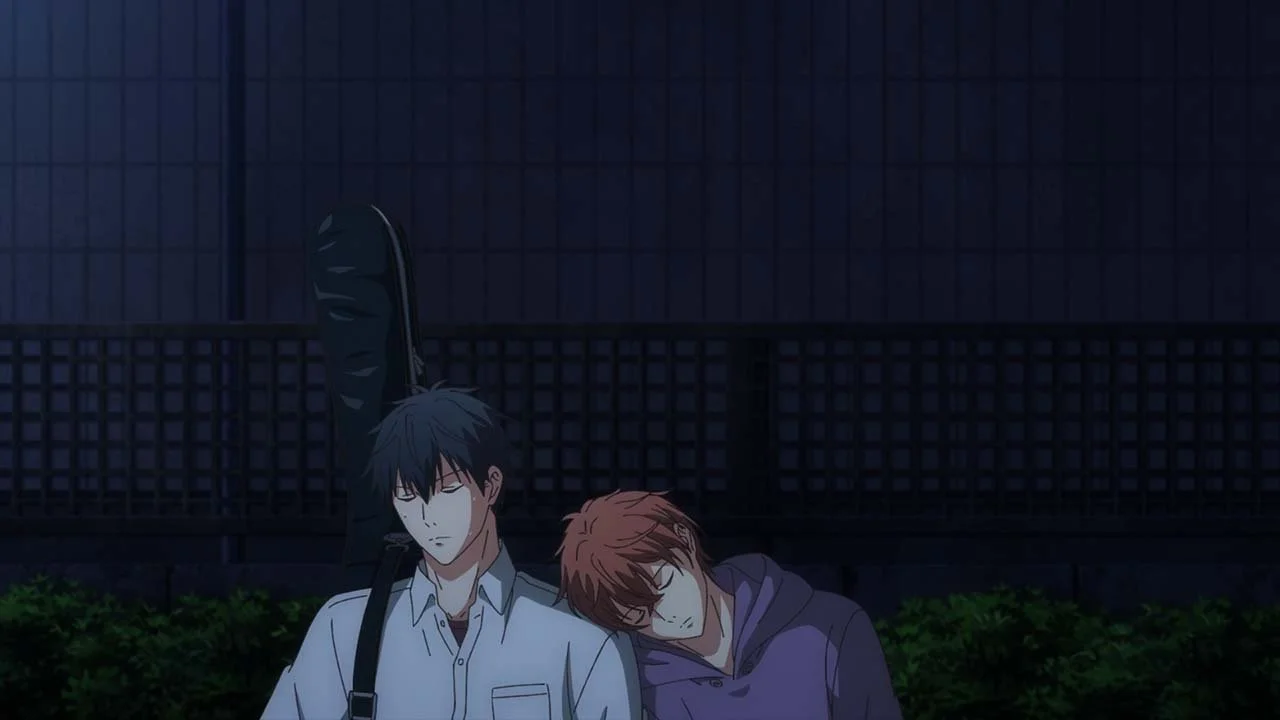
After an eight-hour session at the studio, Uenoyama (Ue) noticed some ominous texts from Mafuyu: “I’m lonely. I want to see you.” Worried that something had happened, Ue rushes over to Mafuyu’s place. He’s still bad at following up with people, and Ue tells him off — again — about replying on time. It’s not like he can stay mad at Mafuyu: he only wanted time with his boyfriend. Ue, feeling bad about how playing for syh has taken all his free time, suggests going to the studio to practice. “Not right now,” Mafuyu responds elusively. As Ue tries to gauge where Mafuyu is coming from with his hesitation, the alarm sounds — Ue has to leave in ten if he’s to catch the last train. He offers Mafuyu a ticket to the show he’s been preparing for, but Mafuyu steps back, rejecting it. As much as Ue wants to know why, there’s no time: he has to leave now.
Shit.
Ue leaves Mafuyu alone… again.
Shit…
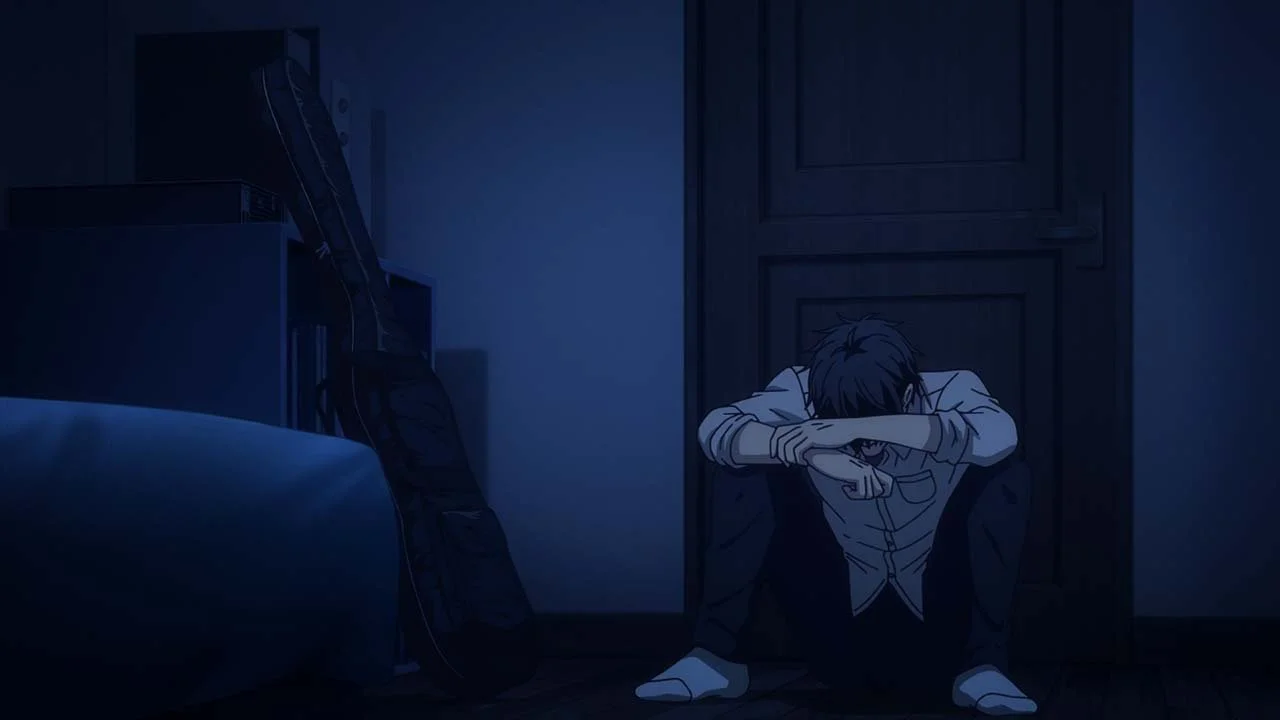
Back home, Ue locks himself up in his room, and doubt seeps in. Is given going to survive Mafuyu rejecting music? Should he not have agreed to play for syh? Will the past two months have been for naught? If only he could be as devoted as Shizusumi (Shizu) is to Hiragi — Ue needs only but to emulate him… or so he thought. He reluctantly agrees with Shizu: “I’ll never be like him.” The more Ue ponders the situation, the angrier he becomes; he then realizes that Mafuyu is preoccupied with something. Akihiko’s suggestion to lure Mafuyu in might have some merit…
Shogo Itaya, Ue’s classmate from the soccer club, runs into Mafuyu one morning while walking to school. He brought up the career survey: with the submission deadline nearing, he was curious if Mafuyu had filled it out. “What about you, Itaya?” Mafuyu asks evasively. Itaya’s path appears set, as he got an offer to go pro in soccer. Mafuyu, still at a crossroads, can only respond in awe at how everyone knows what they’re doing after graduation, though Itaya points out that not everyone knows…
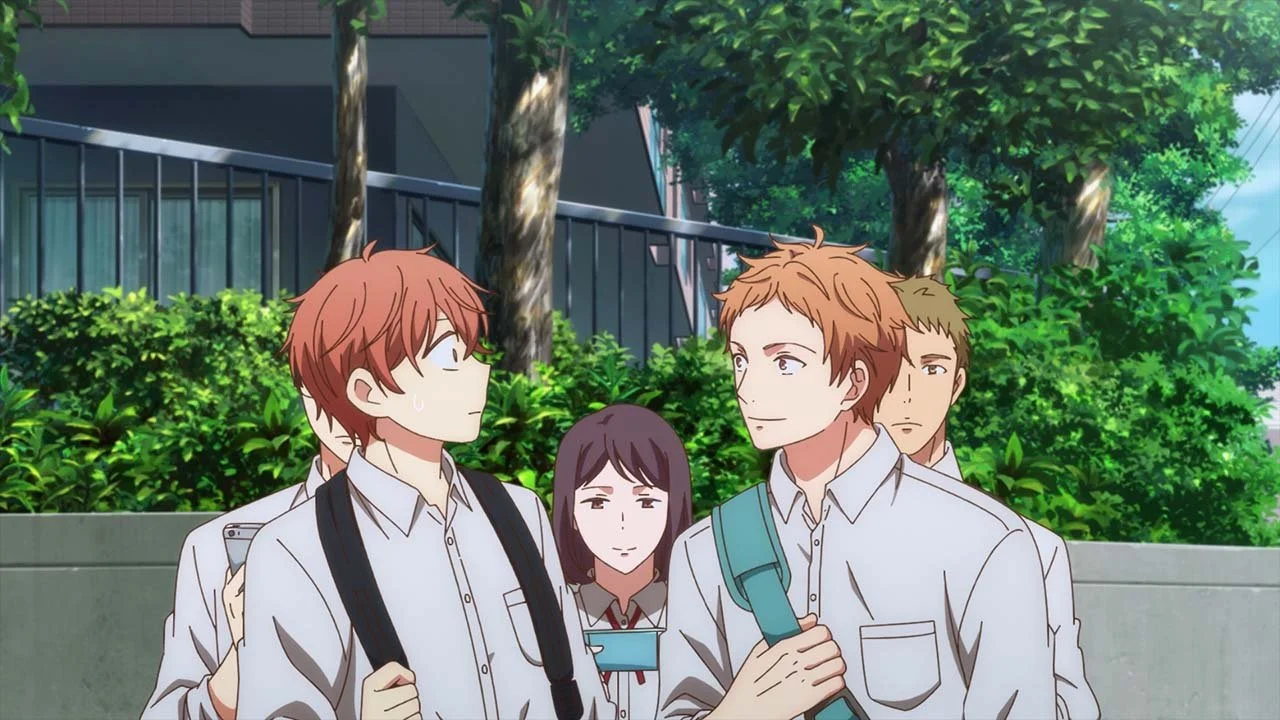
Just a note on minor characters throughout the story: I believe characters like Ryu Ueki, Waka Kurihara, Itaya, and Ayano Kasai don’t have a real role, even if the last two have a small moment that briefly highlights them. When a writer creates a name and profile for a character, it’s unfortunate how rarely these details are actually used, and sometimes not at all.
What do we know about them? Ueki, Itaya, Kasai, and Kurihara are Ue’s classmates. We have two jocks, a girl with an unrequited crush, and a gossiper. Other than that, there’s not much else. They were somehow promoted from background characters to minor ones, but only by barely meeting the criteria. I get the feeling Kizu created them simply to give her main character friends and make the world feel more populated. Given the shallow development of these supporting characters, all of the main characters should've been handled like Akihiko. This may sound wild, but hear me out: outside the interactions with his teammates, and later, his romance with Haruki, the only other person Akihiko spoke to was Ugetsu. He’d be a terrible main character on paper, and somehow he pulled it off in the first film. I’d rather have that than underdeveloped characters.
A crumpled ticket is inside Mafuyu’s shoe box at school, the same one Ue tried to give him the night before. Mafuyu reflexively closed the box shut after realizing what the item was. Ryo Ueki comes down the stairs, accompanied by Ue. Ueki asks Itaya to let the teacher know they’ll be late for the school assembly. Ue stares at Mafuyu with dagger-like eyes — he lowers his head.
The only thing Ue can do is to leave Mafuyu be. When he’s unsure about something, talking is pointless. Ue is determined to show Mafuyu what life on stage is like; if he needs time to think, this should be a good enough answer. His work for syh doesn’t end with the debut show, but continues for some time, presumably. The inferiority complex, the guilt… none of that matters — the only thing that matters is the music, and the path Ue set for himself. Still, the question remains: will Mafuyu attend…?
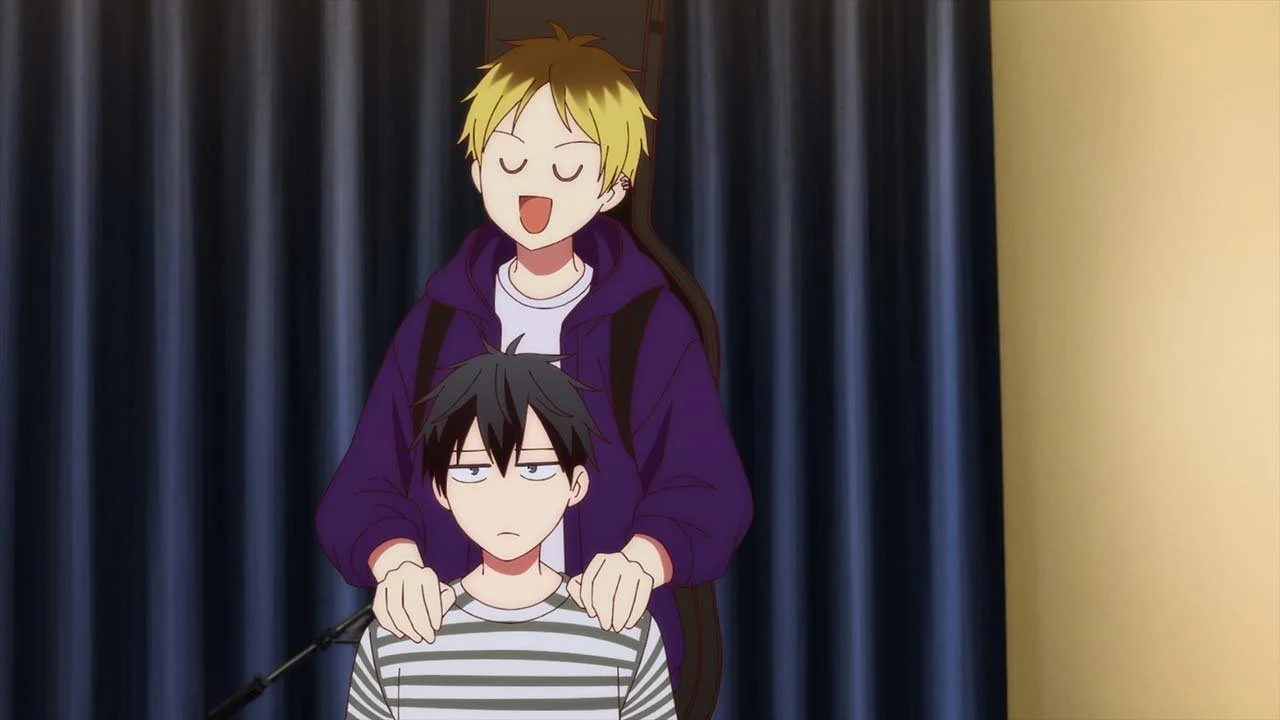
Working with pros means better studio access: when Ue needs the studio earlier than scheduled, Hiragi can arrange it without additional fees. Ue had an early set practice and got additional writing done for Yuki’s song. When the syh boys get to the studio — alongside the obligatory ‘Hiragi teases Ue’ moment — Ue suggests altering one of the guitar parts in the song to make Hiragi stand out more. Really, if it were up to Ue, songs would continuously get minor tweaks. He’s a perfectionist at heart, but I suppose that’s just all prodigies. The set is finished, and what had been called ‘Yuki’s song’ needs a name — Ue takes the lead.
Haruki meets with the promoter who offered his band an opportunity to go pro, to keep the trail warm, as it were. He levels with him: it’s an opportunity that’s being given serious consideration, and one of the members is still on the fence. As this is something Haruki wants everyone to be on board with, he’d like to wait. Haruki never mentions Mafuyu by name, nor did the promoter ask who was the one hesitating. The man agreed that if everyone wasn’t on board, there was no point. He calls himself a fan of the band — while there may be a degree of truth, it may be just platitudes, as he gauges how serious Haruki was. Later, both Yatake and Akihiko agree with giving Mafuyu space, even if the latter is jealous of how Ue takes to the stage.
Back to Mafuyu — on one of the many trips back home, he ponders what he wants to do. On his future, on the upcoming syh show. He’s happy Ue invited him, but doesn’t want to go.
“I want to go.”
“I don’t want to go.”
The phone rings. It’s Hiragi, who’s down at the parking lot: “Let’s hang out!” Hiragi thanks Mafuyu for lending Ue to him, and apologizes for taking up so much of his time. Still coy about what he wants to do — and why Ue was necessary to do ‘that’ in particular — Hiragi passes it off as him being selfish, and echoes Ue in that he wishes for Mafuyu to attend. To that end, he gives him a special ‘invitation’ ticket to the show; in contrast, Ue’s ticket is a general admission one. Both give access to the venue, but an ‘invitation’ one presumably gives backstage access? This detail becomes relevant later.
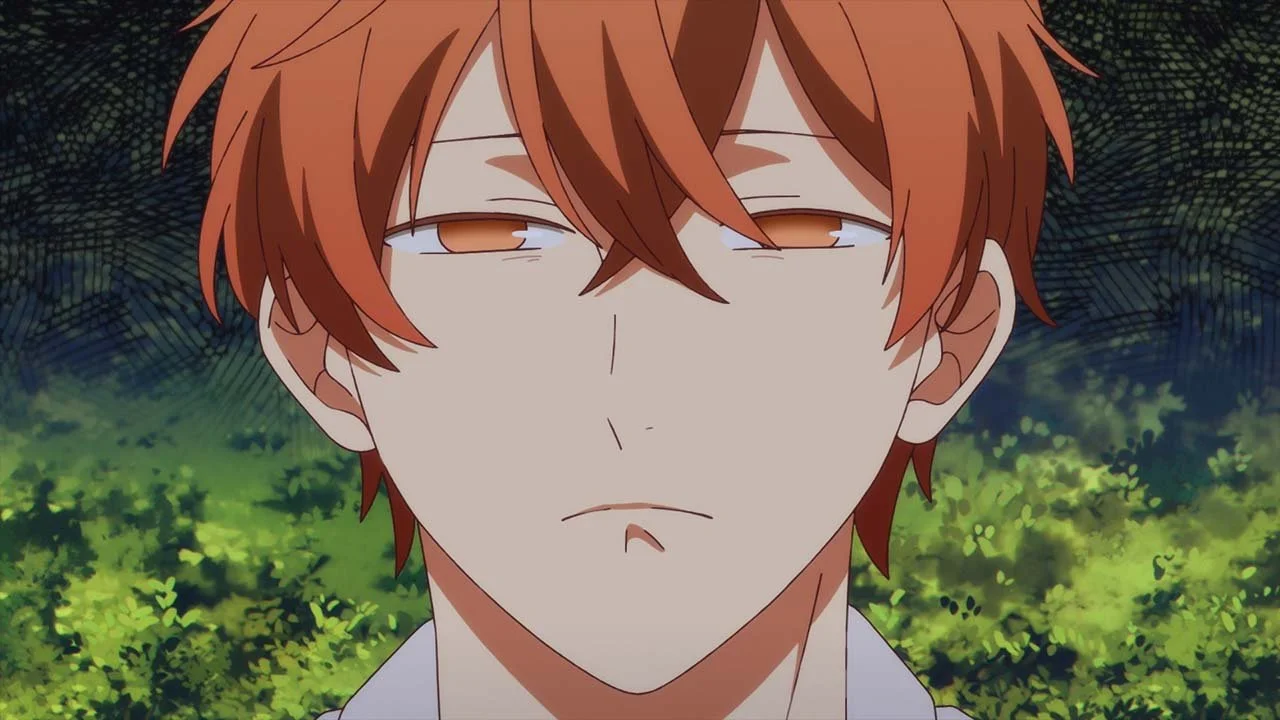
By this point, Mafuyu’s regression to insecurity gnaws at me. The latter part of the Hiragi Mix arc — which I think should’ve been called something different, but that’s a whole other conversation — is written as a solution looking for a problem. At best, it’s written with an incorrect focus; while it’s normal for teenagers to feel anxiety about the future, taking it to the degree of ‘main conflict,’ and establishing an aspect of Mafuyu’s personality late in the story, I think it’s ill-advised. In its place, what if the conflict was over Ue spending so much time on Hiragi’s band? What if this led to a falling out between Mafuyu and Hiragi / Shizu? What if this led to friction between Mafuyu and Ue? Maybe conflict just isn’t for Mafuyu, especially after what happened to Yuki, but that ‘head-dive first’ personality Mafuyu is described as having several times throughout the story — like with the spontaneity of Fuyu no Hanashi’s lyrics — is not on display here, which puts the whole thing into question. It should be displayed in more aspects other than music.
Ayano Kasai, a girl in Ue’s class, appears worried over Mafuyu, though they’ve never spoken before. Nevertheless, she attempts to make conversation. She’s aware that Ue and Mafuyu are dating, and long since accepted the fact that Ue will never return her feelings; now she cheers from the sidelines. Ueki walks by and directly asks whether Mafuyu made up with Ue — Kasai tried to be polite, avoiding saying it in that manner, and was shocked at the brazenness. Mafuyu deflects: “Did you two decide on your career paths?” Kasai’s answer is going to college with no real plan. Ueki hasn’t figured it out either, and assures Mafuyu that people like Ue and Itaya are not the norm.
Kasai’s advice for Mafuyu? Keep moving forward. Don’t overthink. It’ll turn out better than he thinks. As Mafuyu takes the ticket Ue put in his shoe locker, something shifts: for the first time, his heart overrules his head. Still hesitant, but a small step towards the future he wants.
The day of the concert, Mafuyu worked up the courage to get to Shibuya Station at least, but his mind yet again took over. He spots a familiar face, Ugetsu Murata, and they catch up over lunch. Ugetsu’s been living in New York ever since he received an offer from an orchestra over the Pacific and is only back in Japan to gather his belongings. He plans to live there for at least two years — what will happen after that is unknown. By this point, Mafuyu has met every type of person: those who are confident in their path, those still trying to figure things out, and those in between.
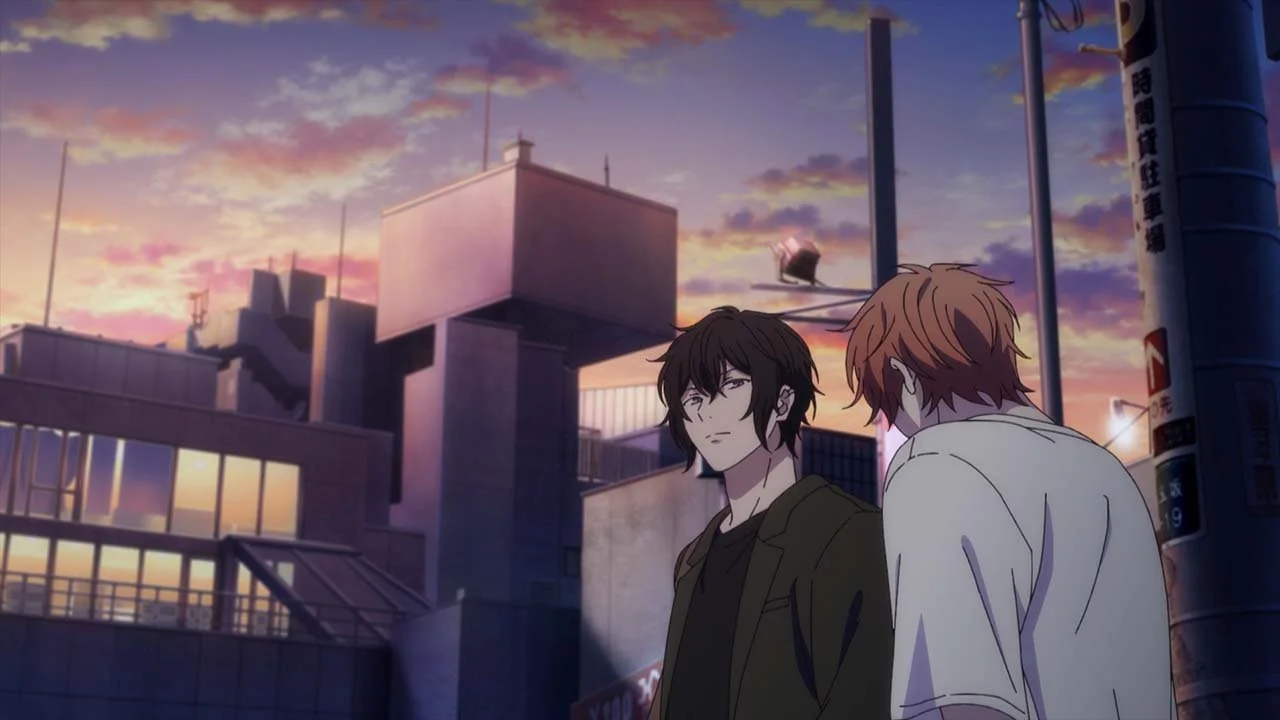
Mafuyu confides in Ugetsu about his paralysis while others surge ahead, caught between yearning and terror, with today’s show representing a point of no return. "That… changes things." Ugetsu takes the lead towards the live venue, despite Mafuyu's protests. When he manages to stop Ugetsu, he pointedly asks: “What exactly are you afraid of?” Mafuyu reiterates his dilemma — how it’s a choice between either music or Ue, with the show being the catalyst. “There’s no going back either way. Whether you choose or not, everything is gonna change beyond this point.” Ugetsu notes how, throughout all of Mafuyu’s turmoil, he hasn’t mentioned how Ue feels, not even once; what does he think about Mafuyu’s dilemma? He meekly responds: “Yeah, but that’s what I’m afraid of…”
Once at the live venue, Ugetsu suggests going to the front. Before Mafuyu even has a chance to object, he gets swept by the crowd — “it’ll be okay.” The same words Mafuyu told Ugetsu when he couldn’t move forward… he returns them to Mafuyu. As Hiragi rallies the crowd, Mafuyu remains lost in thought: “I’m scared. But Hiragi and Uenoyama want me to hear this song. Stand up straight. I need to properly listen.” Hiragi then introduces the song that he, Ue — and Yuki — want Mafuyu to listen to.
“Umi e.”
Memories of Yuki start flooding in. Tears overwhelm Mafuyu. “I’ve found him… he was gone, and I thought I’d never see him again. I found Yuki… he remains unchanged in this little song.” Reflecting on Ue’s actions, Mafuyu continues: “He said it so bluntly, and gave me that crumpled-up ticket… while keeping this in his heart. This whole time… he was trying to give me this gift.”
The rock ballad spouts themes of love, parting, and remembrance. It’s only apt that the song is played at a slower speed — Ue made the right call holding back on the guitar play. Though I find it hard to suspend disbelief on how a new band was able to get such an arrangement of pianos and violins for the song, I have to hand it to Centimillimental — the arrangement is spectacular. I haven’t felt chills listening to a song from the series since Fuyu no Hanashi, and it made me tear up just as Mafuyu did listening to it. It truly comes across as the love letter it purports to be, with the teaming up of two men whom Mafuyu loves the most — and they love him too — to deliver something special. This is music at its most beautiful. Gosh, I’m tearing up writing this…
The show continues after Umi e, with syh playing Straight right after. Mafuyu comes to a realization: choosing music over love or vice versa is a false dichotomy. True, the past isn’t guaranteed, but neither is the future; all he can do is live in the moment. Right now, he wants to be on that stage next to Ue so badly that he can taste it. These feelings of frustration will carry him forward.
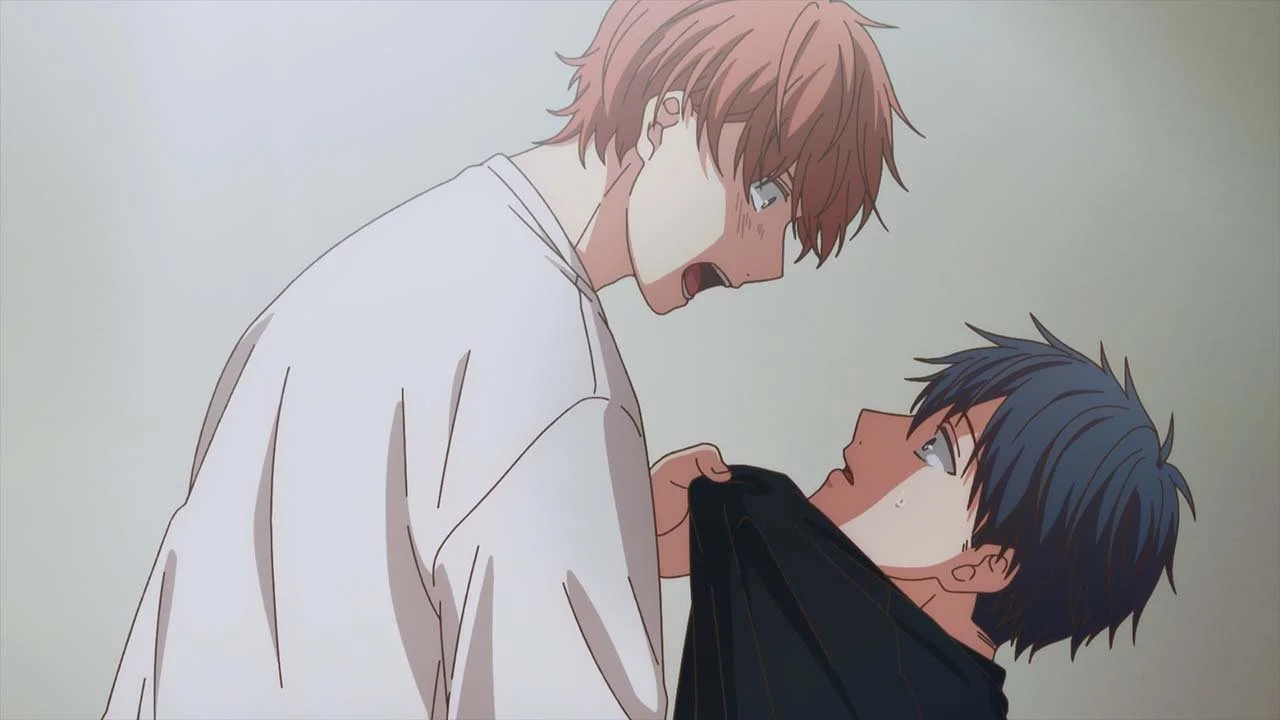
After the show, Ue reflects on everything that happened leading up to Umi e. “Even if he was incomplete, I got to return Yuki to Mafuyu. I still don’t know much about Yuki — I just had a burning passion for that song.” Ue helped deliver closure to both syh & Mafuyu, not to mention proving he has what it takes to make it in the world of professional musicians. Mafuyu busts into the green room, making a beeline towards Ue: “I wanna sing! I want to play music with you! Forever! I promise you won’t regret it!” Ue was lost, wondering what this was all about, until it clicked: Mafuyu *wants* to go pro, with Ue by his side.
Two months have passed since the show. given went pro, Ue tells his family about his wish to pursue music seriously while continuing his post-secondary education, and Mafuyu puts even more of himself into the music. Ue is offered back-up guitarist for syh again, which he accepts. Hiragi issues a challenge to a distraught Mafuyu: “If you don’t like it, you’d better make music good enough to steal him back from me.” Ever the gentle, sensitive soul, Mafuyu doesn’t have the competitive nature Hiragi has.
Mafuyu gifts Kasai his band’s single — a new arrangement of Fuyu no Hanashi with Ue on backing vocals — as thanks for helping him. She insists on paying for it, making this his first-ever sale. Shortly after, given performs that same song in the same venue syh played months ago:
Given’s short stories, Strawberry Swings, were adapted out of order. Divided into four chapters, the first one was covered between the TV anime and the final film, followed by chapter two, in which Saeko Yoshida gives Yuki’s guitar to Mafuyu. The swing set dream setting is Strawberry 4, and the one coming just before Mafuyu’s graduation is a modified version of Strawberry 3.
I won’t question why it was adapted out of order without solid proof that it wasn’t published in Cheri+, but the retooled Strawberry 3 comes across as an afterthought. Its importance is notable, as this is where Mafuyu expresses his gratitude to Ms. Yoshida for giving him Yuki’s guitar — through it, Mafuyu found a way to express himself in a way that comes naturally. Yet the director and the series compositor apparently couldn’t work out where to fit this sequence, adding it arbitrarily just before the graduation scene.
After the graduation ceremony’s over, Ue and Mafuyu go to a seaside town on a date. Before the day ends, they walk by the shore — just like how Mafuyu did with Yuki years ago. With no trash cans in sight and having eaten too many skewers, they needed to be thrown away. Ue loses to Mafuyu in rock-paper-scissors and is tasked with finding one. While waiting, Mafuyu receives a call from Ugetsu.
After a brief catch-up, Mafuyu tells Ugetsu about something he discovered from his journey since they last spoke. “I hope that, at least, the music remains” — these were Ugetsu’s words back when he was in the middle of his tumultuous relationship with Akihiko. Mafuyu didn’t understand what he meant by that back then, but after ‘finding’ Yuki, he now does. Everyone he loves and cares for is present in the music, where they’re at their most vulnerable — just as he is when he sings. This realization is what helps Mafuyu move forward.
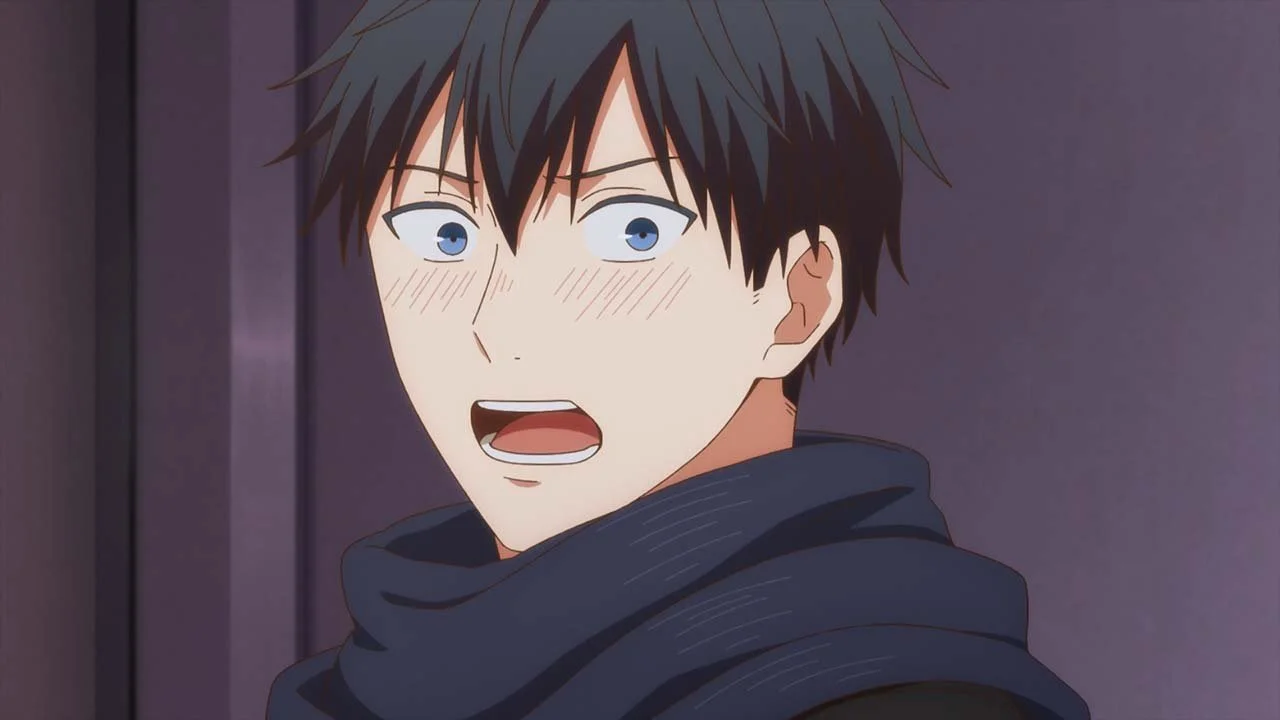
At the end of the movie, Mafuyu proposes that he and Ue should have sex when they return, eliciting a reaction not dissimilar to when Mafuyu first confessed. I don’t believe I’ve talked about Uenoyama throughout all of this, so it’s only proper to dedicate some words to his characterization, especially so when some readers comment about how Kizu ‘hates him.’
I have my reservations with some of her choices, some of which I’ve touched upon here. Yet that one thought I don’t share, and I think it’d take a look at how Uenoyama evolves throughout the story to prove that sentiment wrong. Let’s go back to the beginning: he goes from being a cynic — not just about music, but life itself — to someone who aspires to become somebody by the end. The earlier part is easy to forget due to time: the anime aired in 2019, and counting the Cheri+ releases, the gap is even greater. This highlights some readers' inability to see the broader context. Uenoyama himself states how he’s been a mess ever since he first met Mafuyu, and it’s at the very least believable how this journey, to him, can be read as someone finding himself.
It also stems from a myopic view of the many manifestations love takes. If Uenoyama didn’t care for Mafuyu, why would he agree to finish Umi e, a song whose nature he understood, especially considering who wrote it? He could’ve walked out ever since Hiragi made the proposition, but he didn’t. Going further back, we see throughout the series that Uenoyama consistently puts aside his own needs for people he cares about, and Mafuyu is one such individual. The guitar classes, helping compose Yoru wa akeru, every time Mafuyu had a traumatic reaction to something which reminded him of Yuki — Uenoyama was there through it all. It takes a special kind of resilience to put your needs aside for that special someone.
A cynical reading might suggest Uenoyama pities Mafuyu, but if those instances are not manifestations of love, then I don’t know what love is.
That’s it from me. See you next month soon-ish!