

14 min read
“Manga is often considered like a snack, a simple form of entertainment… However, I think that it is better if it brings you something. Something that brings positive value, I don’t think it should be knowledge, but wisdom instead. I’d like to share that there are alternate ways of thinking.”
Out of all the cartoons I watched as a kid, there are two I remember fondly: Twinkle, The Dream Being and Widget the World Watcher. Back then, children’s programming was commercially viable, not just a requirement for networks using the public airwaves. Both shows concluded long before I first watched them, surviving only through syndication — Hanna-Barbera's business model is alive and well. I must’ve guilt-tripped my parents into buying something I saw advertised in a children’s show commercial break more than once. When I think about it, today’s kids not having that shared experience is sad, but I digress.
The eponymous protagonist of Twinkle used magic to make himself buff just before fighting Diva Weed or any of her minions. It dealt in the power fantasy trope wildly popular in the 80s: think Rambo or Conan in children’s wrapping. The only method Twinkle beat the bad guys was through overwhelming strength, and a ‘believe in your dreams’ upfront message stood in stark contrast. Cartoon violence was all the rage in the 90s, and a buff alien was simply cool. I drew that depiction more than once, though those drawings were lost to time.
On the other hand, Widget took teaching kids about environmental hazards to task. It was, in essence, Captain Planet for younger crowds. While its storylines depicted more fantastical scenarios, they were still based on real events. Compared to its counterpart in the environmental cartoon aimed at teenagers, it served as a cushion for impressionable young minds.
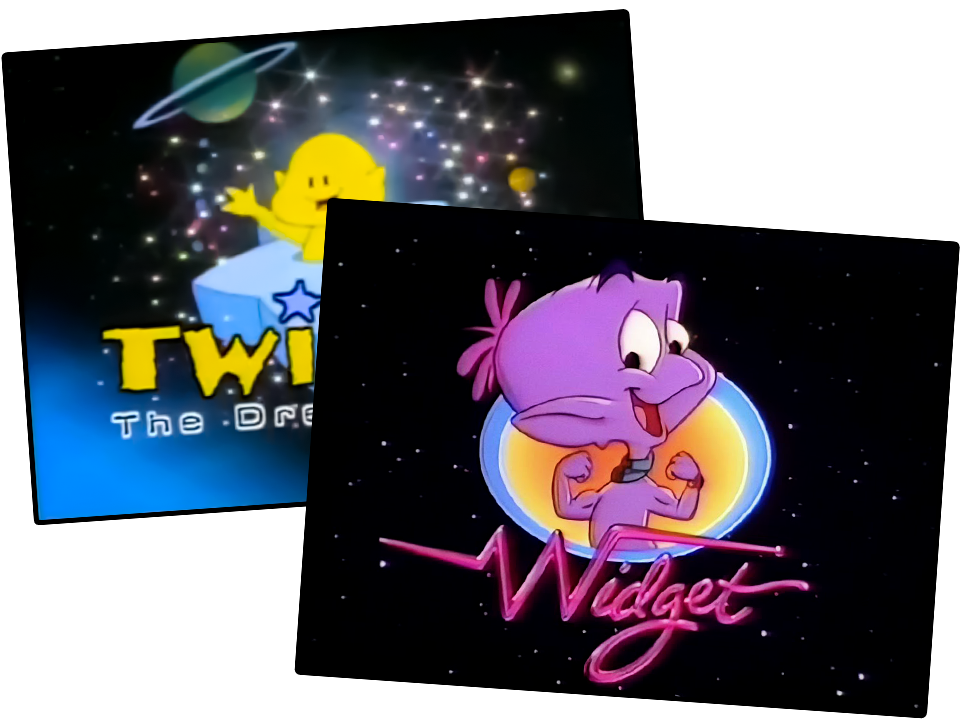
One afternoon, I was at my grandma’s house. The apartment she had at the back, one my parents and I lived in when I was a baby, housed one of my adult cousins. At the time, he was out working; he typically left his apartment unlocked as a relative lived in the front. Widget was about to air, and I ran towards his TV set to record that week’s episode with a VHS tape in hand. There was a tape in his VCR player. I took it out, recorded the episode, and put the original tape back in. However, curiosity got the best of me. I *had* to know what was on that tape I took out.
It was a porn tape, featuring adult star Ron Jeremy.
I’ve heard about Jeremy in passing over recess. His sheer output in the adult entertainment industry of the 90s was notorious: porn watchers were likely familiar with him. The boys among us snuck into their parents’ bedrooms, seeking forbidden secrets — “boys being boys.” Ultimately, they’d stumble across issues of Playboy magazine and videos featuring the man with the biggest girth they’d ever seen. Now, I was experiencing this firsthand. I felt aroused: not abnormal with pornographic content, but it was the first time I saw the sexual act in such rawness. That by itself was shocking, but where was it coming from? It didn’t come from the actress… but the actor.
Many thoughts ran through my head; I didn’t know what to make of them. What is this feeling? Why am I focusing on the man’s penis? I’m a boy — I’m supposed to like girls… I can’t talk about what I’m feeling with my parents, or my cousin for that matter… What cut through the spiral was my dad at the front gate. I wouldn’t tell a soul.
Looking back, if Jeremy were *at least* a handsome man, I could understand why I fell for him. He isn’t — in fact, he often performs with his shirt on, hiding his hairy chest and his beer belly. It makes that whole event even more perplexing, as I’m not into chubby men.
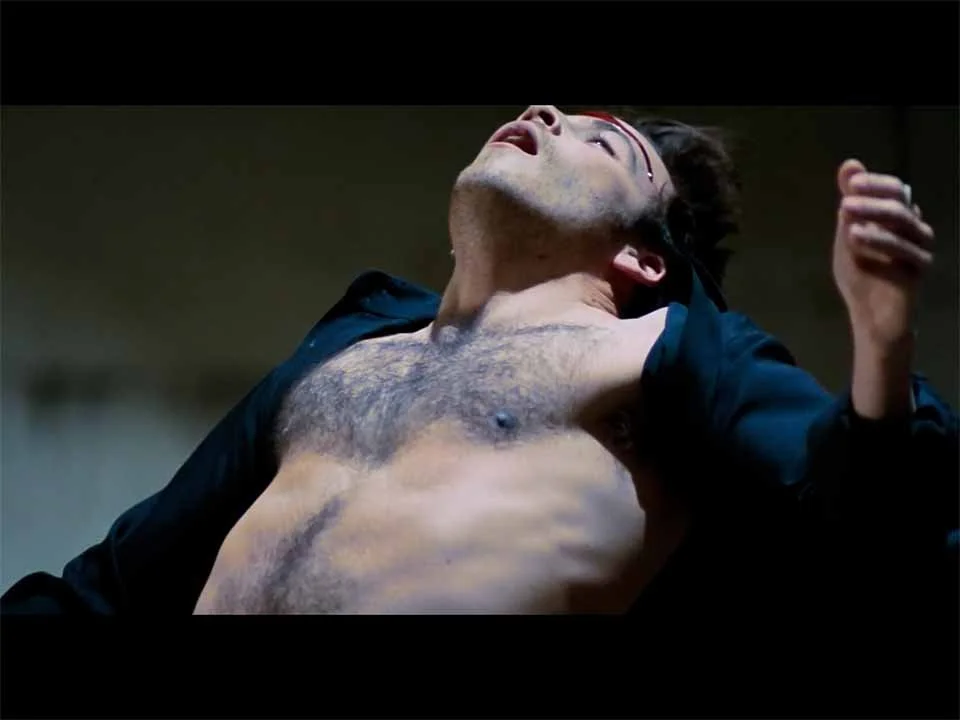
I wouldn’t look at guys in the same way as before. For instance, some time after, I watched the Blade movie. The climax belonged to Deacon Frost, portrayed by American actor Stephen Dorff — his unbuttoned shirt exposed his bare, hairy chest. I could not stop staring at his physique. What if he were as big, or bigger, than Jeremy…? Whether a cousin who was watching with me noticed my physical reaction, I can’t remember. Hell, I can’t even remember if the reaction was low-key... Just what is *wrong* with me…?
I began seeing two of my close friends differently. One, I snuck a shirtless photo of him. The other, in many a crude teenager joke, brags about his size. In one of many hangouts over at his grandma’s house, I asked him, point-blank, to show me — crassness begets crassness. I usually hung out with him when he wasn’t with his clique. It worked for me in two ways: I never liked how he seemed to draw people to him like moths to a flame, though in this metaphor, I am but one more… and he’d never know how I felt, despite my not-subtle advances…
Even acquaintances fell to my lustful eyes — I watched the guys play basketball, hoping they’d sweat enough for them to take off their shirts. As the chubby kid, my eyes went straight to the ones who had the physique I didn’t have and never could have. I told myself how I was merely appreciating how good they looked, but that was just a lie…
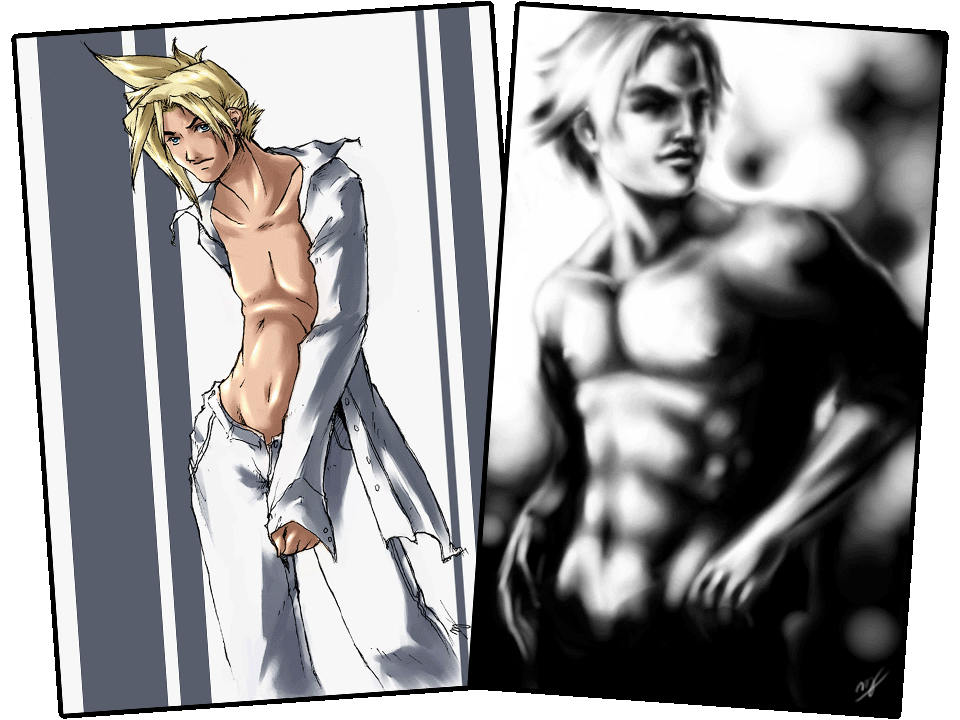
…apparently I was into Cloud — I have ZERO memory of this. I don’t even know if these illustrations are online anymore. They were on a 25-year-old burned CD that, miraculously, still works…
Continuing this trend of falling for shirtless men, Rurouni Kenshin’s Sanosuke Sagara caught the attention of a queer kid who didn’t know he was queer. His upper chest, barely covered by a white happi jacket, was a sight for sore eyes; even more when he loses it. I’d also gawk at Tidus, the protagonist of Final Fantasy X, from previews in GamePro or Game Informer. The rising star of the aquatic sport blitzball had his spin on the Zanarkand Abes outfit: a stylized overall, with both short and long trouser legs and a hooded yellow jacket that barely covered his chest. His disheveled look was charming, the sun-kissed tan only adding to it. While it may seem logical for daytime athletes to be tanned, this is merely a rationalization to keep this nebulous feeling at bay.
Tidus isn’t the only character who meets the criteria of ‘attractive shirtless guy’ — Wakka also fits the criteria. However, I didn’t feel anything towards him. Maybe mild annoyance at how he seemed to be among the weakest party characters, only bested by Rikku. I started to notice how the sources of my obsession became more targeted, slowly becoming my preference — my ‘taste,’ so to speak. There was this harmful misconception that gays liked all guys, which is utterly ridiculous… since those kinds of comments came through bullying, it struck deep within my psyche. Society taught me to hate myself.
Then, I was introduced to hentai by a younger cousin. He was into Pokémon, as was I. One day, likely during a sleepover, he shows me this illustration of Misty lying on top of her Starmie, naked. I didn’t feel anything toward it; however, artists drawing fictional characters that way blew my mind. I lamented how there wasn’t an equivalent of that for guys, so I settled for sexually suggestive images. It titillated me — it was all it needed to do. I didn’t know yaoi existed until much later.
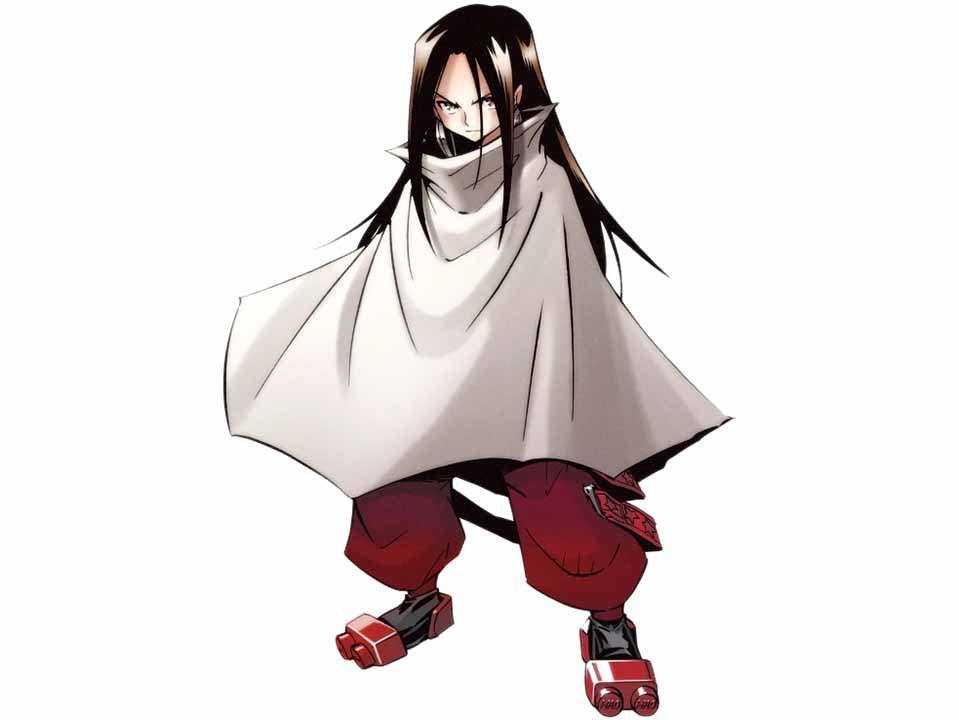
Then came Hao — or Zeke, as I came to know him.
But who is he? Hao Asakura is the main villain in the supernatural series Shaman King. Originally a peaceful man, he had a front seat to the corruption of the Heian period, seeing humankind at its most primal and cruel. This gradually turned him into a misanthrope, realizing how humankind wasn’t fit for the world they lived in. His madness was manifested when he began talking of his aspirations for a shaman-only world; as an all-powerful shaman, he *could* make it happen if left unchecked. Not wanting to be complicit in his crimes, the Asakura family fought Hao and killed him.
Before dying, he partook in the Ritual of Taizan Fukun, which gives shamans control over their souls and their reincarnation. For his second life, Hao chose to be reborn five hundred years after his death into the Patch Tribe, the officiants of the Shaman Fight. Undeterred by his first failure, his choice had the explicit goal of stealing the Spirit of Fire, aiding in his quest to become the Shaman King. His overwhelming power could tame an elemental spirit, but he once again fell to a member of the house he founded. Finally, his third reincarnation returns him to his original bloodline — he was determined to stop the Asakuras from undermining his shaman empire.
Foreseeing his plan, the Asakuras determined that Hao should be killed right at birth. The woman who gave birth to him was pregnant with twins; during the night of labor, he was born first. Before the father could execute, he hesitated. This window was wide enough for the Spirit of Fire to sweep in and rescue Hao from his impending doom, burning the man’s face in the process. The plan failed, but it’d be up to his twin brother to eventually stop him.
The twin in question? Yoh Asakura, the protagonist.
I’ve always singled out Hao as the one who made me realize I was gay. This realization arrived in the same way the Jeremy tape did: something I stumbled into rather than sought out. Hao didn't choose me, and I didn't choose him.
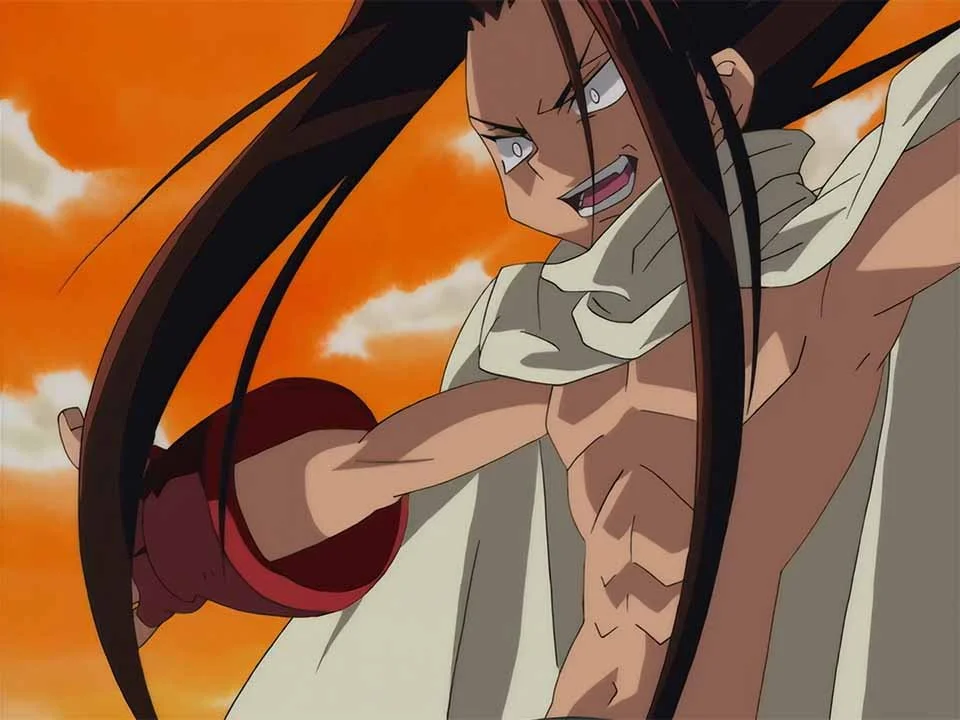
He’s an enticing villain, sure: his sly smile, his menacing aura, how he doesn’t fit the villain stereotype… and a character whose bare torso is kept just out of reach beneath a white poncho. The drape was similar to those used by the Patch Tribe priests — a nod to his second life as an officiant of the shaman fight. Wind gusts delivered scarce, revealing moments, akin to an anime’s beach episode, and the ultimate unveiling happened during the anime-only climax.
During the Gate of Babylon incident, the X-Laws went after Yoh, hoping to draw Hao out. Inside Babylon, the twins face each other: Hao was satisfied with Yoh’s progress and declared there was no longer a need for the shaman fight. When everyone trapped inside Babylon broke out, Hao heads towards the Great Spirit. No shaman was capable of showing any meaningful resistance, the Patch Priests included. Only Yoh and his group had the mettle to go after him. During the final battle, he had his poncho undone — fan service, perhaps, but one all too familiar for that gawking teenager.
Deep down, I knew the constant gawking over guys could only mean I wasn’t growing to be your typical heterosexual male. These feelings were constantly repressed under the weight of relentless bullying, preventing me from embracing who I truly was. I didn’t lack role models, either: there was a visibly queer classmate I remember for his love of Christina Aguilera and Jennifer Lopez. In fact, whenever I come across Aguilera’s Spanish version of ‘Come On Over (All I Want Is You),’ I think of him.
Reggaetón — raw, street-born, aggressively masculine — was the sound of the moment, and pop music was its cultural opposite. My obsession with the Pokémon soundtrack drew less fire than what he had to endure: pop music was ‘girl music,’ and he got relentlessly picked on because of it. Apparently, thinly veiled homophobia had a soundtrack, but the details hardly mattered. I was relieved that it was him and not me, though that relief typically didn’t last long.
Even with all that, I sensed a quiet resolve. He never apologized for the things he liked, while I was concerned with self-preservation. Having been through my own share of it, I felt a kinship — I would’ve loved to get to know him better, though I couldn’t be seen talking to him. After graduation, I wouldn’t see him at school anymore. I believe he moved to a school in another town: whether it was a relocation, the bullying being too much, or something else entirely, I don’t know. My only hope is that, wherever he is, he’s doing alright and happy living as his true self. If I had a chance to talk to him again, I’d thank him for his courage. He was more a part of that journey than he ever knew.
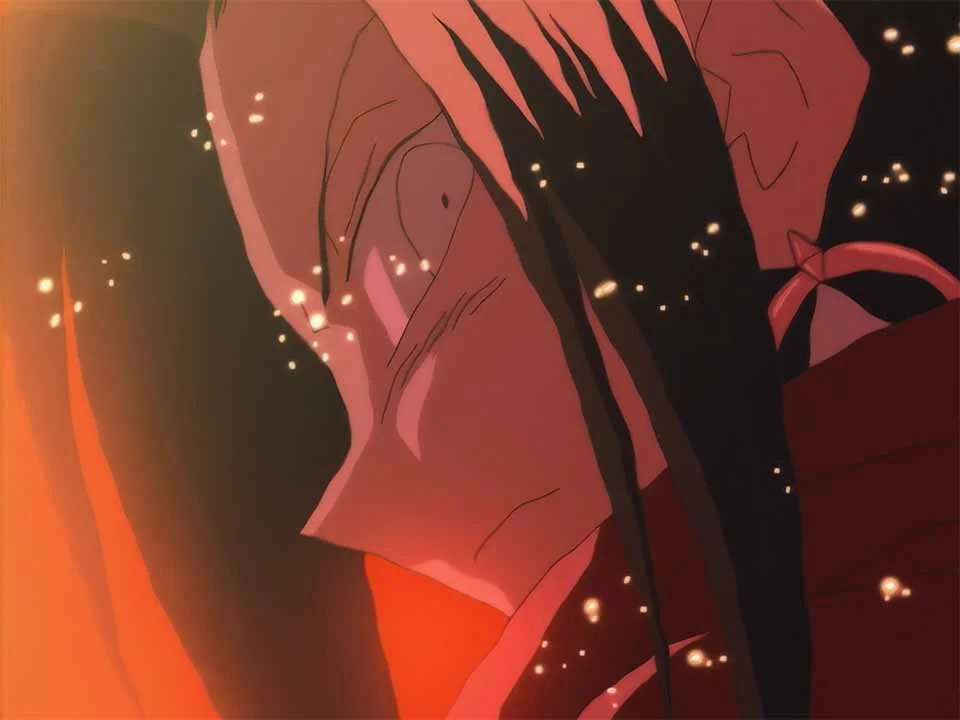
I questioned whether I was gawking at men because they had the physique I didn't. No... that wasn’t it. What I was feeling wasn’t jealousy; this wasn’t the chubby kid wishing he was born thin. This was something else entirely. Jeremy, Frost, my two close friends, Sanosuke, Tidus, Hao, and many nameless, topless strangers... if they’ve met my criteria, I’d be gawking. Coupled with my willingness to let my hormones take over, I could only take this to its logical conclusion. The hellish fires Hao commands cleared away the fog I wandered through for years.
I like men. I can only fall in love with men. I want to be with men.
But I couldn’t tell anyone.
Bullying severely affected my self-esteem; I wasn't ready to assert that I was gay. Putting words to this feeling and the discovery that followed was far from a triumph. Society remained set in its homophobic ways: ridicule by the media, largely led by a gossip show hosted by a puppet that dominated Puerto Rican television for years, abstinence-based sex ed imparted by adults who believed queer elders who died in the AIDS crisis of the 80s had it coming, and harmful stereotypes remaining at large, with no allies in sight. Queerness was isolating.
All that gay kid could do was hide in the closet, not by choice, but out of fear of the worst of society. They're called homophobic, as if the fear belongs to them. But I knew what fear looked like. It looked like me.
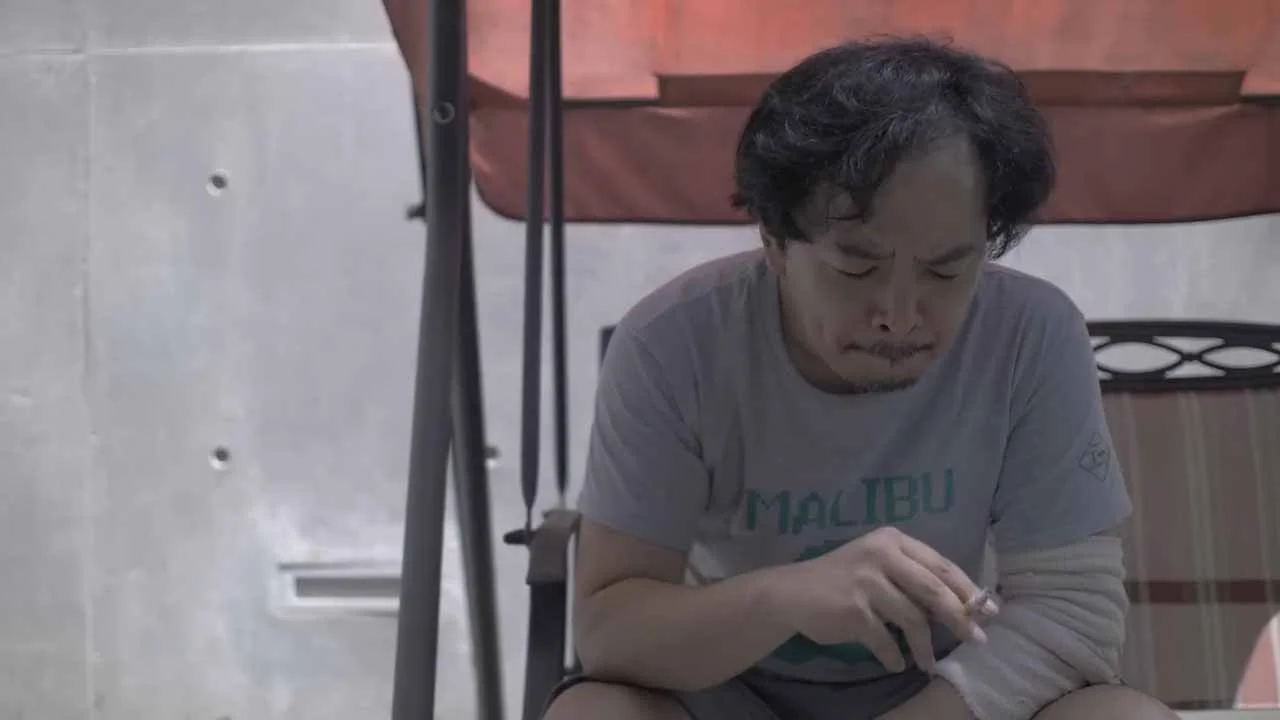
A month ago, I came across a video feature on Hiroyuki Takei, the author of Shaman King. It was posted on Archipel, a YouTube channel run by French ex-pats, and whose work I’ve featured before. The interview was conducted sometime during late 2019 — the b-roll shows him working on the nineteenth chapter of Shaman King: The Super Star. He was contemplative throughout.
Listening to his story, I heard a man who wasn’t sure about his achievements. Takei’s clearly passionate about manga, no doubt about it, but he doesn’t think highly of himself as a manga author. I beg to differ. Takei’s part of one of the most storied assistant stables there is: the ‘Watsuki-gumi.’ He has a strong sense of character design, one that Nobuhiro Watsuki recognized; his contributions to Rurouni Kenshin went far beyond backgrounds and screentones. It wasn’t just luck, or being in the right place at the right time — his skill is the real deal. While his signature work isn’t as popular as that of former stablemate Eiichiro Oda, his work still garnered a passionate following.
He recognizes that Oda’s talent made him realize, perhaps bittersweetly, that the mainstream wasn’t for him. It guts me to hear this self-deprecation, or what comes across to me as such. And as I look back on my life and what little I know about Takei, I may have more in common with him than I thought. This isn’t me trying to establish a parasocial relationship, though I relate to some of his anxieties.
Like Takei, I know what it is to feel unneeded — bullying has a way of convincing you of that. Like him, I found both relief and frustration in a pivotal moment of reckoning. In his case, the cancellation of Shaman King. In mine, finally having a name for something long felt but unspoken, but also knowing I couldn't say it out loud. And, like him, I've arrived somewhere quieter: my identity as a gay man is part of who I am, not the whole of it — something I carry rather than define myself by.
Takei’s not just another manga author for me: his work is instrumental to my discovery. For whatever value the words of this internet stranger hold, Shaman King absolutely deserves its place. His guiding star is sharing “alternate ways of thinking” about manga, and I happen to know someone who is living proof that his work reached further than he realizes.
Myself.