

23 min read
I never saw myself as a writer. In fact, it’s the one aspect of video production I detest, and never sought to become better because of it.
Even so, I wanted a platform to document behind-the-scenes posts on the work I do without making a video explaining how another got made. And it’s not a bad idea; I’ve done it myself and realized how unnecessarily laborious it is. In another timeline, this very post would’ve been my long-form blog debut. However, as it dragged on, it became harder to recall the events that led to this project, some of which date back over a decade. I became complacent with not being able to tell the story, but it’s against what I aspire.
Why do I write about behind-the-scenes? Well, my mind finds it incredibly fascinating to learn how things function and how they came to be. Whether it’s an obscure topic with no practical application or a common thing, I can spend hours learning about it and remain equally fascinated. I’m certain I’m not alone in this. I’d like to think this fascination with learning about whatever captures my attention is beneficial for my craftsman skills, but that’s beside the point.
Let’s talk about the FAMAS video. We’ll explore how it all began, the challenges encountered during its development, and the timeline leading up to its release. The video itself came out in 2018, but the concept had been brewing since 2015. As I’m writing this in 2025, it’s likely some events either slipped my mind or aren’t remembered fully. Please bear with me if certain details seen unusual or incomprehensible, especially those reading who may be familiar. I’ll do my best to recount the story as accurate as possible based on my recollections.
Iconic Arms, a series by British video producer Stuart Brown on his YouTube channel Ahoy, explores the stories and cultural influence of a select range of firearms. Brown, known for producing weapon guides for Call of Duty titles since Modern Warfare 2 (2009), grew disillusioned with the format and sought to expand his creative horizons by embarking on new projects and discontinuing the weapon guides. Experimenting with diverse gaming content, the inaugural video in the series released in 2014. Drawing upon the universally applicable elements of the weapon guides, the series is considered a spiritual successor, but with an identity all of its own. As of writing, the series comprises four seasons, with a total of 24 episodes. New episodes are released periodically.
I’d discover Stuart’s work around 2011 on X, where the community of COD players was small. In a sea of gaming commentators, facilitated not only by the rise of YouTube but also of hardware solutions like the Hauppauge HD PVR, his work resonated with me. It wasn’t just a voice over on top of gaming footage – there were graphics! There were segments! There were production values exceeding those of the average gaming commentator! The majority of what creators were putting out was not to my liking; it was either trolling like what MinnesotaBurns did, over-the-top stunts like those of Whiteboy7thst, or novel schticks with no lasting impact like ONLYUSEmeBLADE. Stuart’s work gave me immense hope for the future of the platform if everyone embraced it as an avenue for well-produced media.
Fast forward to the debut of Iconic Arms, the Desert Eagle video was rough but had potential. The format was polished by the AK-47 video, and it and subsequent entries quickly became favorites of the Ahoy catalog. Comment sections on the videos, on his subreddit, and on X were flooded with requests to feature specific weapons. Some of those requests were mine, even in private. As we collaborated on a podcast, we developed a friendship, or at the very least a mutual respect as fellow colleagues. I asked for a P90 video for quite some time, possibly since the beginning of season 2.
As the calls fell on deaf ears, I got impatient. I wanted this video so bad; I took matters into my own hands.
How hard could it be?
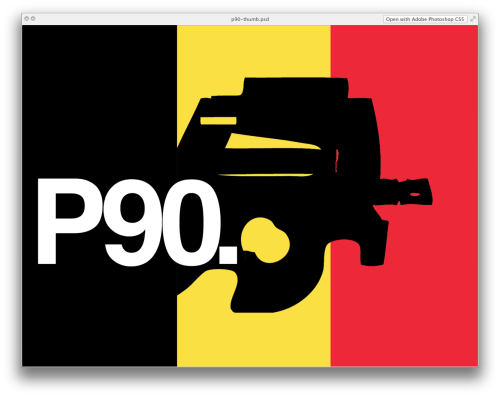
On May 2015, the foundation for what eventually became the FAMAS video was laid with the P90. I discussed this with Stuart, and he didn’t object. Now that we have the concept and the original creator’s approval, what did we need to do to make it a reality?
A few months prior, I purchased an Elgato capture card from a friend who was transitioning to a newer model that could record at a high frame rate in 1080p. Mine, on the other hand, could only do so in 720p. As I was new to capture cards, I thought this was acceptable, considering that YouTube didn’t support high frame rate footage at the time.
I’ve some stories about that capture card and building the original setup, but that’s for another time.
Having a device to record the gameplay is important, but another challenge was the graphics. I consider myself an above-average Photoshop user, and the initial art was created using it. However, Iconic Arms heavily relies on vector art, which is not Photoshop’s strongest suit. I was familiar with Illustrator but never bothered to learn how to use it. I found it difficult to use and couldn’t grasp its purpose. Nevertheless, if my goal was to create a near-perfect imitation, I would need to learn how to use Illustrator.
For starters, I studied Illustrator files I had access to at the time. One of those was Stuart’s: as I’ve commissioned him to create vector Itachi, I not only had the pictures, but also the file. Additionally, I had an automatically traced image from a Naruto opening available - I figured there was stuff I could learn from it, despite its origin. Between these and other resources, it took me a few weeks to get moderately familiar with the software. I could transition my workflow away from using Photoshop exclusively, and not a moment too soon - when the initial graphics were exported, its cleaner nature made it evident that it was a definite improvement. However, I still wasn’t confident. So, I chose to focus on the one thing I knew: playing video games.
Made a compilation of clips out of the footage I’ve recorded back then. This is perhaps the most effort done on a task related to the project before its pivot.
For the first real use of the capture card, I recorded approximately 10 titles from my existing collection that featured the P90. Considering the weapon’s popularity, I knew these alone aren’t enough to paint an overview of its depiction in media. The Internet Movie Firearms Database (IMFDB) proved to be a valuable resource, filling these gaps. While not exhaustive, it should have enough data for my intended use. Armed with a list of games, I emulated some and bought others. From what I remember, the purchases included Counter-Strike: Global Offensive, Kane & Lynch: Dead Men, and Grand Theft Auto: Episodes from Liberty City. There might have been others, but these three were specifically chosen for the project.
As a Mac OS X user, I had to resort to a Windows partition I had installed to record the game footage. There was no Mac software compatible with the capture card at the time, and an official one wouldn’t be released until 2023, which is disappointing. To make matters worse, I was working with outdated hardware: a seven-year-old computer that served me well through college and most of my podcasting career. Since it outlived everything else I’ve had, I believed I could do far more demanding work than, say, word processing or audio editing. As the project moved forward, I start to encounter issues beyond the creative aspect. If only I noticed the strain when it struggled to emulate games from less capable software. While new hardware would’ve been a better solution, my budget was limited.
First, the hard drive, the absolute worst first thing to fail. It stopped the project for two weeks while I scrambled for a replacement. To avoid any irreparable damage to the drive, I kept the laptop turned off. As I was dumping the game footage onto an external drive, I wasn’t immediately at risk of losing those files, but the art assets were another matter. Once I offloaded the drive data onto the new one, production could resume, but…
Second, the power supply showed signs of failure. It was oddly specific, too - it only happened while booting into Windows. Imagine if you disconnected a computer from power while it’s running; that’s the behavior my laptop exhibited. Initially, it happened when the computer was under heavy stress such as recording footage and editing videos. Shortly after, any moderate stress like web browsing, word processing, or even playing music triggered the sudden shut down. I initially thought it was the battery, but that was quickly ruled out as it exhibited the same behavior even while disconnected.
My financial situation hasn’t changed and I couldn’t afford new hardware. Given these issues, a huge bulk of the project couldn’t be realized unless I had a new computer. As I couldn’t rely on the Windows partition to function as expected, I made a copy of the user documents on the Mac side of it and deleted the partition. On a positive note, both Photoshop and Illustrator were installed on the Mac, alongside Word. I could do some production work…
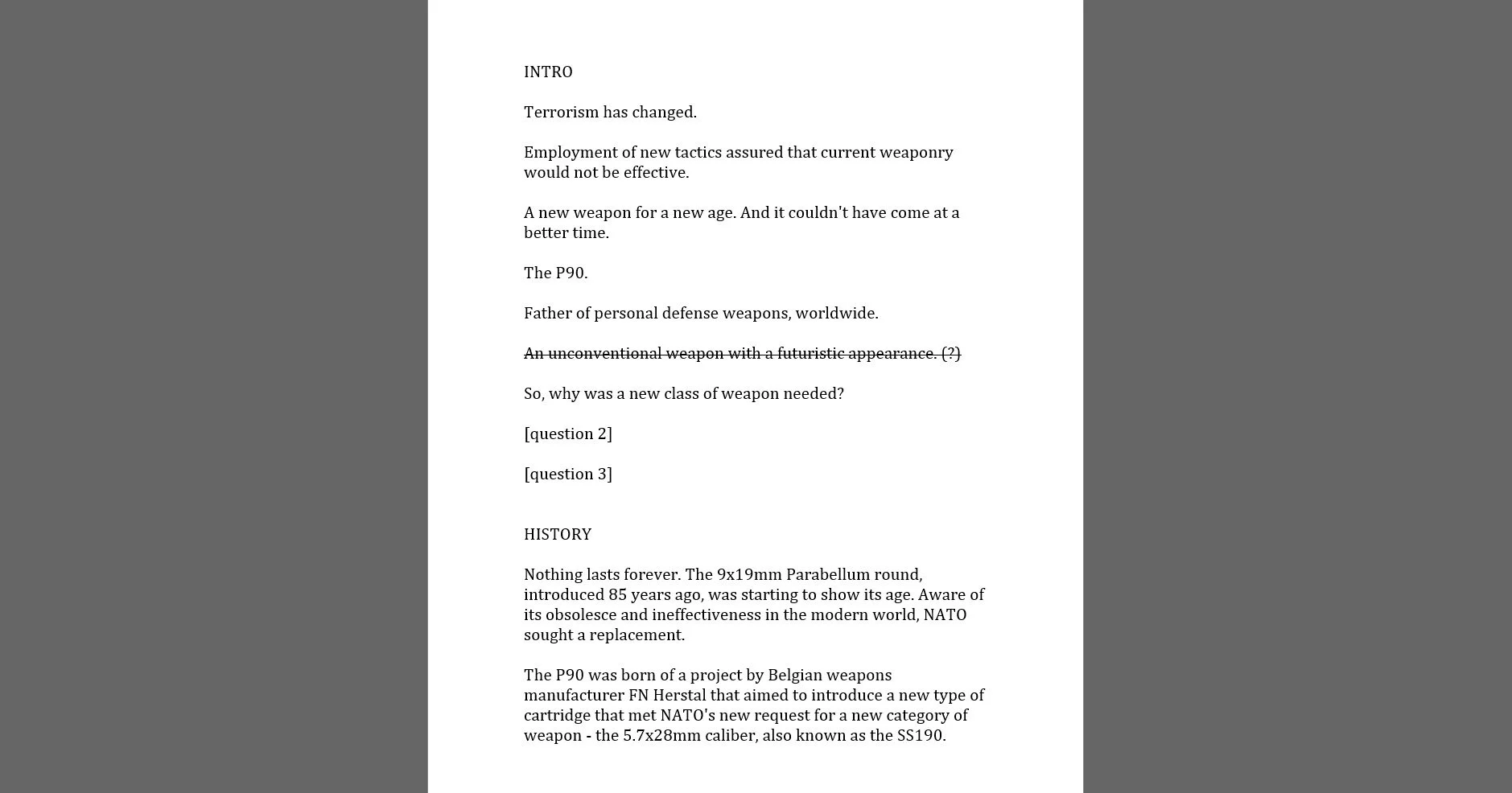
A portion of the incomplete P90 script.
I began researching the P90’s story, how it was conceived, under which conditions, and its rivalry with the MP7, among others aspects to craft a script. Despite extensive reading, I’d never complete a first draft as my creative interests began to diverge. As my co-host duties on an anime podcast were coming to a close, I wanted to keep covering the medium, but this time, for my own channel. Around this period, mom gave me a laptop she wasn’t using, a Sony VAIO, which reignited my creative spark and allowed the pursuit of a new frontier: anime-related videos.
Those were my videos! Not an imitation! Surely, I could make something out of these, right? Nevertheless, the P90 project lingered on my mind, and even if I wasn’t ready to produce it at the moment, I hoped that I’d do it eventually. There’s no rush.
And so, it began: Meandering Thoughts, a vlog where I shared my thoughts and experiences throughout the week. On the other hand, Impressions was an anime-related series where I looked at the first episode of a currently airing series to determine its worthiness. I viewed this series as a “three-episode rule” on steroids: if a show from the shortlist didn’t hook me on the first episode, I’d drop it. Despite gradually integrating Illustrator into my workflow, Photoshop remained my primary tool - most of my early videos had minimal vector art. This would change, as the more I use the software, the more proficient I became. Soon, I was doing much more intricate pieces.
As Impressions led to copyright claims on my channel, I was forced to reconsider my approach. I couldn’t continue the series in the manner I envisioned, but as I settled nicely on a Photoshop / Illustrator workflow, I wanted to capitalize on that skill set. Back then, I was obsessed with the Persona 4 dancing game, aptly titled “Dancing All Night”, and it was there that I found my next project – an overview of the game titled Shadow One-Step, released in late 2016.
(hums Jaws’ theme)
While I worked on my stuff, Stuart kept busy. Over at the Ahoy channel, the release of Nuclear Fruit, a five-part video on the connection between video games and the Cold War, and the revival of RetroAhoy, a separate channel merged onto the main one in preparation for the id Software retrospectives. Furthermore, the launch of his Patreon, allowing those who wanted to financially support his work to do so.
After those projects ended, it was time for the third season of Iconic Arms. As before, Stuart used X to tease the weapons that would be featured, but this time, there was a twist. Instead of straightforward announcements, he employed cryptic crossword-style riddles, challenging viewers to decipher which weapon the riddle referred to. A new riddle was released each week covering a different weapon throughout the season’s run. And the final riddle?
“A futuristic top loader in a caliber of its own. (2,3)”
There are plenty of weapons with three-letter names, but mentioning “top loader” and “caliber of its own” significantly narrowed down the options. Suddenly, it hit me like lightning:
FN (2) P90 (3)
Shit.
Eight months after the initial tease, Stuart’s P90 video released. I should’ve been ecstatic, but instead, I felt a complex mix of emotions. It was bittersweet.
As a producer working on derivative work with this project, the threat of being overshadowed loomed large over me. It’s true that the P90 is a popular weapon, and I wasn’t the only one asking for that episode. Perhaps Stuart already considered it before adding it on the roadmap. Regardless, the Ahoy P90 video rendered my work, no matter how small, irrelevant. Despite his reassurance that I was free to do my own version, I couldn’t bring myself to compete with my idol.
Disheartened but determined, I return to the drawing board. If a P90 video would soon exist, what other gun could I feature in an Iconic Arms-style episode? I didn’t have strong feelings towards other guns, so this search could take some time. My mind was cast back to Black Ops’ multiplayer, the one COD title I put the most time on, to find inspiration. I thought it was my best chance…
First, we discard the guns that have episodes:
M16
Commando (the M4 platform shares many similarities with the M16, and is considered covered)
M14 (partially covered in the M1 Garand video)
MP5k
AK-74u (partially covered in the AK-47 video)
Uzi
MAC-11 (basically American Uzi)
L96A1 (part of the Arctic Warfare platform video)
SPAS-12
Olympia (part of the Double Barrel Shotgun video)
M1911
Python (part of the Magnum Revolver video)
My shortlist narrowed down to four guns: the G11, Galil, AUG and FAMAS.
What the G11 stands for - the development of caseless ammunition - is fascinating. As it never entered mass production, it wouldn’t have a significant cultural impact, making it less suitable for a compelling episode.
I believed I could make the Galil interesting, but since Israeli weapon development was covered in the Uzi episode, it’s best I don’t cover it to avoid repeating topics already discussed.
I have an affinity for the AUG. Not as much as the P90, but close. As the first modern bullpup rifle, it’s a popular weapon. There could be an audience for an Iconic Arms-style video about it, but it’d put me in a similar position as before in which Stuart produces the episode before I could put something together. In fact, I anticipate this gun will be covered in a future season.
That leaves me with the FAMAS. I wasn’t excited about the idea - it’s an ugly gun, and I’m aware of the French’s negative perception online. It could go bad, but we’ll go with it. The choice of the FAMAS was driven by pragmatism, and my apprehension extended to the initial research. I doubted it was an interesting gun to write about.
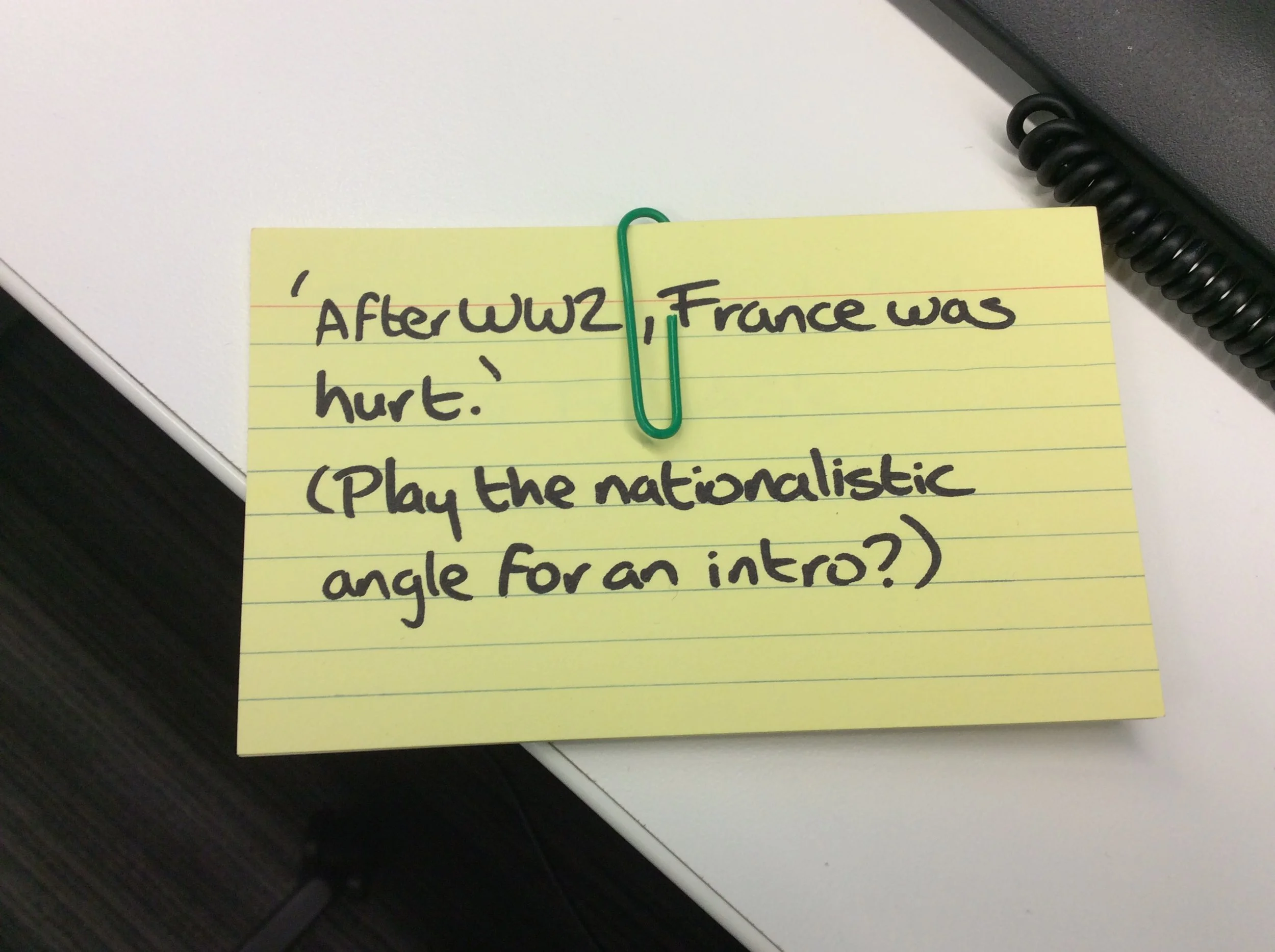
The weapon choice was made, but production didn’t resume in earnest. At the time, I was between jobs. Since Shadow predates my job change, it was completed only because it was nearing completion when I was hired. Fearing that I wouldn’t stay at the new job beyond the probationary period after overcoming my years-long inertia, my efforts went to ensuring I’d stay in my role. I didn’t want to go back! I’ve never worked a 40-hour job before and didn’t realize how taxing it’d be on my creative output. Whenever I had free time, I only wanted to play video games.
I planned to resume production once I had job security, figuring out the schedule as we went on. Then, in April, a certain video game that I was genuinely hyped for released.
During my free time, if I wasn’t recuperating, doing housework or engrossed in Persona 5, I’d do research on the FAMAS. One significant challenge I couldn’t overcome was that a majority of its history was in print. I don’t read or speak French, which made my choice of discussing a French gun seem rather ill-advised. Nevertheless, I persevered, looking into as many online sources I could, and verifying the accuracy of my findings through triangulation.
I had a vague idea of the angle I wanted to take: one of pride and empowerment. Given the French reputation, this seemed logical. And as I delved deeper, the more convinced I was on that choice being the right one, to the extent in which I dismissed any other alternatives. I’d write in service of this angle or find ways to make it work when viewed through that lens.
That said, feedback I’ve received from my editor and friends pointed out some embellished writing. How can you make a potentially dense topic more accessible? Often, the truth is boring: listing a series of facts about the FAMAS isn’t engaging. A writer’s job is to tell a story; whether I was successful in doing so is up to the audience to decide, but I believe pride for one’s country is universally understood. I may’ve had misinterpreted information from my sources but I’m confident I didn’t made facts up to fit the angle. That said, some information did need to be presented in a different light to align with the angle, but it doesn’t make them lies. As long as that’s the case, I see nothing wrong with taking creative liberties.
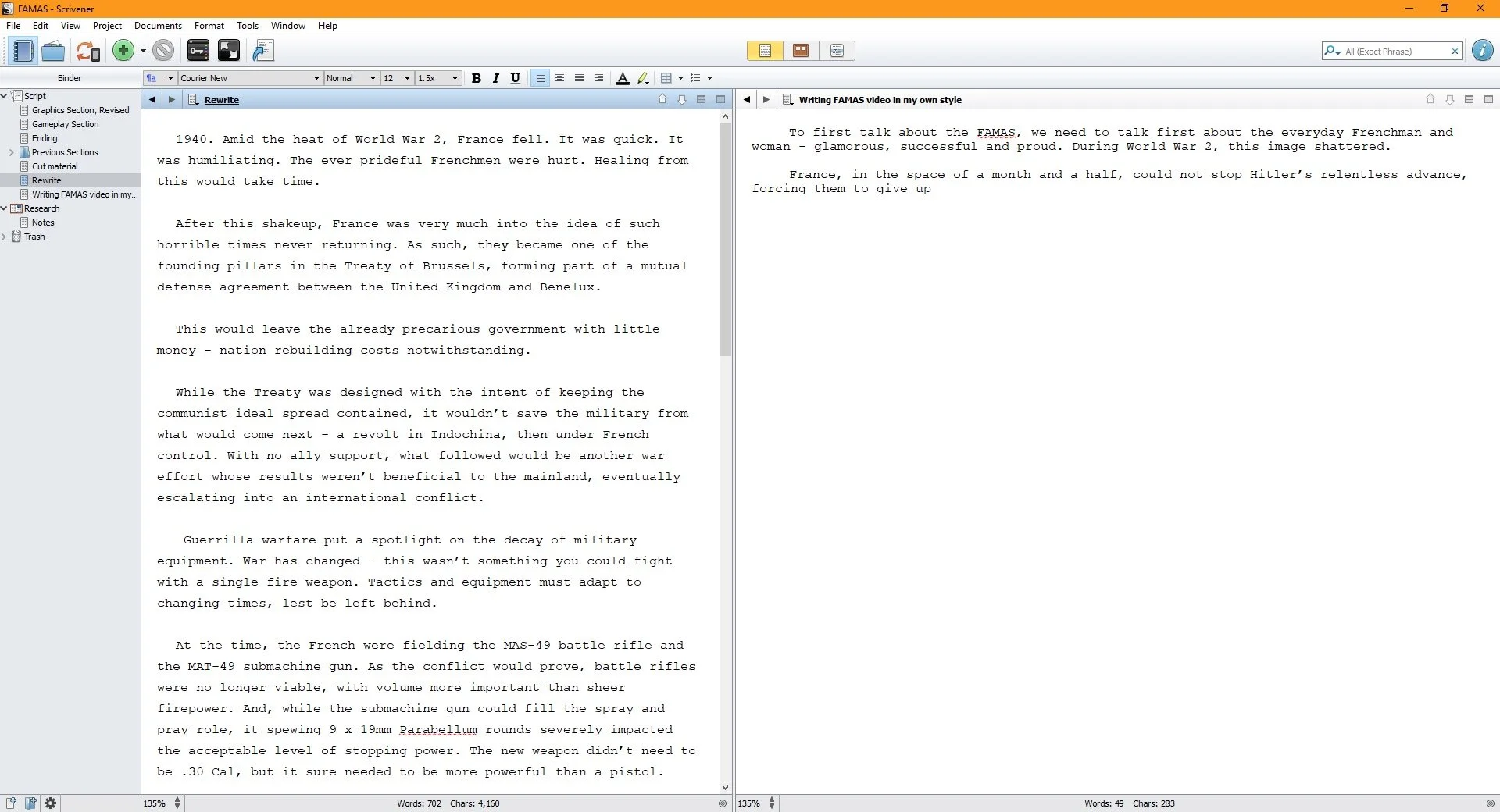
Scrivener, my script writing software of choice. The FAMAS script is open, and we’re about to do the first major rewrite.
A first draft was ready by late 2017, and underwent two substantial rewrites before the final copy was completed in early April 2018. I sought Stuart’s feedback to ensure the text adheres to the established format and style. While I was determined on doing as most as I could on observational study of the format alone, there’s always opportunities to learn more, not just for this project but also for future ones. I recall those conversations being pleasant – Stuart understood and respected that this was my project, despite that I’m working with his creation. Nevertheless, I didn’t feel pressured, and as a creator, I deeply appreciated his vote of confidence.
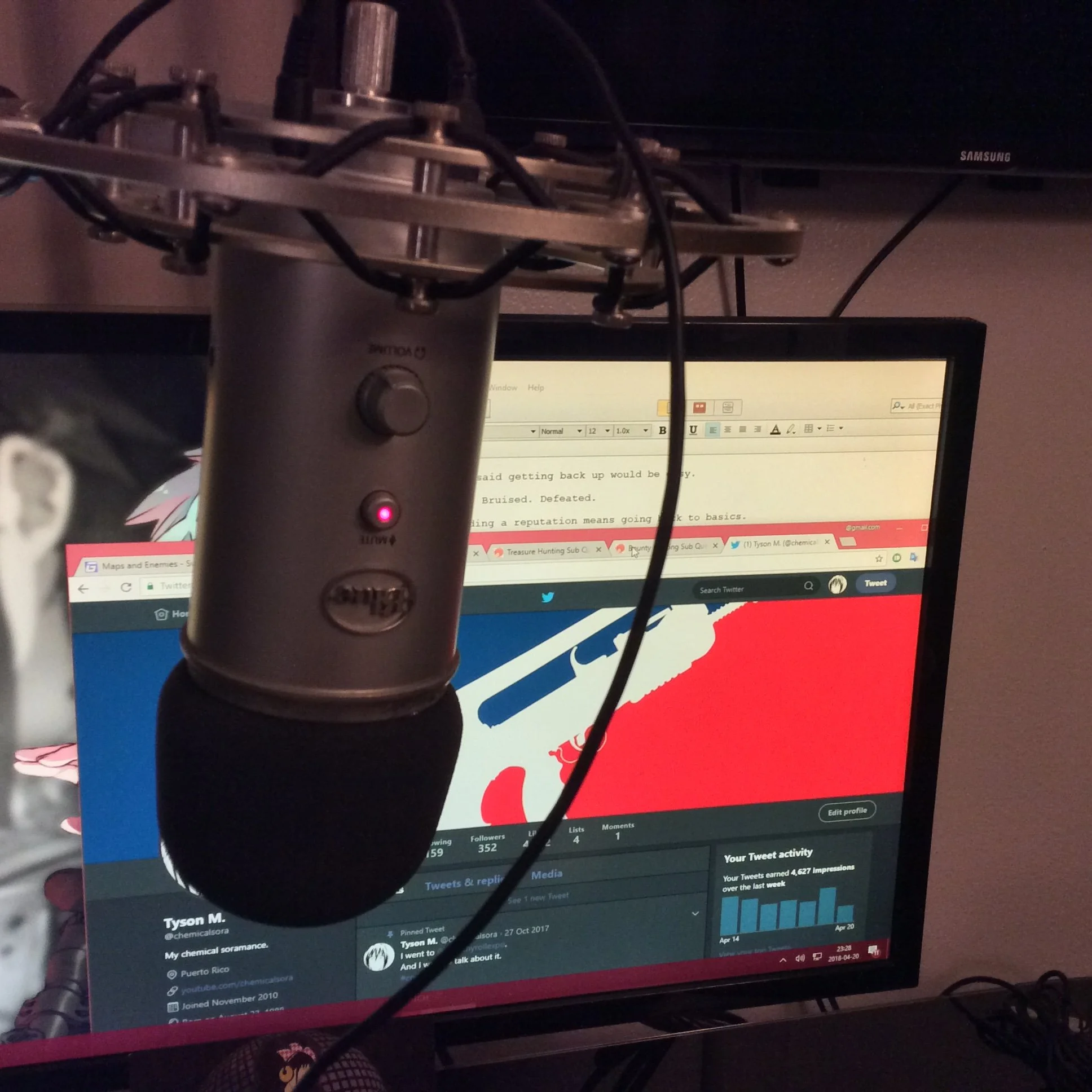
There would be an additional section added to the copy later on, but since the script was very much finalized, it’s time to record the voice-over.
I’d rely on my trusty Blue Yeti, a microphone I’d been using since 2012. It’s quite reliable, even though it has a reputation: either you love it or hate it. And I’d argue that the latter group had far too many negative experiences with inexperienced users. As I had a good understanding of sound theory, I knew how to get the best possible sound out of it, even in challenging environments. I’m definitely a fan of this microphone – a piece of gear that got me through my podcasting career can’t be that bad, even if there’s better options out there?
Between April and early August, I’d be between audio editing, graphic work and video assembly. Not much noteworthy during this period although there are some highlights.
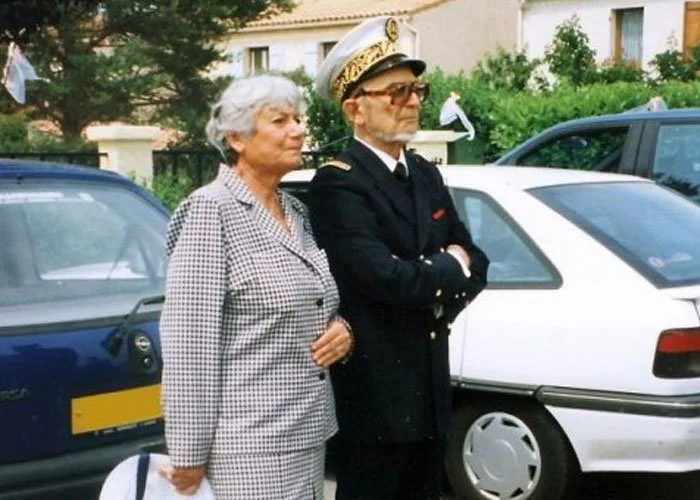
The man in the picture is alleged to be Paul Tellié, but I couldn’t independently verify this.
As I was creating graphics on real people, I wanted to make sure I was vectorizing the correct individual. Paul Tellié posed a challenge. A search for “paul tellie famas” yielded an image of an elderly couple, with the man allegedly being Tellié, but I couldn’t confirm this. In contrast, I had multiple credible sources with various images of de Gaulle and Bigeard, which allowed me to confirm their identities. I considered abandoning my rigor process, but ultimately realized it was a bad idea. What if it wasn’t him? The time and effort spent making the graphic would be wasted and the final video would have that glaring error. It wasn’t worth the potential embarrassment. Instead, I drove my attention to researching the ranks of the French army as I was already vectorizing their logo for a graphic. The result was the depiction of Tellié’s rank when he took on the FAMAS project for the final product.
De Gaulle was an interesting case. I was aware this could inadvertently turn into a World War 2 video and did my best to avoid that outcome. Still, I must give it to the man: he has a fascinating story. I couldn’t avoid touching on the war if I were to tie the Frenchman’s pride with the development of the FAMAS, but I’d use de Gaulle, a man who deeply loved his country even during exile, as my catalyst. And when he became France’s president, I could tie it back to the weapon. As far as the FAMAS is concerned, de Gaulle could either advocate for increased funding for MAS with the legislative branch or instruct his prime minister to do so. This is purely speculative, as none of my sources explicitly linked him to the weapon’s development. It’s possible that it could be on one of those French history books I mentioned, ones I can’t read as I don’t know French. Back to his depiction, a search for “de gaulle 1960” gives you pictures from his speeches, parliamentary activities, and other engagements. I don’t know if the selected image was taken before the project’s conception, but I do know I was looking at de Gaulle.
Bigeard was a fun one. A noted pipe-smoker, there was no way I wouldn’t incorporate that habit of his into the graphic. Selecting a suitable picture was difficult, not because I couldn’t confirm it was him, but rather that there were numerous good choices! I went with a photograph which appeared to be part of a photoshoot he did in 1978. Not period-correct, but it was within the timeframe. It’s fine.
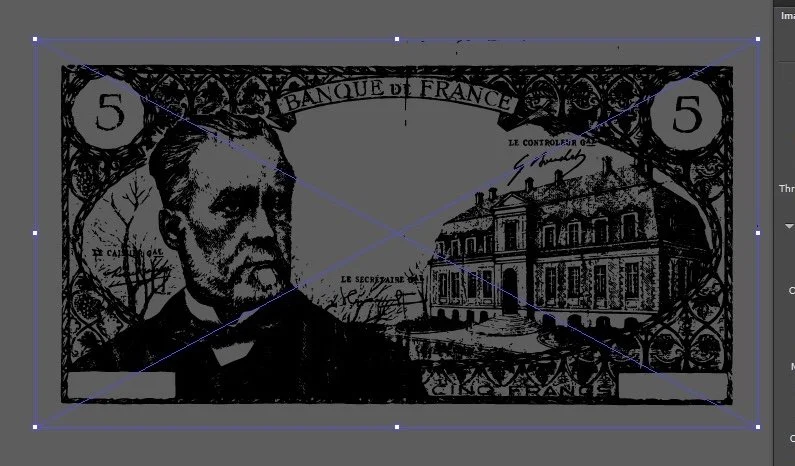
Expanding on the thought above, I went to great lengths to ensure that my graphics were as period-correct as possible. One notable effort that I’m proud of is the Franc that appears when discussing MAS’s finances. The Euro wasn’t around in the 1970s, and all European nations used their own currencies. I spent hours researching obsolete Franc notes, wondering which ones would’ve been used in that era, down to the face in the note. I can confidently say that the graphic is of a note that would’ve been in circulation during the 1970s. Writing this now, it doesn’t sound exciting, especially for a graphic that saw 2 seconds at most, but I recall feeling quite giddy about it.
August is here, and the video was almost complete. I didn’t want this project to drag on any further. I was flying to California later that month and would be filming an event there. Living in a country prone to hurricane impacts, I didn’t want to repeat the harrowing experience of editing a video during a hurricane’s landfall and its aftermath. Last year’s Hurricane Maria had traumatized me, and I’m sure everyone here shares that sentiment. By this point, I had upgraded my PC - my first time I build one - and transferred my files from the laptop to it. With hardware limitations out of the way, I could edit intricate details that the laptop couldn’t handle and even record PC-only games, which I had a few of.
I completed the video on the week I was scheduled to fly out. Stuart uploads his videos on Fridays at 4PM BST (11AM my time). If it works for him, it should work for me, right? Back then, premieres were not a thing, but scheduled uploads were. I uploaded the video early with a scheduled release for August 31 at 4:00PM BST. With the production over, I could focus on packing my bags for the flight. The night before the release, I was incredibly nervous. Losing my iPad and having an uncomfortable situation in the hotel’s lobby earlier didn’t help matters. Would the audience feel betrayed or upset that what appeared to be an XboxAhoy upload wasn’t one? Would my intention with the project be understood? Would there be any nitpickers? Would someone want my head for making a copycat Iconic Arms episode? A friend had to calm me down, and I couldn’t afford to be on the verge of a mental breakdown over something I couldn’t control, especially as I had a packed agenda the following day. I had to trust that the video would speak for itself, that it wasn’t a lazy copy, and that I put in the effort to genuinely show I cared not only about the format but also Stuart as a creator. I brushed my teeth and went to sleep.
When I woke up, I noticed that the video went live as scheduled. However, I couldn’t respond to any feedback until I got back. The priority was for me to enjoy my stay abroad, and I can’t let this overwhelm me. The initial feedback was as expected: I was being labeled a fraud, and my video being called a “parody” – while technically accurate, the choice of words was unkind. Some even demanded I remove the video. After a few days, I began to notice constructive feedback and more positive comments. One of those pointed out that Nazi Germany initially consisted of Germany and Austria, and my graphic depicting their invasion of France didn’t account for this historical fact. This oversight was genuine.
Do I have any regrets about this project? Well, there’s one thing that bothers me – what if I disregarded my feelings, take Stuart at his word and proceed with the P90 video, even if he’d make one soon? I wonder how that video would’ve turned out. But I promised myself I’d only do this once, and I believe the video accurately represents my skills at the time. More importantly, it’s the homage I had envisioned and set out to create. There are many copycats out there: his subreddit was full of Iconic Arms-style thumbnails of varying quality at one point, to the extent that Stuart felt compelled to make a style guide. If nothing else, I find comfort in the fact that I’ll probably be the only producer who managed to deceive an audience into believing my video was a genuine Iconic Arms episode.
And that’s the story behind the FAMAS project as best as I recall it. One final thing I’d like to share before I close this post: a clip I’ve kept to myself for years…